Runoff / Nonpoint Source Pollution
Nonpoint sources of pollution refer to pollution that does not have a single point of origin or has not been introduced into a receiving freshwater or maritime environment from a specific outlet. The pollutants are generally carried off from the land by agricultural runoff, urban stormwater, atmospheric deposition or subaqueous groundwater discharges. The most common categories of nonpoint pollution are agriculture, forestry, urban areas, mining, construction, dams and channels, land disposal and saltwater intrusion.
Primary reference(s)
UN Data. Non-point Source Pollution. UN data: A world of information. Accessed 21 January 2025.
Ahmad, Z.U., Sakib, S. and Gang, D.D., 2016. Nonpoint Source Pollution. Water Environment Research, 88: 1594-1619. DOI: 10.2175/106143016X14696400495497. Accessed 21 January 2025.
Annotations
Additional scientific description
Nonpoint source pollution generally results from land runoff, precipitation, atmospheric deposition, drainage, seepage or hydrologic modification. Unlike pollution from industrial and sewage treatment plants, it originates from many diffuse sources. Runoff carries away natural and human-made pollutants, depositing them into lakes, rivers, wetlands, coastal waters and groundwaters (US EPA, 2020; NOAA, no date).
Nonpoint source pollution can include: excess fertilisers, herbicides and insecticides from agricultural lands and residential areas; oil, grease and toxic chemicals from urban runoff and energy production; sediment from improperly managed construction sites, crop and forest lands, and eroding streambanks; salt from irrigation practices and acid drainage from abandoned mines; bacteria and nutrients from livestock, pet wastes and faulty septic systems; and atmospheric deposition and hydromodification (US EPA, 2020).
Metrics and numeric limits
Not identified.
Key relevant UN convention / multilateral treaty
While there are no UN conventions or multilateral treaties that specifically address nonpoint source pollution, there are some that focus on point source pollution that may have some relevance when considering nonpoint source pollution, as outlined below.
The Convention on the Prevention of Marine Pollution by Dumping of Wastes and Other Matter 1972 (IMO, 1972), the ‘London Convention’, is one of the first global conventions to protect the marine environment from human activities and has been in force since 1975. Its objective is to promote the effective control of all sources of marine pollution and to take all practicable steps to prevent pollution of the sea by dumping of wastes and other matter.
The International Convention for the Prevention of Pollution from Ships (MARPOL) 1996 (IMO, 1996) is the main international convention covering the prevention of pollution of the marine environment by ships from operational or accidental causes. The MARPOL Convention was adopted on 2 November 1973. The Protocol of 1978 was adopted in response to a spate of tanker accidents in 1976–1977. As the 1973 MARPOL Convention had not yet entered into force, the 1978 MARPOL Protocol absorbed the parent Convention. The combined instrument entered into force on 2 October 1983. In 1997, a Protocol was
The UNECE Convention on Long-range Transboundary Air Pollution was the first international treaty to deal with air pollution on a broad regional basis. The Convention entered into force in 1983, laying down the general principles of international cooperation for air pollution abatement and setting up an institutional framework which has since brought together research and policy. Over the years, the number of substances covered by the Convention and its protocols has been gradually extended, notably to ground-level ozone, persistent organic pollutants, heavy metals and particulate matter.
Drivers
Nonpoint source pollution, originating from diffuse sources rather than a single identifiable point, poses a significant threat to water quality and ecosystem health. Several anthropogenic activities contribute to nonpoint source pollution. Land-use practices, including agriculture, forestry and urbanisation, are primary drivers (Müller et al., 2020). Agricultural activities, such as the application of fertilisers and pesticides (see Pesticides CH0501 and Ammonium Nitrate CH0902 HIPs), are major sources of nutrient and chemical contamination (Xia et al., 2020). Deforestation and land clearing associated with urbanisation and development can increase soil erosion, leading to elevated sediment loads in waterways (Benavides et al., 2005). Additionally, climate change, through altered precipitation patterns and increased frequency of extreme weather events, can exacerbate nonpoint source pollution by enhancing runoff and erosion processes (Sharma et al., 2016; Ahmed et al., 2016).
The primary concern associated with nonpoint source pollution lies in its degradation of water quality. Pollutants like fertilisers, pesticides, sediment and pathogens carried by runoff contaminate freshwater and marine environments. This contamination disrupts vital ecological processes, reduces biodiversity, and diminishes the suitability of water bodies for various uses, including drinking water, recreation and fisheries. Furthermore, excess nutrients from nonpoint source pollution can trigger the proliferation of harmful algal blooms. These blooms deplete oxygen levels in water bodies upon decomposition, creating hypoxic zones where aquatic life struggles to survive (Pericherla et al., 2020). Additionally, deforestation and land-use changes associated with nonpoint source pollution can alter drainage patterns and increase soil erosion, leading to increased sediment loads in waterways and a higher risk of landslides and floods (Benavides et al., 2005).
Climate change is projected to alter precipitation patterns, potentially leading to increased runoff events and exacerbating nonpoint source pollution. Similarly, extreme weather events like hurricanes and floods can further exacerbate erosion and pollutant mobilisation. Conversely, land degradation processes like desertification and overgrazing can leave soil more susceptible to erosion, further intensifying nonpoint source pollution (Bolan et al., 2023). The consequences of this multi-hazard context are far-reaching. Public health risks arise from exposure to pathogens and harmful chemicals in contaminated water sources (Ahmed et al., 2019). Degraded water quality can also negatively impact fisheries and tourism industries, affecting livelihoods and economic stability in affected regions. Food security can also be threatened by disruptions to fish populations due to harmful algal blooms and dead zones (McCarthy et al., 2008). Moreover, the combined effects of nonpoint source pollution and other environmental hazards can strain freshwater resources, making clean water a scarce commodity in some areas.
Impacts
The consequences of nonpoint source pollution are far-reaching. Water quality degradation, characterised by elevated nutrient levels, increased turbidity and contamination by pathogens, is a primary impact. Eutrophication, resulting from nutrient enrichment, can lead to harmful algal blooms, hypoxia and anoxia, disrupting aquatic ecosystems (Pericherla et al., 2020). Sedimentation can smother benthic habitats, impair aquatic organism reproduction and reduce water clarity. Furthermore, nonpoint source pollution can pose human health risks through exposure to contaminated water, with implications for recreation, drinking water supply and fisheries (Wu et al., 2013; Xepapadeas, 2011).
Multi-hazard context
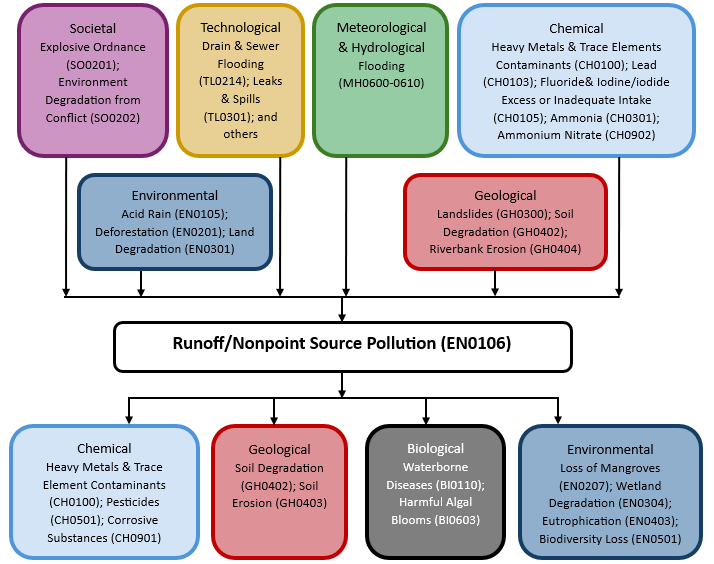
The figure below summarises common interactions between runoff/nonpoint source pollution and other hazards. This information should be used with caution and not be solely relied upon in disaster risk management, particularly as some interactions may not have been included. Note that hazardous events occurring together or locally in space or time may not necessarily cause, amplify or be otherwise related to each other. Specific examples of multi-hazard context can be found in the ‘Hazard drivers’ and ‘Impacts’ sections above.
Multi-hazard diagram
Risk Management
Effective management of nonpoint source pollution requires a multi-faceted approach. Implementing best management practices in agriculture, forestry and urban areas is crucial for reducing pollutant loads. This includes practices such as cover cropping, conservation tillage and riparian buffers (Barber et al., 2012). Land-use planning and zoning regulations can also help mitigate nonpoint source pollution by minimising development in sensitive areas (Revitt et al., 2014; Ioannidou et al., 2020).
Given the diffuse nature of nonpoint source pollution, it can be difficult to develop early warning systems that specifically target their sources and impacts.
Monitoring
The section above and the table below offer an overview of monitoring for runoff/nonpoint source pollution. This information can be used for forecasting within a national early warning system (EWS). Since EWS capacities and processes differ across countries, the most current and specific information regarding EWS should be obtained from the appropriate national or regional agency/authority responsible for disaster management.
| Which institution(s) produce(s) disaster risk data/information? | Environmental agencies, water agencies, health agencies |
| How is the hazard observed/monitored/forecast? | General monitoring of common pollution sources, water and air quality. Deploying sensors in rivers, streams and lakes to measure turbidity, nitrate levels and dissolved oxygen provides continuous data on water body health. Sudden spikes in these parameters can indicate potential nonpoint source pollution events. Satellite imagery can track land cover changes, identifying areas prone to erosion and runoff. Additionally, monitoring soil moisture levels can provide insights into potential pollutant transport. Weather forecasts, particularly those predicting heavy rainfall or extreme weather events, are crucial, as these conditions can significantly increase nonpoint source pollution risks. Ground-level observations are equally important. Citizen science programmes, engaging local communities in water quality monitoring, can provide valuable data on localised pollution events. Visual observations of water clarity, algal blooms or increased erosion can serve as early indicators (Munafò et al., 2005). |
References
Ahmed, W., Hamilton, K., Toze, S., Cook, S., and Page, D., 2019. A review on microbial contaminants in stormwater runoff and outfalls: Potential health risks and mitigation strategies. Science of the Total Environment, 692, 1304-1321. DOI: 10.1016/j.scitotenv.2019.07.055. Accessed 21 January 2025.
Ahmad, Z.U., Sakib, S., and Gang, D.D., 2016. Nonpoint source pollution. Water Environment Research, 88(10), 1594-1619. DOI: 10.2175/106143016X14696400495497. Accessed 21 January 2025.
Barber, N.J., and Quinn, P.F., 2012. Mitigating diffuse water pollution from agriculture using soft‐engineered runoff attenuation features. Area, 44(4), 454-462. DOI: 10.1111/j.1475-4762.2012.01118.x. Accessed 21 January 2025.
Benavides, F., and Veenstra, J.N., 2005. The impact of tropical deforestation on river chemical pollution. In Proceedings of the International Conference on Environmental Science and Technology (Vol. 1, pp. 173-178). DOI: 10.30955/gnj.000336. Accessed 21 January 2025.
Bolan, S., Padhye, L.P., Jasemizad, T., Govarthanan, M., Karmegam, N., Wijesekara, H., ... & Bolan, N., 2023. Impacts of climate change on the fate of contaminants through extreme weather events. Science of The Total Environment, 168388. DOI: 10.1016/j.scitotenv.2023.168388. Accessed 21 January 2025.
Ioannidou, V., and Stefanakis, A.I., 2020. The Use of Constructed Wetlands to Mitigate Pollution from Agricultural Runoff. In: Naeem, M., Ansari, A., Gill, S. (eds) Contaminants in Agriculture. Springer, Cham. DOI: 10.1007/978-3-030-41552-5_11. Accessed 21 January 2025.
McCarthy, S. G., Incardona, J.P., and Scholz, N. L.., 2008. Coastal storms, toxic runoff, and the sustainable conservation of fish and fisheries. In American Fisheries Society Symposium (Vol. 64, No. 12, pp. 7-27).
Müller, A., Österlund, H., Marsalek, J., and Viklander, M., 2020. The pollution conveyed by urban runoff: A review of sources. Science of the Total Environment, 709, 136125. DOI: 10.1016/j.scitotenv.2019.136125. Accessed 21 January 2025.
Munafò, M., Cecchi, G., Baiocco, F., and Mancini, L., 2005. River pollution from non-point sources: a new simplified method of assessment. Journal of Environmental Management, 77(2), 93-98. DOI: 10.1016/j.jenvman.2005.02.016. Accessed 21 January 2025.
NOAA. Nonpoint Source: Pollution Tutorial. National Oceanic and Atmospheric Administration (NOAA), National Ocean Service. Accessed 21 January 2025.
Pericherla, S., Karnena, M. K., and Vara, S., 2020. A review on impacts of agricultural runoff on freshwater resources. Int. J. Emerg. Technol, 11, 829-833.
Revitt, D.M., Lundy, L., Coulon, F., and Fairley, M., 2014. The sources, impact and management of car park runoff pollution: a review. Journal of Environmental Management, 146, 552-567. DOI: 10.1016/j.jenvman.2014.05.041. Accessed 21 January 2025.
Sharma, A.K., Vezzaro, L., Birch, H. et al. Effect of climate change on stormwater runoff characteristics and treatment efficiencies of stormwater retention ponds: a case study from Denmark using TSS and Cu as indicator pollutants. SpringerPlus 5, 1984 (2016). DOI: 10.1186/s40064-016-3103-7. Accessed 21 January 2025.
US EPA, No Date. Basic Information about Nonpoint Source (NPS) Pollution. United States Environmental Protection Agency (US EPA). Accessed 21 January 2025.
Wu, Y., and Chen, J., 2013. Investigating the effects of point source and nonpoint source pollution on the water quality of the East River (Dongjiang) in South China. Ecological indicators, 32, 294-304. DOI: 10.1016/j.ecolind.2013.04.002. Accessed 21 January 2025.
Xepapadeas, A., 2011. The economics of non-point-source pollution. Annu. Rev. Resour. Econ., 3(1), 355-373. DOI: 10.1146/annurev-resource-083110-115945. Accessed 21 January 2025.
Xia, Y., Zhang, M., Tsang, D.C.W. et al., 2020. Recent advances in control technologies for non-point source pollution with nitrogen and phosphorous from agricultural runoff: current practices and future prospects. Appl Biol Chem 63, 8. DOI: 10.1186/s13765-020-0493-6. Accessed 21 January 2025.