
Air Pollution (Point Source)
A point source of air pollution is an identifiable stationary location or fixed facility from which air pollutants are released, which may be human-made or natural in origin (adapted from Kibble and Harrison, 2005; Dunne et al., 2014).
Primary reference(s)
Dunne, A., L. Mitchem, J. Wilding and A. Kibble, 2014. Air pollution and public health. In: Bradley, N., H. Harrison, G. Hodgson, R. Kamanyire, A. Kibble and V. Murray (eds.), Essentials of Environmental Public Health Science: A Handbook for Field Professionals. Chapter 4. Oxford University Press. Accessed 21 January 2025.
Kibble, A. and R. Harrison, 2005. Point sources of air pollution. Occupational Medicine, 55:425-431.
Annotations
Additional scientific description
Point source air pollution focuses on acute and chronic sources of such pollution. It can be natural or human-made. A human-generated point source of air pollution emits a significant amount of air pollutants from a fixed location such as an explosion, pollutants from a chimney stack or a tyre fire, power stations, steel works, foundries, incinerators, wood and pulp processors, paper mills, refineries and chemical production (Kibble and Harrison, 2005; Dunne et al., 2014). Point sources of air pollution from naturally occurring sources include smoke from wildfires, ash from volcanic eruptions and sand particles from deserts lifted and transported in the wind across cities and continents in the form of sandstorms (Aghababaeian, 2021; Stewart, 2022; Paul et al., 2023).
Air pollutants can be emitted directly from a source (i.e. primary pollutants) or can form from chemical reactions in the atmosphere (i.e. secondary pollutants). When concentrations of these substances reach critical levels in the air, they harm humans, animals, plants and ecosystems, reduce visibility and corrode materials, buildings and cultural heritage sites (UNEP, no date).
In many cases, the key question is whether releases from a point source result in a significant increase in exposure or whether other sources (background exposure) give rise to the dominant exposure (Kibble and Harrison, 2005). Detailed investigation of these differences requires high spatiotemporal resolution air quality data alongside incidence data obtained from accurate health information systems, such as disease registers or via case-control studies.
Metrics and numeric limits
The WHO Air Quality Guidelines (WHO, 2021) offer recommended exposure levels for particulate matter (PM10 and PM2.5), ozone, nitrogen dioxide, sulphur dioxide and carbon monoxide, as well as a set of interim targets to encourage a progressive improvement in air quality, as outlined in Table 1 (WHO, 2021).
Table 1: Summary of recommended long- and short- term air quality levels in interim targets (WHO, 2021)
| Pollutant | Averaging time | Interim target | AQG level | |||
|---|---|---|---|---|---|---|
| 1 | 2 | 3 | 4 | |||
| PM2.5, µg/m³ | Annual | 35 | 25 | 15 | 10 | 5 |
| 24-houra | 75 | 50 | 37.5 | 25 | 15 | |
| PM10, µg/m³ | Annual | 70 | 50 | 30 | 20 | 15 |
| 24-houra | 150 | 100 | 75 | 50 | 45 | |
| O3, µg/m³ | Peak seasonb | 100 | 70 | – | – | 60 |
| 8-houra | 160 | 120 | – | – | 100 | |
| NO2, µg/m³ | Annual | 40 | 30 | 20 | – | 10 |
| 24-houra | 120 | 50 | – | – | 25 | |
| SO2, µg/m³ | 24-houra | 125 | 50 | – | – | 40 |
| CO, mg/m³ | 24-houra | 7 | – | – | – | 4 |
a 99th percentile (i.e. 3–4 exceedance days per year).
b Average of daily maximum 8-hour mean O3 concentration in the six consecutive months with the highest six-month running-average O3 concentration.
Key relevant UN convention / multilateral treaty
In 1979, the UNECE Convention on Long-range Transboundary Air Pollution, was signed to deal with air pollution on a broad regional basis. The Convention entered into force in 1983, laying down the general principles of international cooperation for air pollution abatement and setting up an institutional framework which has since brought together research and policy. WHO International Health Regulations (WHO, 2016).
Drivers
Point source air pollution, emanating from fixed locations, poses significant threats to human health and the environment. As outlined above, several factors contribute to point source air pollution, including industrial activities, power plants, transportation infrastructure such as airports and shipping ports, as well as the incineration of waste, particularly hazardous materials, that can release toxic air pollutants into the atmosphere. Incidents such as wildfires and volcanic eruptions can also impact air quality. For example, research shows that wildfires can cause a large increase in gaseous air pollutants such as carbon monoxide, nitrogen dioxide, acetaldehyde and formaldehyde (Finlay et al., 2012).
Although most emissions of point source air pollution are from local or regional sources, under certain atmospheric conditions air pollution can travel long distances across national borders over time scales of four to six days, thereby affecting people far from its original source. For example, windblown dust from desert regions of Africa, Mongolia, Central Asia and China can carry large concentrations of particulate matter, fungal spores and bacteria that impact health and air quality in remote areas. Therefore, global cooperation is needed to address international flows and sources of air pollutants, complementary to local and regional efforts in air pollution management (WHO, 2020).
Heatwaves or extreme temperatures can exacerbate ozone formation and intensify the impacts of pollutants on respiratory health.
Impacts
The impacts of point source air pollution are multifaceted. Exposure to air pollutants can lead to a range of health problems, including respiratory diseases, cardiovascular issues and increased risk of cancer. Vulnerable populations, such as children, the elderly and individuals with pre-existing conditions, are particularly susceptible (Kilian et al., 2018; Niu et al., 2022; Manisalidis, 2020). The WHO considers that all sources of air pollution contribute to early deaths; included in this are the combined effects of ambient (outdoor) and household air pollution, largely as a result of increased mortality from stroke, heart disease, chronic obstructive pulmonary disease, lung cancer and acute respiratory infections (Health Effects Institute, 2020; WHO, 2020). Adverse health consequences of air pollution can occur as a result of short- or long-term exposure. The pollutants with the strongest evidence of health effects are particulate matter, ozone, nitrogen dioxide and sulphur dioxide. Moreover, air pollution can harm ecosystems by acidifying lakes and rivers, damaging forests and contributing to climate change. Pollutants can also contaminate soil and water resources (Paerl, 1995).
Point sources emit a range of pollutants which can lead to both acute and chronic health effects in nearby populations (Kilian et al., 2018; Niu et al., 2022).
The environmental hazards associated with point source pollution are multifaceted. For instance, SO2 and NOx emissions contribute to the formation of acid rain, which can degrade ecosystems, harm aquatic life and damage vegetation and infrastructure (Paerl, 1995). Additionally, these pollutants react with ground-level ozone and fine particulate matter, thereby damaging crops and forested areas, leading to reduced agricultural yields and biodiversity loss (Emberson, 2020; Ramanathan et al., 2009). Climate change introduces another layer of complexity, as higher temperatures can intensify the formation of secondary pollutants, such as ozone, and alter wind patterns, affecting the dispersion of emissions (Zanobetti et al., 2014).
Many people, particularly those in poorer populations or with pre-existing vulnerabilities, live near point sources of air pollution such as industrial sites and waste disposal operations. Point sources frequently generate speculation regarding potential associations with disease clusters such as cancer, among those living near the source location (Fairburn et al., 2019). However, there are currently limited epidemiological methods to enable effective detailed investigations into the impact of point-source air pollution and causal links with the disease of interest in identified clusters. There is a particular challenge with respect to obtaining reliable and accurate population exposure data at a very local level.
Multi-hazard context
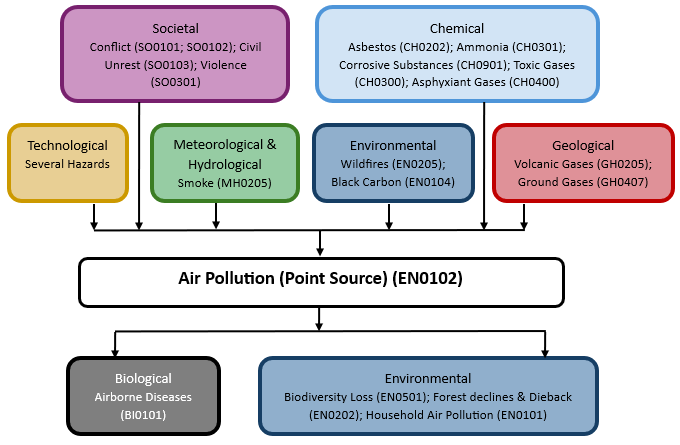
The figure below summarises common interactions between air pollution (point source) and other hazards. This information should be used with caution and not be solely relied upon in disaster risk management, particularly as some interactions may not have been included. Note that hazardous events occurring together or locally in space or time may not necessarily cause, amplify or be otherwise related to each other. Specific examples of multi-hazard context can be found in the ‘Hazard drivers’ and ‘Impacts’ sections above.
Multi-hazard diagram
Monitoring
The section and the table below offer an overview of monitoring for air pollution. This information can be used for forecasting within a national early warning system (EWS). Since EWS capacities and processes differ across countries, the most current and specific information regarding EWS should be obtained from the appropriate national or regional agency/authority responsible for disaster management.
| Which institution(s) produce(s) disaster risk data/information? | Environmental agencies, health agencies. |
How is the hazard observed/monitored/forecast?
| Network of air quality monitoring stations strategically placed across urban and industrial areas. These stations continuously measure concentrations of key pollutants, including PM2.5 and PM10, NO2, SO2, O3 and CO. Data from these sensors are transmitted in real-time to a central database, where they are analysed (Kelly et al., 2011). |
References
Aghababaeian, H., Ostadtaghizadeh, A., Ardalan, A., Asgary, A., Akbary, M., Yekaninejad, M.S., & Stephens, C., 2021. Global health impacts of dust storms: a systematic review. Environmental health insights, 15. DOI: 10.1177/11786302211018390 Accessed 21 January 2025.
Dunne, A., Mitchem, L., Wilding, J., Kibble,A., 2014. Air pollution and public health. In: Bradley, N., H. Harrison, G. Hodgson, R. Kamanyire, A. Kibble and V. Murray (eds.), Essentials of Environmental Public Health Science: A Handbook for Field Professionals. Chapter 4. Oxford University Press. https://oxfordmedicine.com/view/10.1093/med/9780199682881.001.0001/med-9780199682881 Accessed 21 January 2025.
Emberson, L., 2020. Effects of ozone on agriculture, forests and grasslands. Philosophical Transactions of the Royal Society A, 378(2183), 20190327. DOI: 10.1098/rsta.2019.0327 Accessed 21 January 2025.
Fairburn J., Schüle S.A., Dreger S.,Hilz L.K., Bolte G., 2019. Social Inequalities in Exposure to Ambient Air Pollution: A Systematic Review in the WHO European Region. International Journal of Environmental Research and Public Health. 2019; 16(17):3127. DOI: 10.3390/ijerph16173127. Accessed 21 January 2025.
Finlay, S.E., Moffat, A., Gazzard, R., Baker, D., Murray, V., 2012. Health impacts of wildfires. PLoS Currents, 4: e 4f959951cce2c.
Health Effects Institute, 2020. State of Global Air 2020. Special Report. Health Effects Institute, Boston, MA. Accessed 21 January 2025.
Kelly, F.J., Fuller, G.W., Walton, H.A., Fussell, J.C., 2012. Monitoring air pollution: Use of early warning systems for public health. Respirology, 17(1), 7-19. DOI: 10.1111/j.1440-1843.2011.02065.x Accessed 21 January 2025.
Kibble, A., Harrison, R., 2005. Point sources of air pollution. Occupational Medicine, 55:425-431.
Kilian J., Kitazawa M., 2018. The emerging risk of exposure to air pollution on cognitive decline and Alzheimer's disease - Evidence from epidemiological and animal studies. Biomed J. 41(3):141-162. doi:10.1016/j.bj.2018.06.001.
Manisalidis, I., Stavropoulou, E., Stavropoulos, A., Bezirtzoglou, E., 2020. Environmental and health impacts of air pollution: a review. Frontiers in public health, 8, 14. Accessed 21 January 2025.
Niu, Z., Habre, R., Chavez, T.A., Yang, T., Grubbs, B.H., Eckel, S.P., Berhane, K., Toledo-Corral, C.M., Johnston, J., Dunton, G.F., Lerner, D., Al-Marayati, L., Lurmann, F., Pavlovic, N., Farzan, S.F., Bastain, T.M., Breton, C.V., 2022. Association Between Ambient Air Pollution and Birth Weight by Maternal Individual- and Neighborhood-Level Stressors. JAMA Netw Open 5(10):e2238174. doi: 10.1001/jamanetworkopen.2022.38174.
Paul, M.J., LeDuc, S.D., Boaggio, K., Herrick, J.D., Kaylor, S.D., Lassiter, M.G., Nolte, C.G., Rice, R. B., 2023. Effects of air pollutants from wildfires on downwind ecosystems: Observations, knowledge gaps, and questions for assessing risk. Environmental Science & Technology, 57(40), 14787-14796. Effects of Air Pollutants from Wildfires on Downwind Ecosystems: Observations, Knowledge Gaps, and Questions for Assessing Risk | Environmental Science & Technology. Accessed 21 January 2025.
Paerl, H.W., 1995. Coastal eutrophication in relation to atmospheric nitrogen deposition: Current perspectives. Ophelia, 41(1), 237–259. DOI: 10.1080/00785236.1995.10422046. Accessed 21 January 2025.
Stewart, C., Damby, D.E., Horwell, C.J., Elias, T., Ilyinskaya, E., Tomasek, I., longo, B.M., Schmidt, A., Krage Carlsen, H., Mason, E., baxter, P.J., Cronin, S., Witham, C., 2022. Volcanic air pollution and human health: recent advances and future directions. Bull Volcanol 84, 11. Volcanic air pollution and human health: recent advances and future directions | Bulletin of Volcanology. Accessed 21 January 2025.
Ramanathan, V., Feng, Y., 2009. Air pollution, greenhouse gases and climate change: Global and regional perspectives. Atmospheric environment, 43(1), 37-50. DOI: 10.1016/j.atmosenv.2008.09.063. Accessed 21 January 2025.
WHO, 2006. WHO Air quality guidelines for particulate matter, ozone, nitrogen dioxide and sulfur dioxide. Global Update 2005. Summary of Risk Assessment. World Health Organization (WHO). Accessed 21 January 2025.
WHO, 2016. International Health Regulations (2005), 3rd ed. World Health Organization (WHO). Accessed 21 January 2025.
WHO, 2020. Air Pollution. Accessed 21 January 2025.
WHO, 2021. WHO Global Air Quality Guidelines on PM₂.₅, PM₁₀, NO₂, O₃, and SO₂. Geneva: World Health Organization. Accessed 4 April 2025.
Zanobetti A., Peters A., 2015. Disentangling interactions between atmospheric pollution and weather. J Epidemiol Community Health 69(7):613-5. DOI: 10.1136%2Fjech-2014-203939. Accessed 21 January 2025.