Loss of Mangroves
Mangroves are distinctive tropical and sub-tropical, woody plants that grow at the interface/intertidal zone between land and sea, where they exist in conditions of high salinity, extreme tides, strong winds, high temperatures and muddy, anaerobic soils (Kathiresan and Bingham, 2001). The destruction of mangrove habitat is caused by both human and natural causes. Humans have cleared mangrove forests to expand farmlands, aquaculture ponds or urban areas. Natural stressors, such as sediment erosion, extreme storm surges or drought have also resulted in mangrove habitat loss. The loss of mangroves has devastated coastal communities, which depend on them for socio-economic activities and environmental conservation, especially in regions with low mangrove diversity and coverage.
Primary reference(s)
Kathiresan, K., and Bingham, B. L., 2001. Biology of mangroves and mangrove ecosystems. Accessed 21 January 2025.
Annotations
Additional scientific description
There are over 70 species of mangroves worldwide (Polidoro et al., 2010). Distinct species make up a forest, which can be categorised as fringe, riverine, overwash, basin, or dwarf (Lugo and Snedaker, 1974). The ecosystem services that healthy mangrove forests provide include coastal protection, timber and fuel supply, fisheries generation, and eco-tourism support (Mukherjee et al., 2014). They are also crucial for climate change mitigation, storing more carbon than other ecosystems due to their high carbon density (Temmink et al., 2022).
Metrics and numeric limits
The Global Mangrove Watch (GMW), an initiative of the Global Mangrove Alliance, is an online platform that provides remote sensing data and tools for monitoring mangroves. The GMW comprises the Japan Aerospace Exploration Agency Kyoto and Carbon Initiative, Aberystwyth University, Solo Earth Observation, The Nature Conservancy, and Wetlands International. The GMW also hosts the official mangrove datasets used by the United Nations Environment Programme (UNEP) for reporting on Sustainable Development Goal 6.6.1 (change in the extent of water-related ecosystems over time) (GMW, last accessed 13 May 2024).
The most recent global extent maps are for 2020, and historical assessments span as far back as 1996. Between 1996 and 2020, there was a total net global mangrove loss of 3.4% of area coverage, which equates to a loss of 5,245 km² (Bunting et al., 2022).
The availability of GMW has resulted in the Mangrove Restoration Potential Map (MRP Map), a unique interactive tool developed to explore potential mangrove restoration areas worldwide and model the potential socio-ecological benefits associated with such restoration. The mapping tool was developed by The Nature Conservancy and the International Union for Conservation of Nature (IUCN), in collaboration with the University of Cambridge (Worthington and Spalding, 2018).
The MRP Map includes assessments of global maximum mangrove extent, mangrove deforestation, and potential restorable area. From 1996 to the present, 1,389 km² of mangroves have been degraded, and a total of 8,120 km² has the potential to be restored.
Data suggest an average loss rate of 0.13% annually from 1996 to 2016, higher than the average for tropical and sub-tropical forest losses (Goldberg et al., 2020). At national levels, losses are recorded in 97% of the countries and territories with mangroves (105 out of 108 countries), while degradation is recorded in 76% (82 out of 108 countries) (Worthington and Spalding, 2018).
Key relevant UN convention / multilateral treaty
The Convention on Wetlands, adopted in 1971, was one of the earliest policy frameworks for the conservation and management of coastal wetlands, including mangroves (UNESCO, 1971). In 2015, the Sendai Framework for Disaster Risk Reduction (2015–2030) acknowledged, although not explicitly, the protective role of mangroves in the potential reduction of coastal disaster risks (UNDRR, 2015). Furthermore, the 2016 United Nations General Assembly resolution on oceans and the law of the sea (UN/A/RES/71/257) recognised the socio-ecological value of mangroves through the generation of vital ecosystem
Drivers
Mangroves are vulnerable to sea-level rise when they are unable to accrete sediments in pace with the sea-level rise, which results in their submergence and subsequent loss. This is compounded by their inability to migrate inland to higher elevations when suitable migration space is lacking due to coastal development or natural barriers, resulting in coastal squeeze (Alongi, 2015). Furthermore, mangroves are sensitive to other climatic events, such as storms, high water events, precipitation and drought, and climate fluctuations, such as the El Niño-Southern Oscillation (ENSO) (Field, 1995). Mangroves are most vulnerable when they experience combinations of these climatic events; for example, mangroves along a 1,000 km length in northern Australia recently experienced substantial dieback after an ENSO event led to a temporary sea-level drop and a marked reduction in precipitation (Duke et al., 2017).
The extent of mangrove loss varies regionally, with Southeast Asia representing a particular hotspot, accounting for 47% of the global net mangrove loss between 1996 and 2020, with the primary drivers of this loss also being regionally dependent (Bunting et al., 2022; UNEP-WCMC, 2014). Mangrove loss is primarily due to the deforestation of existing mangrove areas, with around 62% (Goldberg et al., 2020) attributed to aquaculture and agriculture (including oil palm, rice cultivation, and other forms of agriculture and undefined uses). Other significant causes include direct and indirect settlement (urbanisation), which involves the clearing of mangroves for housing and other infrastructure, and development activities that alter hydrology and sediment inputs, or create severe pollution, leading to mangrove loss (FAO, 2023). An estimated 26% of mangrove loss is also due to natural causes, which occur as a result of changes in riverbeds, sediment inputs, or sea level (FAO, 2023).
Impacts
The loss of mangroves and the ecosystem services they generate can negatively affect local coastal communities and global populations. These include reduced ability to mitigate climate change as a sink of atmospheric carbon; reduced disaster risk reduction and lower protection of coastal communities from hazards, such as sea-level rise and storm surges; reduced adaptive capacity of coastal populations through reduced access to sources of food, fibres, timber, chemicals, and medicines. The loss of these resources often translates into a loss of revenue, as local fisheries, tourism, and related industries are sustained by the mangrove forests. In addition, as mangroves store a large amount of carbon in their soils, mangrove deforestation can release 25–100% of the total cleared biomass as carbon dioxide (CO₂) emissions and as much as 45% of soil carbon is lost within three years (Lovelock et al., 2017). Emissions from wetlands are explicitly considered in national greenhouse gas emissions reporting through the Intergovernmental Panel on Climate Change. Mangrove loss may also have unintended impacts on other connected coastal ecosystems, such as seagrass meadows or coral reefs (UNEP-WCMC, 2006).
Mangroves play a crucial role in mitigating the impacts of natural hazards, such as storms, floods, erosion, strong winds, and tsunamis. In that way, they contribute to disaster risk reduction. Studies indicate that ecologically healthy mangroves played a crucial role in saving lives and property during the tsunami (Danielsen et al., 2005; Goda et al., 2019). For example, during the 2018 earthquake in Palu Bay, Indonesia, tsunamis caused severe damage, with some areas experiencing waves as high as 2 metres. Homes located directly in front of mangrove forests were completely destroyed or swept away, while those sheltered behind the mangrove forests were largely spared (Goda et al., 2019). Similarly, the 2004 Indian Ocean tsunami showed that areas protected by mangroves suffered less damage than areas without such natural barriers (Danielsen et al., 2005). In Indonesia, land subsidence worsens the effects of sea-level rise on coastal ecosystems and communities, impacting both mangroves and coastal villages. However, mangroves experience subsidence to a lesser extent than villages, highlighting their protective role in reducing coastal flooding (Nurhidayah et al., 2022). A model also revealed that developing countries and small islands gain the most economic benefit from flood protection provided by mangroves. In Belize, Suriname, and Mozambique, these benefits represent over 15% of their national GDP (Menéndez et al., 2020).
However, the loss of mangroves reduces their ability to provide protective services. As mangrove forests degrade or are lost, the natural buffer they provide against extreme events is lost (Goldberg et al., 2020). This, in turn, increases both the frequency and severity of damage caused by natural hazards and leaves coastal communities more vulnerable to disasters. Mangrove loss will eliminate their function as effective natural filters for chemical pollutants (Sultana et al., 2023), leading to a decline in water and sediment quality.
Multi-hazard context
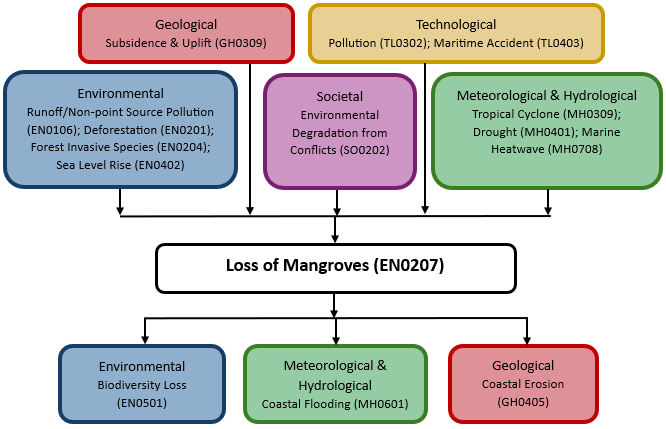
The figure below summarises common interactions between the loss of mangroves and other hazards. This information should be used with caution and not be solely relied upon in Disaster Risk Management, particularly as some interactions may not have been included. Note that hazardous events occurring together or locally in space or time may not necessarily cause, amplify, or be otherwise related to each other. Specific examples of multi-hazard context can be found in the ‘Hazard drivers’ and ‘Impacts’ sections above.
Multi-hazard diagram
Risk Management
Mangrove loss can be reduced or managed by efforts to stabilise existing mangrove extent and restore (replant) mangroves that have been lost. Mangrove coverage can be stabilised by conservation efforts, including increased protected area management and enforcement of national laws that prohibit mangrove loss. Furthermore, it is important to integrate local knowledge and increase community participation. In addition, the promotion of flexible and robust governance is essential for dealing with uncertainty, complexity, and dynamics of mangroves and ecosystems (e.g. adaptive management). Investigating, monitoring, and mitigating drivers of mangrove loss on regional and national levels are critical to maintaining existing mangrove forests.
Mangrove coverage can be increased by rehabilitation of previously deforested mangrove areas, such as the rehabilitation of abandoned aquaculture ponds. Potentially 800,000 hectares globally may be biophysically suitable for rehabilitation (Worthington and Spalding, 2018), although several socio-economic and governance challenges exist. These may reduce the area that is ultimately feasible to rehabilitate. The success of these interventions requires an expansion of research on the basic ecology and hydrology of mangroves and social sciences of human–mangrove interactions. Understanding local enabling conditions (social equity, environmental sustainability, and economic viability) is key to successful mangrove management and its associated blue economy.
Mangroves play a crucial role in the resilience of coastal ecosystems, as they can adapt to rising sea levels through enhanced sedimentation. However, this ability can be suddenly lost, especially when mangroves experience long-term degradation. In such cases, ecosystems can rapidly revert to earlier conditions, leading to sediment loss and reduced functionality. To prevent this, early warning systems and monitoring are essential. These strategies help anticipate mangrove loss, enhancing ecological functions and services such as coastal protection and disaster mitigation. For example, in China, regular monitoring supports the development of tailored management measures, allowing for prompt responses to changes in ecosystem stability (Zheng, 2023). There are more datasets as well that could help comprehensive mangrove monitoring (Worthington et al., 2020).
Monitoring
No information available
References
Alongi, D.M., 2015. The impact of climate change on mangrove forests. Current Climate Change Reports, 1:30-39. DOI: 10.1007/s40641-015-0002-x. Accessed 21 January 2025.
Bunting, P., Rosenqvist, A., Hilarides, L., Lucas, R.M., Thomas, N., Tadono, T., Worthington, T.A., Spalding, M., Murray, N.J., and Rebelo, L.-M., 2022. Global Mangrove Extent Change 1996–2020: Global Mangrove Watch Version 3.0. Remote Sens., 14, 3657. DOI: 10.3390/rs14153657. Accessed 21 January 2025.
Danielsen, F., Sørensen, M.K., Olwig, M.F., Selvam, V., Parish, F., Burgess, N.D., et al., 2005. The Asian tsunami: a protective role for coastal vegetation. Science 310, 643–643. DOI: 10.1126/science.1118387. Accessed 21 January 2025.
Duke, N.C., Kovacs, J.M., Griffiths, A.D., Preece, L., Hill, D.J., Van Oosterzee, P., Mackenzie, J., Morning, H.S., and Burrows, D., 2017. Large-scale dieback of mangroves in Australia’s Gulf of Carpentaria: a severe ecosystem response, coincidental with an unusually extreme weather event. Marine and Freshwater Research, 68:1816-1829. Accessed 23 January 2025
FAO. 2023. The world’s mangroves 2000–2020. Rome. DOI: 10.4060/cc7044en. Accessed 21 January 2025.
Field, C.D., 1995. Impact of expected climate change on mangroves. In: Asia-Pacific Symposium on Mangrove Ecosystems, pp. 75-81. Springer. DOI: 10.1007/978-94-011-0289-6_10. Accessed 21 January 2025.
GMW, no date. Global Mangrove Watch (GMW). Accessed 21 January 2025.
Goda, K., Mori, N., Yasuda, T., Prasetyo, A., Muhammad, A., and Tsujio, D., 2019. Cascading Geological Hazards and Risks of the 2018 Sulawesi Indonesia Earthquake and Sensitivity Analysis of Tsunami Inundation Simulations [Original Research]. Frontiers in Earth Science, 7. DOI: 10.3389/feart.2019.00261. Accessed 21 January 2025.
Goldberg, L., Lagomasino, D., Thomas, N., and Fatoyinbo., T., 2020. Global declines in human-driven mangrove loss. Global Change Biology, 26:5844-5855. DOI: 10.1111/gcb.15275. Accessed 21 January 2025.
Lecerf, M., Herr D., Elverum, C., Delrieu, E. and Picourt, L., 2023. Coastal and marine ecosystems as Nature-based Solutions in new or updated Nationally Determined Contributions, Ocean & Climate Platform, Conservation International, IUCN, Rare, The Nature Conservancy, Wetlands International and WWF. Accessed 21 January 2025.
Lovelock, C.E., Fourqurean, J.W., and Morris, J.T., 2017. Modeled CO2 emissions from coastal wetland transitions to other land uses: tidal marshes, mangrove forests, and seagrass beds. Frontiers in Marine Science, 4:143. DOI: 10.3389/fmars.2017.00143. Accessed 21 January 2025.
Lugo, A.E. and Snedaker, S.C., 1974. The ecology of mangroves. Annual Review of Ecology and Systematics, 5:39-64. Accessed 21 January 2025.
Menéndez, P., Losada, I. J., Torres-Ortega, S., Narayan, S., and Beck, M. W., 2020. The global flood protection benefits of mangroves. Scientific reports, 10(1), 1-11. DOI: 10.1038/s41598-020-61136-6. Accessed 21 January 2025.
Mukherjee, N., Sutherland, W.J., Dicks, L., Hugé, J., Koedam, N., & Dahdouh-Guebas, F., 2014. Ecosystem Service Valuations of Mangrove Ecosystems to Inform Decision Making and Future Valuation Exercises. Plos One, 9(9), e107706. DOI: 10.1371/journal.pone.0107706. Accessed 21 January 2025.
Nurhidayah, L., Davies, P., Alam, S., Saintilan, N., & Triyanti, A., 2022. Responding to sea level rise: challenges and opportunities to govern coastal adaptation strategies in Indonesia. Maritime Studies, 21(3), 339-352. Accessed 21 January 2025.
Polidoro, B.A., Carpenter, K.E., Collins, L., Duke, N.C., et al., 2010. The loss of species: mangrove extinction risk and geographic areas of global concern. PLoS ONE 5(4): e10095. DOI: 10.1371/journal.pone.0010095. Accessed 21 January 2025.
Sultana, S., Huang, R., Van Zwieten, L., Wang, H., and Wu, J., 2023. Trapping effect of mangrove and saltmarsh habitats on geochemical elements: a case study in Ximen Island, Zhejiang, China. Journal of Soils and Sediments, 23(6), 2327-2343. DOI: 10.1007/s11368-023-03503-0. Accessed 21 January 2025.
Temmink, R.J., Lamers, L.P., Angelini, C., Bouma, T.J., Fritz, C., van de Koppel, J., ... & van der Heide, T., 2022. Recovering wetland biogeomorphic feedbacks to restore the world’s biotic carbon hotspots. Science, 376(6593), eabn1479. DOI: 10.1126/science.abn1479. Accessed 21 January 2025.
UNDRR, 2015. The Sendai Framework for Disaster Risk Reduction 2015-2030. United Nations Office for Disaster Risk Reduction (UNDRR). Accessed 23 January 2025
UNEP, 2019. Resolution focused on the sustainable management for global health of mangroves. Accessed 23 January 2025.
UNEP-WCMC, 2006. In the Front Line: Shoreline protection and other ecosystem services from mangroves and coral reefs. United Nations Environment Programme and World Conservation Monitoring Centre (UNEP-WCMC), Cambridge, UK.
UNEP-WCMC, 2014. The Importance of Mangroves to People: A Call to Action. United Nations Environment Programme and World Conservation Monitoring Centre (UNEP-WCMC), Cambridge, UK. Accessed 23 January 2025.
UNESCO, 1971. Convention on Wetlands of International Importance especially as Waterfowl Habitat 1971. Accessed 23 January 2025.
United Nations, 2015. Sustainable development. Department of Economic and Social Affairs. Accessed 23 January 2025.
Worthington, T.A., and Spalding, M., 2018. Mangrove Restoration Potential. International Union for the Conservation of Nature, University of Cambridge, The Nature Conservancy. Accessed 11 September 2024.
Worthington, T.A., Andradi-Brown, D.A., Bhargava, R., Buelow, C., Bunting, P., Duncan, C., ... and Spalding, M., 2020. Harnessing big data to support the conservation and rehabilitation of mangrove forests globally. One Earth, 2(5), 429-443. DOI: 10.1016/j.oneear.2020.04.018. Accessed 23 January 2025.
UN/A/RES/71/257, 2016. Oceans and the law of the sea. Accessed 23 January 2025.
Zheng, J., Xu, W., Tao, A., Fan, J., Xing, J., and Wang, G., 2023. Synergy between coastal ecology and disaster mitigation in China: Policies, practices, and prospects. Ocean & Coastal Management, 245, 106866. DOI: 10.1016/j.ocecoaman.2023.106866. Accessed 23 January 2025.