Ammonium Nitrate
Ammonium nitrate (NH4NO3) is principally used as a high nitrogen content fertilizer in agricultural applications. It is also a major component of industrial explosives, and similar mixtures have been used as improvised explosive devices. Thousands of people have been killed in accidental ammonium nitrate explosions triggered either by a shock/explosion, or by fire spreading into a storage facility. Overuse as a fertilizer can lead to contamination of drinking water.
Primary reference(s)
UNECE 2009 Recommendations on the Transport of Dangerous Goods, Model Regulations, Sixteenth edition, United Nations, ISBN` 978-92-1-139136-7 (Recommendations on the Transport of Dangerous Goods, Model Regulations | UNECE)
UK Legislation 2003 (The Ammonium Nitrate Materials (High Nitrogen Content) Safety Regulations 2003 (legislation.gov.uk))
IMO, International Maritime Dangerous Goods Code (IMDG), two volumes. IMO Publications, London (The International Maritime Dangerous Goods (IMDG) Code (imo.org))
Annotations
Additional scientific description
Ammonium nitrate is a highly reactive material. Its principal use is as a high nitrogen content fertiliser, but it is also used in rocket propellants and other explosives. The principal acute hazard is explosive, but overuse in agriculture can lead to contamination of water supplies and contribute to eutrophication. When heated or involved in a fire, ammonium nitrate can decompose, releasing toxic gases including nitrogen oxides and ammonia. It can melt and potentially explode if the molten mass becomes confined. Ammonium nitrate also falls into HSNO Hazard Class 5.1 - oxidising agents. Contact with combustible materials, particularly flammable liquids (HSNO Hazard Class 3 materials) or flammable or reactive solids (HSNO Hazard Class 4) will generate potentially explosive mixtures that may detonate on exposure to even minimal mechanical shocks or mild heating. Mixtures of ammonium nitrate and fuel oil (or other hydrocarbon sources) have been used as improvised explosive devices on both small and large scales (e.g. Oklahoma City bombing). Ammonium nitrate is a strong oxidizer that can accelerate burning when involved in a fire and cause combustible materials (e.g., wood, paper, oil) to ignite, even in the absence of air. The International Labour Organisation provides a safety card for the pure compound and notes the shock sensitivity when contaminated with organic material (ILO, no date).
Metrics and numeric limits
Many jurisdictions regulate storage facilities and limit quantities, based on conditions, due to the potential for accidental detonation. For example, the UK Health and Safety Executive specifies that amounts greater than 150 tons must be notified to the local Fire and Rescue Service (UK HSE, No Date). Detonation resistance tests are sometimes employed (UNECE 2009, UK Legislation 2003).
Key relevant UN convention / multilateral treaty
UNECE Industrial Accidents Convention Industrial accidents | UNECE
Drivers
Ammonium nitrate is essential and used in large amounts as a fertiliser in maintaining agricultural production to feed increasing populations. In its pure form (>98%), ammonium nitrate is still an explosive, but it is much less sensitive than when mixed with oxidisable fuels. Examples have been reported where bombs or shells have exploded in ammonium nitrate stockpiles and succeeded only in spreading it, but there are also examples where the stockpile has exploded in such circumstances. Ammonium nitrate may be relatively insensitive, but it is also unpredictable. Detonation resistance tests are sometimes employed to assess the explosive tendencies of particular batches of material.
The risk of explosion increases significantly when the material is heated to melting (mp 169ºC), particularly if the liquid is in a confined space. Fire therefore presents a particular risk of explosion. Impurities such as chloride salts or heavy metals have been associated with higher risks of explosion, as has low pH (i.e. more acidic conditions) or the presence of high pressures. The sensitivity to detonation also varies with the particle size, with fine powders or porous solids exhibiting higher propensity to explode than larger, more dense particles. The high reactivity of fine powders is likely due to the high surface area (more area at which chemical reaction can occur), while that of the porous solids may be due to both higher surface areas and the ability to absorb contaminants such as those mentioned above. Most ammonium nitrate that is to be used in fertiliser applications is formulated in the more dense prill form (small spheres) or granules, but fine powders will inevitably be produced through mechanical action as the material is handled after production.
Impacts
Fires that impact ammonium nitrate transport or storage facilities can trigger explosions (e.g. Oppau, Germany, 1921; Texas City, USA, 1947; Toulouse, France, 2001; Neyshabur, Iran, 2004; Beirut, Lebanon, 2020).
Products from complete reaction of ammonium nitrate during an explosion are dinitrogen (N2), dioxygen (O2), and water (H2O). The high bond energies (946 kJ/mol, 497 kJ/mol, and 926 kJ/mol respectively) of these stable molecules mean that a great deal of energy is released when they are formed, and this contributes to the explosive properties of the compound. The large number of molecules that are produced through the chemical reactions during the explosion contributes to the large forces and blast waves associated with such explosions. The presence of fuel oil or other materials such as powdered metal allows further reactions to occur that generate even more energy and more gaseous products (e.g. carbon dioxide, CO2) that will increase the explosive effect. The explosion may release toxic chemicals (resulting from incomplete reaction) and spread unreacted ammonium nitrate, contaminating the environment (Rehman 2021).
If it does not explode, ammonium nitrate will decompose on heating to generate toxic nitrogen oxide gases (NOx).
Nitrate run-off from (over-) fertilised pastures can contaminate aquifers and drinking water supplies.
Multi-hazard context
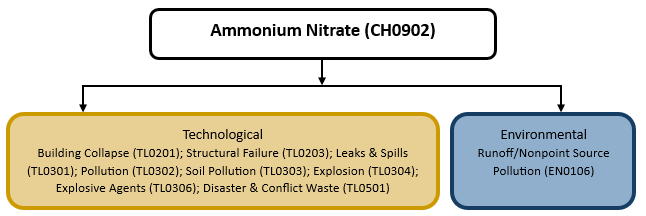
he figure below summarises common interactions between ammonium nitrate and other hazards. This information should be used with caution and not be solely relied upon in Disaster Risk Management, particularly as some interactions may not have been included. Note that hazardous events occurring together or locally in space or time may not necessarily cause, amplify or be otherwise related to each other. Specific examples of multi-hazard context can be found in the ‘Hazard drivers’ and ‘Impacts’ sections above.
Multi-hazard diagram
Risk Management
The principal hazards of storage of ammonium nitrate are associated with the propensity for explosion, either through direct detonation or detonation as a result of heating and/or melting (possibly as a result of a fire). There are also significant risks associated with contamination and leakage. Contamination with combustible materials through spillage on packaging or other contact can produce materials that are much more sensitive and may detonate on either mild mechanical shocks or minimal heating. Should this occur on even a small scale, it may be sufficient to detonate the surrounding bulk material. Leakage of ammonium nitrate from bags or other containment can result in caking of material on the warehouse floor and an increased risk of contamination with spilled oil (e.g. from forklifts, trucks or other vehicles) and consequent explosion. Sparks from electrical equipment or build-up of static electricity are more likely to initiate an explosion if finely powdered ammonium nitrate is present as the result of leakage from bags. Such powder will almost certainly be present even if the bulk material is made up of prills or granules.
The scale of the hazard will depend on the quantity of the material present as a large amount of material increases the likelihood of leakage. Furthermore, a large quantity has the potential to generate a very large explosion, whereas a small amount of material will have a correspondingly smaller effect. There are numerous examples of explosions occurring during the transport or storage of ammonium nitrate. In many cases, these have occurred as a result of fires, particularly in enclosed places such as holds of cargo vessels. Some of them have been very large and killed hundreds (e.g. Oppau, Germany, 1921; Texas City, USA, 1947; Toulouse, France, 2001; Neyshabur, Iran, 2004; Beirut, Lebanon, 2020).
Monitoring
The section and the table below offer an overview of monitoring ammonium nitrate. This information can be used for forecasting within a national early warning system (EWS). Since EWS capacities and processes differ across countries, the most current and specific information regarding EWS should be obtained from the appropriate national or regional agency/authority responsible for disaster management.
| Which institution(s) produce(s) Disaster Risk Data/Information? | UNECE 2009 Recommendations on the Transport of Dangerous Goods UK Legislation 2003 ILO No Date ICSC 0216 - AMMONIUM NITRATE (ilo.org) IMO, International Maritime Dangerous Goods Code (IMDG) |
| How is the Hazard Observed/Monitored/Forecast? | Regular inspections as part of risk management may provide some element of early warning, but the nature of these events makes early warning very difficult. |
References
International labour Organization (ILO), no date.ICSC 0216 - AMMONIUM NITRATE (ilo.org) Accessed 8 September 2024.
IMO No Date, International Maritime Dangerous Goods Code (IMDG), two volumes. IMO Publications, London (The International Maritime Dangerous Goods (IMDG) Code (imo.org)).
Rehman 2021 Sajid ur Rehman, Rida Ahmed, Kun Ma, Shuai Xu, Muhammad Adnan Aslam, Hong Bi, Jianguo Liu, Junfeng Wang, Ammonium nitrate is a risk for environment: A case study of Beirut (Lebanon) chemical explosion and the effects on environment, Ecotoxicology and Environmental Safety, Volume 210, 1 March 2021, 111834.
UNECE, 2009 United Nations Economic Commission for Europe (UNECE) Recommendations on the Transport of Dangerous Goods, Model Regulations, Sixteenth edition, United Nations, ISBN` 978-92-1-139136-7 (Recommendations on the Transport of Dangerous Goods, Model Regulations | UNECE).
UNECE, 2023. Globally Harmonised System (GHS) of Classification and Labelling of Chemicals (2023). United Nations Economic Commission for Europe (UNECE). Accessed 11 May 2024.
UK Legislation 2003 (The Ammonium Nitrate Materials (High Nitrogen Content) Safety Regulations 2003 (legislation.gov.uk)) accessed 20 January 2025.
UK HSE No Date, UK Health and Safety Executive, Notification of dangerous substances and ammonium nitrate on farms - HSE Accessed 20 January 2025.