Perfluoroalkyl and Polyfluoroalkyl Substances
Polyfluoroalkyl substances (PFAS) are a large family of chemicals in which multiple fluorine atoms are attached to an alkyl chain within a molecule. If all possible sites of an alkyl chain are occupied by fluorine atoms, the substance may also be referred to as a perfluoroalkyl substance as in perfluorooctanoic acid (PFOA) or perfluorooctanesulfonic acid (PFOS). (WHO, 2023).
Primary reference(s)
WHO, 2023. PFOS and PFOA in Drinking-water: Background document for development of WHO Guidelines for Drinking-water Quality (WHO). Accessed 16 November 2024
Annotations
Additional scientific description
PFAS are a large family of chemicals with a common feature: they contain carbon-fluorine bonds that make them highly stable, persistent, and resistant to degradation. They are widely used in various consumer products and industrial applications, but they also raise significant environmental and health concerns due to their persistence in the environment and their potential to accumulate in the human body. The European Union, The EU Commission, the U.S. Environmental Protection Agency (EPA), Centers for Disease Control and Prevention (CDC), and other health agencies have ongoing research and guidelines regarding the regulation, monitoring, and health risks associated with PFAS exposure. Because of their chemical structure, PFAS are also referred to as "forever chemicals" because they do not break down easily over time.
The most widely studied of these PFAS are perfluorooctane sulfonic acid (PFOS) and perfluorooctanoic acid (PFOA). Although the stability of PFOS and PFOA as well as their surfactant properties make them useful in consumer and industrial applications, there are concerns with their persistence and impacts on the environment and human health, as a result of exposure through the widespread uses of these chemicals. Drinking-water is one of several environmental sources of human exposure to PFAS, along with exposure via food, use in consumer products and occupational exposures (WHO, 2023)
Key Characteristics:
- Persistence: PFAS are extremely persistent in the environment and in human bodies due to the strong carbon-fluorine bond.
- Wide Application: PFAS are used in products such as stain-resistant fabrics, waterproofing agents, firefighting foams, and non-stick cookware.
- Health Concerns: Many PFAS chemicals have been linked to adverse health effects, including developmental effects, immune system disruption, liver toxicity, and cancer.
Metrics and numeric limits
PFAS (Per- and Polyfluoroalkyl Substances) are a large class of human-made chemicals, and various organizations, including The European Union, The EU Commission, the U.S. Environmental Protection Agency (EPA), World Health Organization (WHO), and other health and environmental regulatory bodies, have set guidelines and limits to manage exposure. These limits pertain to drinking water quality, environmental contamination, food safety, waste management, and occupational exposure. Below are key metrics, numeric limits, and relevant guidelines.
On April 10, 2024, EPA announced the final National Drinking Water Standards for six PFAS (PFOS, PFOA, PFNA, PFBS, PFHxS, and GenX). The new limits require public water systems to monitor for PFAS at some of the lowest levels ever regulated. It also requires water systems to notify the public of PFAS levels in their drinking water and take action, if above the regulated values (US EPA, 2025).
In October 2022, the European Environment Agency (EEA) proposed quality standards for the sum of 24 PFAS, including PFOS, in surface water and groundwater. These were based on an opinion of the European Food Safety Authority (EFSA), supported by opinions of the Scientific Committee on Health, Environment and Emerging Risks. The proposed standard for surface and groundwaters is 4.4 ng/L (as PFOA equivalents) (EU, no date).
The key EU regulation for PFAS in drinking water is the recast Drinking Water Directive (EU) 2020/2184, which came into force in January 2021 (EU, 2020).
WHO is still reviewing the available scientific evidence and has not yet established definitive guideline values for PFAS in drinking water. The organization is continuing to assess the potential health risks associated with PFAS exposure through drinking water and other sources
Summary of Key Numeric Limits for PFAS in drinking water:
| Standard/Agency | PFAS Compound | Limit | Effective date |
|---|---|---|---|
| US EPA 2025 | PFOA, PFOS | 4.0 ppt (individually) | 2029 |
| US EPA 2025 | PFHxS, PFNA, HFPO-DA (GenX) | 10 ppt (individually) | 2029 |
| EU, no date | Sum of 20 PFAS | 100 ng/L | 2026 |
| EU, no date | Total PFAS | 500 ng/L | 2026 |
Key relevant UN convention / multilateral treaty
PFAS are included in the Stockholm Convention. The Stockholm Convention on Persistent Organic Pollutants was adopted by the Conference of Plenipotentiaries on 22 May 2001 in Stockholm, Sweden (UNEP, 2001). The Convention entered into force on 17 May 2004. By September 2019, 183 UN member states and the European Union had adopted the Stockholm Convention.
Drivers
- Widespread Industrial Use: PFAS chemicals have been used in a wide range of industries due to their water- and oil-repellent properties, chemical stability, and resistance to heat. This widespread use has led to their persistent presence in the environment;
- Regulatory Gaps and Historical Use: PFAS were largely used before their full health and environmental risks were understood. In the past, chemicals like PFOA and PFOS were not well-regulated, and manufacturers did not initially recognize their long-term persistence;
- Environmental Persistence: PFAS are resistant to environmental degradation, leading to bioaccumulation in ecosystems. Once released into the environment, they can persist for decades or longer.
Impacts
PFAS is in general not an acute toxic substance to human health in the concentrations that normally surround humans. But given its effect on a long-term basis or in high doses due to e.g. accidents at chemical industry plants or industrial sites using PFAS in their production - such exposure could pose an increased risk to human health in a disaster situation. PFAS is so widespread - and is/has been used in many products - and it is found all over the world - including many inland water streams and rivers etc. - and in the sea - so when flooding occurs - due to heavy storms, increasing due to climatic change - PFAS contamination will follow. Therefore, monitoring is vital.
- Health Impacts: PFAS are linked to a range of adverse health outcomes, including developmental, immune, liver, and kidney problems, and may be carcinogenic (EEA, 2023; IARC, 2025; CDC, no date).
- Environmental Impacts: PFAS compounds can contaminate soil, water, and wildlife, leading to widespread environmental contamination that is difficult to remediate (EEA 2024).
- Economic Impacts: The economic cost of PFAS contamination includes the cost of water treatment, cleanup of contaminated sites, and potential litigation.
Multi-hazard context
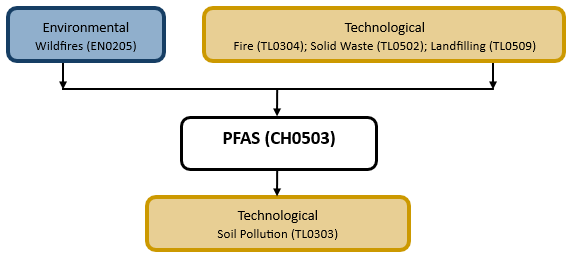
The figure below summarises common interactions between PFAS and other hazards. Particular note should be made of fire as a multi-hazard context. Many fire-fighting foams contain PFAS, which raises the concern that response to one disaster situation could precipitate another (related to PFAS, in this case).
This information should be used with caution and not be solely relied upon in Disaster Risk Management, particularly as some interactions may not have been included. Note that hazardous events occurring together or locally in space or time may not necessarily cause, amplify or be otherwise related to each other. Specific examples of multi-hazard context can be found in the ‘Hazard drivers’ and ‘Impacts’ sections above.
Multi-hazard diagram
Risk Management
- Regulatory Actions: Governments around the world are increasing efforts to regulate PFAS and reduce exposure to these chemicals. The EU has set drinking water standards for PFAS, specifically PFOS + PFOA, limiting their presence to 0.1 µg/L (100 ng/L). The European Food Safety Authority has a significant programme of work related to PFAS (EFSA, 2024) Stockholm Convention. PFOS has been listed under the Stockholm Convention on Persistent Organic Pollutants (POPs), which regulates the production and use of certain persistent chemicals.
- Technological Solutions for Remediation: Various technologies are being explored or used to address PFAS contamination, especially in drinking water and soil (EPA, no date).
- Public Health and Awareness Campaigns: Increasing public awareness of PFAS risks is a key strategy in risk management (e.g. EWG, no date).
Early warning systems for PFAS contamination are critical for protecting public health and the environment. They rely on environmental monitoring, advanced detection technologies, public health advisories, and regulatory frameworks to identify contamination before it reaches dangerous levels. These systems also require collaboration across sectors and regions to address global contamination issues effectively. Key players such as the EPA, WHO, OECD, and regional governments are taking significant steps to build and enhance early warning systems to prevent and mitigate PFAS-related risks.
Key Components of Early Warning Systems for PFAS are:
- Environmental Monitoring;
- Regulatory Surveillance and Health Impact Studies;
- Public Data Platforms and Transparency;
- Early Detection Technologies;
- International Collaboration
Monitoring
The section and the table below offer an overview of monitoring PFAS. This information can be used for forecasting within a national early warning system (EWS). Since EWS capacities and processes differ across countries, the most current and specific information regarding EWS should be obtained from the appropriate national or regional agency/authority responsible for disaster management.
| Which institution(s) produce(s) Disaster Risk Data/Information? | World Health Organisation (WHO) Environmental protection agencies |
| How is the Hazard Observed/Monitored/Forecast? | Environmental monitoring, advanced detection technologies, public health advisories, and regulatory frameworks |
References
CDC, no date. U.S. Centers for Disease Control and Prevention (CDC). "Perfluoroalkyl and Polyfluoroalkyl Substances (PFAS) and Human Health." CDC Per- and Polyfluoroalkyl Substances (PFAS) and Your Health | PFAS and Your Health | ATSDR Accessed 8 May 2025.
EEA, 2024 European Environment Agency (EEA). PFAS pollution in European Waters. PFAS pollution in European waters | European Environment Agency's home page. Accessed 7 May 2025.
EEA, 2023. European Environment Agency (EEA). Emerging chemical risks in Europe — ‘PFAS’ — European Environment Agency. Accessed 9 May 2025.
EFSA, 2024. European Food Safety Authority - EFSA: Per- and polyfluoroalkyl substances (PFAS). Accessed 28 April 2025. Accessed 9 May 2025.
EPA, no date U.S. Environmental Protection Agency (EPA) 1. Perfluoroalkyl and Polyfluoroalkyl substances (PFAS) Technologies for Reducing PFAS in Drinking Water. Accessed 8 May 2025.
EPA, 2025 U.S. Environmental Protection Agency (EPA) Per- and Polyfluoroalkyl Substances (PFAS) | US EPA. Accessed 23 February 2025.
EU, no date. European Union (EU). Drinking water - European Commission. Accessed 15 January 2025.
EU, 2020. European Union (EU) Drinking Water Directive. Directive - 2020/2184 - EN - EUR-Lex. Accessed 9 May 2025.
EU, 2024. European Union (EU) Official Journal. Technical guidelines regarding methods of analysis for monitoring of per- and polyfluoroalkyl substances (PFAS) in water intended for human consumption (C/2024/4910) Commission Notice – Technical guidelines regarding methods of analysis for monitoring of per- and polyfluoroalkyl substances (PFAS) in water intended for human consumption. Accessed 7 May 2025
EWG, no date Environmental Working Group (EWG). EWG PFAS Resources PFAS resources | Environmental Working Group. Accessed 7 May 2025
IARC, 2025. International Agency for Research on Cancer (IARC). "IARC Monographs on the Evaluation of Carcinogenic Risks to Humans." IARC PFAS IARC Publications Website - Perfluorooctanoic Acid (PFOA) and Perfluorooctanesulfonic Acid (PFOS). Accessed 8 May 2025.
UNECE, 2023. Globally Harmonised System (GHS) of Classification and Labelling of Chemicals (2023). United Nations Economic Commission for Europe (UNECE). Accessed 11 May 2024.
UNEP, 2001. Stockholm Convention on Persistent Organic Pollutants. UN Environment Programme (UNEP). Accessed 12 June 2024
WHO, 2023. PFOS and PFOA in Drinking-water: Background document for development of WHO Guidelines for Drinking-water Quality (WHO). Accessed 16 November 2024