
Pesticides
Pesticide means any substance, or mixture of substances of chemical or biological ingredients intended for repelling, destroying or controlling any pest, or regulating plant growth.
Primary reference(s)
UNEP, 2021. Highly Hazardous Pesticides (HHPs). Accessed 12 June 2024.
Annotations
Additional scientific description
Pesticides can also be grouped according to the types of pests which they kill: insecticides (insects); herbicides (plants); rodenticides (rodents); bactericides (bacteria); fungicides (fungi); and larvicides (larvae) (WHO and FAO, 2016). Pesticides are used in many different sectors (e.g., agriculture, forestry, food industry, domestic etc.).
Insecticides are chemicals used to control insects by killing them (CDC, 2019). Insecticides are classified based on their structure and function. They include:
- Carbamates/Organophosphates: Humans may be exposed via inhalation, ingestion or through skin contamination; and acute and chronic exposure can produce varying levels of toxicity. Similar to the insects exposed, these pesticides disrupt the function of the human nervous system, mainly the brain. They have also been linked to cancer risk. Their toxicity to humans has led to bans and use restrictions in many countries (CDC, 2019);
- Organochlorines: These are a group of chlorinated compounds that typically affect the central nervous system. They are known for their high toxicity, slow degradation and bioaccumulation. Examples include dichlorodiphenyltrichlorethane (DDT), methoxychlor, chlordane, and lindane. Human exposure may occur via inhalation, ingestion or through skin contamination. Many organochlorines have been banned in many countries, although a few are still registered for use (CDC, 2019).
- Boric acid: This type of pesticide comes in many forms (most commonly in pellets or tablets or a finely ground powder) and has many uses. It is a combination of boron and other elements. Toxicity depends on the amount of boron in the product. In addition to controlling insects, boric acid can be used to control growth of moulds, fungi and weeds. Boric acid is low in toxicity but can still cause irritation to the skin or eyes, and nausea, vomiting, stomach aches and diarrhoea if ingested (CDC, 2019).
- Pyrethroids/Pyrethrins: Pyrethrum is a naturally occurring mixture of chemicals found in certain chrysanthemum flowers. Pyrethrum was first recognised as having insecticidal properties around 1800 in Asia and was used to kill ticks and various insects such as fleas and mosquitos. From pyrethrum extract, individual chemicals called pyrethrins which have active insecticidal properties were developed. Pyrethroids are manufactured chemicals that are very similar in structure to the pyrethrins, but are often more toxic to insects, as well as to mammals, and last longer in the environment than pyrethrins (ATSDR, 2003). These insecticides are used widely in households, agriculture, on pets, and in mosquito control. While they are generally less toxic to mammals than some other insecticides, they can still have harmful health effects (CDC, 2019).
Fungicides are pesticides that kill or slow the growth of fungi and their spores. They can be used to control fungi that damage plants, including rusts, mildews and blights. They might also be used to control mould and mildew in other settings. Fungicides work in a variety of ways, but most of them damage fungal cell membranes or interfere with energy production within fungal cells (NPIC, 2019).
Pesticides are inherently toxic, and among them, a small number of Highly Hazardous Pesticides, cause disproportionate harm to the environment and human health. Highly Hazardous Pesticides means pesticides that are acknowledged to present particularly high levels of acute or chronic hazards to health or environment according to internationally accepted classification systems such as WHO or Global Harmonized System (GHS) or their listing in relevant binding international agreements or conventions. In addition, pesticides that appear to cause severe or irreversible harm to health or the environment under conditions of use in a country may be considered to be and treated as highly hazardous.
Around a thousand active ingredients are used to manufacture the wide array of pesticides in countries all over the world. Pesticide ingredients come in many thousands of different formulations, including nanopesticide formulations in which an active ingredient is carried on or within a nanoparticle. All these formulations degrade over time although some are more persistent in the environment than others. The chemical by-products that form as the pesticide deteriorates can be more toxic than the original product (FAO, no date b).
Hazardous pesticide contamination in soils often results from improper storage of (obsolete) agrochemicals, as a result of which pesticides are spilled in the surroundings of the storage site, where they seep into the soil or are dispersed by wind. In some cases, pesticide spillage has been ongoing for many years. Such spillage may cause serious soil or groundwater contamination. In addition, highly toxic and persistent compounds have been used in agriculture for decades to control pests and diseases, which are proven to cause harm to non-target species. Although international agreements are put in place to regulate the production and use of those highly toxic and persistent compounds they will still remain in soils for several more decades. Moreover, in some countries, the international agreements are not yet being implemented or fully implemented, and therefore toxic pesticides are still being used. When soil and groundwater are contaminated, crops, livestock and drinking water may become affected and, when they are consumed by people, health risks may occur (FAO, 2000).
Once pesticides enter soil, their fate depends on the physico-chemical characteristics of the soil, such as moisture, texture, and soil organic matter content, as well as the pesticide properties. A relatively small amount of spilled pesticides can therefore create a much larger volume of polluted soil. For example, approximately 30 tonnes of pesticides buried at a site in Yemen in the 1980s contaminated over 1500 tonnes of soil. This can pose a serious health and environmental threat to nearby communities (FAO, no date c).
Pesticide residue refers to the pesticides that may remain on or in food after they are applied to food crops or owing to their persistence in the environment or because of other uses such as vector control to combat endemic pests such as mosquitos transmitting malaria. Risk of pesticide residues mainly concerns occupational health of field workers, food safety (consumer health) and the environment. The maximum allowable levels of pesticide residues in foods are often stipulated by national regulatory bodies and by the Joint Food and Agriculture Organization of the United Nations (FAO) / World Health Organization (WHO) Food Standards Programme (Codex Alimentarius Commission).
The following definitions are relevant to the Codex Alimentarius (FAO, no date):
Pesticide: means any substance intended for preventing, destroying, attracting, repelling, or controlling any pest including unwanted species of plants or animals during the production, storage, transport, distribution and processing of food, agricultural commodities, or animal feeds or which may be administered to animals for the control of ectoparasites. The term can also include substances intended for use as a plant growth regulator, defoliant, desiccant, fruit-thinning agent, or sprouting inhibitor and substances applied to crops either before or after harvest to protect the commodity from deterioration during storage and transport. The term normally excludes fertilisers, plant and animal nutrients, food additives, and animal drugs.
Metrics and numeric limits
Available data are too limited to estimate the overall global health impacts of pesticides; however, the global impact of
self-poisoning (suicides) from preventable pesticide ingestion was estimated to be 155,488 deaths and 7362,493 Disability Adjusted Life Years (DALYs) for 2016 (WHO, 2019).
The WHO provides maximum residue limits (MRLs) for pesticides in food and levels in drinking-water as follows (WHO, 2019):
- Maximum residue limits in food: The Joint Food and Agriculture Organization of the United Nations (FAO) / WHO Meeting on Pesticide Residues (JMPR) evaluates those pesticides likely to contaminate food. MRLs are published by the Codex Alimentarius Commission. Guidance for individual pesticides or pesticide components - including for a number of highly hazardous pesticides - can be accessed via the FAO, WHO, Codex Alimentarius Commission or National Framework for Chemicals Environmental Management (INCHEM) websites and in hard-copy publications.
- Drinking-water: WHO water quality guidelines exist for some pesticides used in agriculture and public health - including for some highly hazardous pesticides - where there is a likelihood of drinking-water contamination. Many pesticides have a maximum contaminant level given by the US Environmental Protection Agency of approximately 0.2 ppb (EPA, no date).
Key relevant UN convention / multilateral treaty
The Stockholm Convention on persistent organic pollutions (POPs) (UNEP, 2001). At the time of writing, there were 183 parties.
The Rotterdam Convention on the Prior Informed Consent Procedure for Certain Hazardous Pesticides (1998). At the time of writing there were 161 parties.
The Basel Convention on the Control of Transboundary Movements of Hazardous Wastes and their Disposal (1989). At the time of writing, there were 187 parties.
The Montreal Protocol on Substances that Deplete the Ozone Layer (1987) has been ratified by all 197 UN Member States.
Drivers
Hazard Drivers of pesticide use include:
- Agricultural Productivity: The primary driver of pesticide use is the need to increase agricultural productivity. Pesticides help control pests and diseases that can significantly reduce crop yields.
- Economic Factors: The economic pressure to maximize crop yields and minimize losses drives farmers to use pesticides. The availability of cost-effective pesticides and their perceived benefits further incentivize their use.
- Technological Advancements: Development and commercialization of new pesticide formulations and delivery systems encourage their widespread use. Innovations in pest management techniques also play a role.
- Regulatory Policies: Government policies and subsidies can influence the use of pesticides. In some regions, subsidies for pesticide purchases promote their use, while regulations on permissible residues can limit it.
- Market Demands: Consumer preferences for aesthetically perfect produce lead farmers to use pesticides to ensure their crops meet market standards.
Impacts
Impacts of exposure to highly hazardous pesticides include (WHO, 2019):
The use of pesticides in agriculture and other sectors intersects with multiple hazards, posing complex risks to health, environment, and economies. Pesticide exposure can cause immediate health effects such as skin rashes and respiratory issues, as well as long-term health effects including cancer, endocrine disruption and neurological disorders - vulnerable populations (such as children, pregnant women and agricultural workers) are particularly susceptible. The economic burden of health care for pesticide-related illnesses and the costs associated with environmental remediation can be substantial. Environmental hazards such as water contamination and soil degradation are caused by leaching and accumulation of pesticides. Over-reliance on pesticides can lead to the development of resistant pest populations, necessitating the use of more or stronger chemicals, which increases costs for farmers - this could lead to a constant cycle of over-reliance leading to use of stronger pesticides leading to increased costs for health and environmental consequences. Pesticide residues on crops can affect market access, as international trade regulations and consumer preferences increasingly favour produce with low or no pesticide residues. (Aktar et al., 2009.; EEA, 2024; ILO, 2011). There is a possibility that excessive use of pesticides could reduce populations of insects required for plant pollination/reproduction, with consequent risks for food production.
Examples of impacts include:
- Unintentional and self-inflicted (suicide) acute poisonings by pesticides are a serious public health concern in many parts of the world.
- The acute hazard is highly variable depending on the pesticide and includes peripheral and central neurotoxicity and reduced blood clotting capacity. The specific pesticide formulation can significantly affect both exposure and toxicity. Short-term exposure can cause harmful effects on the liver, kidneys, blood, lungs, nervous system, immune system and gastrointestinal tract.
- Chronic exposure to highly hazardous pesticides can affect the skin, eyes, nervous system, cardiovascular system, gastro- intestinal tract, liver, kidneys, reproductive system, endocrine system, immune system and blood. Some highly hazardous pesticides may cause cancer, including childhood cancer.
- Toddlers and children are considered more vulnerable to exposure to pesticides due to their smaller size, hand to mouth activity, different metabolism, and because they are still developing.
Multi-hazard context
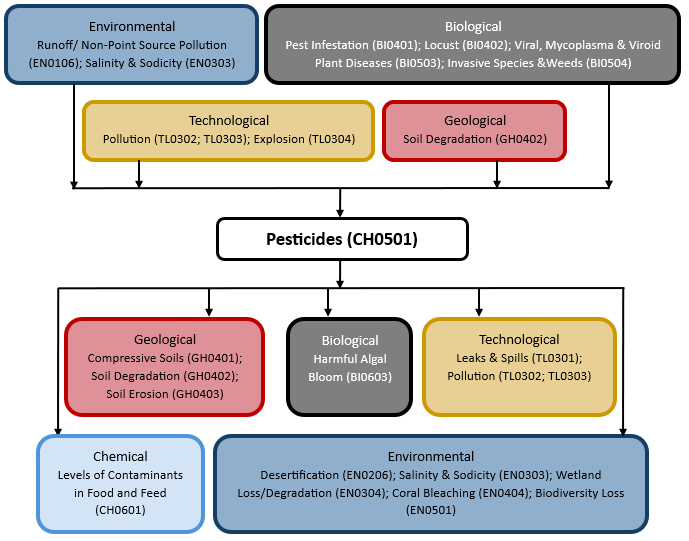
The figure below summarises common interactions between pesticides and other hazards. This information should be used with caution and not be solely relied upon in Disaster Risk Management, particularly as some interactions may not have been included. Note that hazardous events occurring together or locally in space or time may not necessarily cause, amplify or be otherwise related to each other. Specific examples of multi-hazard context can be found in the ‘Hazard drivers’ and ‘Impacts’ sections above.
Multi-hazard diagram
Risk Management
Risk mitigation measures are critical. In 2015, the Strategic Approach to International Chemicals Management (SAICM) International Conference on Chemicals Management adopted a resolution that recognised highly hazardous pesticides as an issue of concern and called for concerted action by countries to address these substances, with emphasis on promoting agro-ecologically based alternatives and strengthening national regulatory capacity to conduct risk assessment and risk management (WHO, 2019). Several initiatives undertaken by international organisations, including the WHO/FAO, support this resolution. These include the publication of guidelines to support the International Code of Conduct on Pesticide Management, including those on highly hazardous pesticides, Good Labelling Practice for Pesticides, Pesticide Legislation and other important resources and guidance documentation to assist in the implementation of best practices, which have been brought together in a toolkit (FAO, 2018).
The highly hazardous pesticides risk reduction process consists of three main consecutive steps: identification of highly hazardous pesticides by checking registered pesticides against the FAO/WHO criteria; assessment of highly hazardous pesticides by assessing each product for risks and needs to determine whether action is desirable; and mitigation of highly hazardous pesticides risks by determining for each product whether risk mitigation measures are required, and if so, which options would be most appropriate (WHO, 2019).
To reduce exposure to highly hazardous pesticides and their health impacts, the WHO summarised actions required in the following areas: handling, storage, use and disposal; elimination and replacement of pesticide use; education; and regulation, monitoring and surveillance (WHO, 2019).
Early Warning Systems for pesticides are multi-faceted and require a combination of technological, regulatory, and community-based approaches to be effective.
Pesticide Action Network (PAN):
- PAN works globally to monitor and reduce pesticide risks through community-based action and policy advocacy.
European Union's Pesticide Monitoring Program:
- The EU conducts comprehensive monitoring of pesticide residues in food and the environment, informing policy decisions.
Integrated Pest Management (IPM) Programs:
- Many countries implement IPM programs that focus on reducing pesticide use through alternative pest control methods and monitoring.
Monitoring
The section and the table below offer an overview of monitoring pesticides. This information can be used for forecasting within a national early warning system (EWS). Since EWS capacities and processes differ across countries, the most current and specific information regarding EWS should be obtained from the appropriate national or regional agency/authority responsible for disaster management.
| Which institution(s) produce(s) Disaster Risk Data/Information? |
1. World Health Organization (WHO) WHO is a key institution for providing information on pesticide hazards from a health perspective. The organization offers reports and data on the toxicological effects of pesticides and related chemicals, as well as the risks of exposure during disasters, including natural hazards like floods or storms. 2. Food and Agriculture Organization (FAO) FAO works on disaster risk reduction related to chemicals, providing training, guidelines, and information to countries on preventing pesticide misuse in disaster contexts. 5. European Food Safety Authority (EFSA) In Europe, EFSA is responsible for assessing the risks posed by pesticides to human health and the environment. 6. Environmental Protection Agencies (National Level) National environmental or agricultural agencies, like the U.S. Environmental Protection Agency (EPA) or India’s Central Insecticides Board, may also monitor and report pesticide-related hazards, especially during environmental disasters (e.g., floods, wildfires, chemical spills). 7. International Programme on Chemical Safety (IPCS) The IPCS, a joint initiative between WHO, UNEP, and the International Labour Organization (ILO), conducts assessments of chemical hazards, including pesticides, and provides guidelines and data to reduce risks, especially during emergencies. |
| How is the Hazard Observed/Monitored/Forecast? | Pesticide hazards are monitored and forecasted using a multi-disciplinary approach that combines environmental monitoring, meteorological forecasting, remote sensing, risk assessment models, and emergency response systems. These efforts help reduce the potential for harmful pesticide exposures, particularly in the context of natural disasters, and support effective risk management strategies to protect public health and the environment. |
References
Aktar et al., 2009. Md. W. Aktar, D. Sengupta, A. Chowdury. Impact of pesticides use in agriculture: their benefits and hazards. Interdisc Toxicol. 2009; Vol. 2(1): 1–12. doi: 10.2478/v10102-009-0001-7
Basel Convention on the Control of Transboundary Movements of Hazardous Wastes and their Disposal (1989). Accessed 12 June 2024.
EEA, 2024. How Pesticides Impact Human Health and Ecosystems in Europe. European Environment Agency (EEA). Accessed 14 July 2024.
EPA, no date. National Primary Drinking Water Regulations, National Primary Drinking Water Regulations | US EPA Accessed 7 May 2025
FAO, 2018. Pesticide registration toolkit: Identification of highly hazardous pesticides. Food and Agriculture Organization of the United Nations (FAO). Accessed 12 June 2024.
FAO, 2000. Assessing Soil Contamination: A reference manual. FAO Pesticide Disposal Series 8. Food and Agriculture Organization of the United Nations (FAO). Assessing_contamination_-_A_reference_manual.pdf (fao.org) Accessed 12 June 2024.
FAO and WHO, no date. Codex Alimentarius. Database for Maximum Residue Limits for Pesticides in Food and Feed. Food and Agriculture Organization of the United Nations (FAO) and World Health Organization (WHO). Accessed 12 June 2024
FAO and WHO, 2019. Codex Alimentarius Procedural Manual. 27th Edition. Food and Agriculture Organization of the United Nations (FAO) and World Health Organization (WHO). Accessed 12 June 2024.
ILO, 2011. Safety and Health in Agriculture (2011). International Labour Office (ILO). Accessed 14 July 2024.
Pesticide Action Network, 2009. PAN International List of Highly Hazardous Pesticides. Accessed 12 June 2024.
CDC, 2019. Pesticide Exposures. Centres for Disease Control and Prevention (CDC). Accessed 12 June 2024.
Rotterdam Convention on the Prior Informed Consent Procedure for Certain Hazardous Chemicals and Pesticides in International Trade (1998). Accessed 12 June 2024.
UNECE, 2023. Globally Harmonised System (GHS) of Classification and Labelling of Chemicals (2023). United Nations Economic Commission for Europe (UNECE). Accessed 11 May 2024.
UNEP, 2001. Stockholm Convention on Persistent Organic Pollutants. UN Environment Programme.
WHO, 2019. Preventing Disease Through Healthy Environments. World Health Organization (WHO). Accessed 12 June 2024.