
Asbestos
Asbestos is the term for a group of naturally occurring fibrous silicate minerals widely used historically in building materials and other products (WHO, 2018). All types of asbestos cause lung cancer, mesothelioma, cancer of the larynx and ovary, and asbestosis (fibrosis of the lungs) (WHO, 2018).
Primary reference(s)
WHO, 2018. Asbestos: elimination of asbestos-related diseases. World Health Organization (WHO). Asbestos: elimination of asbestos-related diseases (who.int)Accessed 30 April 2024.
Annotations
Additional scientific description
Asbestos is a Category 1A Carcinogen. Asbestos is known to have carcinogenic potential for humans, based on human evidence. The International Labour Organisation provides safety cards for chrysotile (white asbestos) and crocidolite (blue asbestos) (ILO, no date).
Asbestos has current or historical commercial use due to its extraordinary tensile strength, poor heat conduction, and relative resistance to chemical attack. For these reasons, asbestos is used for insulation in buildings and as an ingredient in a number of products, such as roofing shingles, water supply lines, and fire blankets, as well as clutches and brake linings, gaskets, and pads for automobiles (WHO, 2018).
The main forms of asbestos are chrysotile (white asbestos) and crocidolite (blue asbestos). Other forms include amosite, anthophylite, tremolite and actinolite (WHO, 2018).
All forms of asbestos are carcinogenic to humans. Exposure to asbestos, including chrysotile, causes cancer of the lung, larynx, and ovaries, and also mesothelioma (a cancer of the pleural and peritoneal linings). Asbestos exposure is also responsible for other diseases such as asbestosis (fibrosis of the lungs), and plaques, thickening and effusion in the pleura (WHO, 2018).
Metrics and numeric limits
There is no Threshold Limit for asbestos as it is carcinogenic, It should be completely removed from use and sequestered in ways that prevent human exposure to asbestos.
According to the World Health Organization (WHO), globally about 125 million people are currently exposed to asbestos at the workplace. In 2004, asbestos-related lung cancer, mesothelioma and asbestosis from occupational exposure resulted in 107,000 deaths and 1,523,000 Disability Adjusted Life Years (DALYs) (WHO, 2014). In addition, nearly 400 deaths have been attributed to non-occupational exposure to asbestos. The burden of asbestos-related diseases is still rising, even in countries that banned its use in the early 1990s. Owing to the long latency periods attached to the diseases in question, stopping the use of asbestos now will only result in a decrease in the number of asbestos-related deaths after a number of decades (WHO, 2014).
The WHO air quality guidelines for Europe estimate likely lifetime exposure for asbestos based on typical environmental concentrations and the associated health risk factors such as mesothelomia and lung cancer (WHO, 2000:38).
Key relevant UN convention / multilateral treaty
Asbestos Convention, 1986 (ILO, 1962).
Basel Convention on the Control of Transboundary Movements of Hazardous Wastes and their Disposal (Basel Convention, 1989). At the time of writing, there were 187 parties to the Basel Convention.
Drivers
In many disaster-prone areas, asbestos cement is widely used as a building material and when the material corrodes due to aging or is damaged it releases harmful asbestos fibres. Fires in buildings can release large amounts of dust and fibres from asbestos and fibreglass insulation (WHO, 2018).
The wide use of asbestos materials in construction means that any event that causes significant damage to buildings and other facilities has the potential to release asbestos dust and fibres (Whitmer, 2024). These represent a significant health hazard. Environmental events that affect opencast asbestos mines may also distribute asbestos dust and fibres.
Impacts
Asbestos is a proven human carcinogen (International Agency for Research on Cancer [IARC] Group 1). No safe level can be proposed for asbestos because a threshold is not known to exist. Exposure should therefore be kept as low as possible (IARC, 1987/1998).
Multi-hazard context
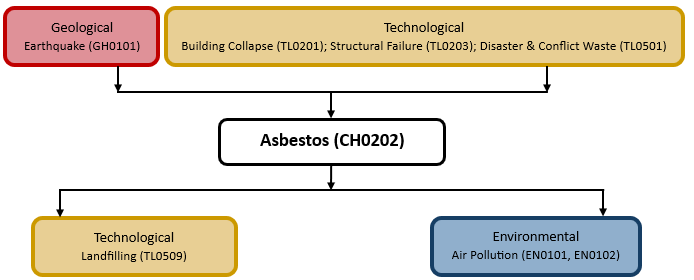
The figure below summarises common interactions between asbestos and other hazards. This information should be used with caution and not be solely relied upon in Disaster Risk Management, particularly as some interactions may not have been included. Note that hazardous events occurring together or locally in space or time may not necessarily cause, amplify or be otherwise related to each other. Specific examples of multi-hazard context can be found in the ‘Hazard drivers’ and ‘Impacts’ sections above.
Multi-hazard diagram
Risk Management
The WHO, in collaboration with the International Labour Organization and other intergovernmental organisations and civil society, works with countries towards elimination of asbestos-related diseases by (WHO, 2014):
- Recognising that the most efficient way to eliminate asbestos-related diseases is to stop the use of all types of asbestos.
- Providing information about solutions for replacing asbestos with safer substitutes and developing economic and technological mechanisms to stimulate its replacement.
- Taking measures to prevent exposure to asbestos in place and during asbestos removal (abatement).
- Improving early diagnosis, treatment, and rehabilitation services for asbestos-related diseases.
- Establishing registries of people with past and/or current exposures to asbestos and organising medical surveillance of exposed workers.
- Mapping of areas known to have high asbestos burdens may assist with disaster response.
- Providing information on the hazards associated with asbestos-containing materials and products, and by raising awareness that waste containing asbestos should be treated as hazardous waste.
Cost-effective interventions for preventing occupational lung diseases from exposure to asbestos are among the policy options for implementing the Global Action Plan for the Prevention and Control of Noncommunicable Diseases (2013-2020), as endorsed by the Sixty-sixth World Health Assembly in 2013 (WHO, 2013).
Monitoring
The section and the table below offer an overview of monitoring asbestos. This information can be used for forecasting within a national early warning system (EWS). Since EWS capacities and processes differ across countries, the most current and specific information regarding EWS should be obtained from the appropriate national or regional agency/authority responsible for disaster management.
Which institution(s) produce(s) Disaster Risk Data/Information? | ILO, 1962. C162 - Asbestos Convention, 1986 (No. 162) IARC, 1987. Asbestos (Actinolite, amosite, anthophyllite, chrysotile, crocidolite, tremolite) WHO |
| How is the Hazard Observed/Monitored/Forecast? | As made clear under Drivers, above, asbestos release is often a result of other events that cause damage or fires in the vicinity of asbestos fibres (see Multi-Hazard Context). Early warning will therefore be related to those precipitating events coupled with good risk management related to mapping areas with high asbestos burdens. |
References
Basel Convention, 1989. Basel Convention on the Control of Transboundary Movements of Hazardous Wastes and their Disposal (1989). At the time of writing, there were 187 parties to the Basel Convention. Official website. Accessed 30 April 2024.
International Agency for Research on Cancer (IARC), 1987. Asbestos (Actinolite, amosite, anthophyllite, chrysotile, crocidolite, tremolite) (Group 1). Summaries & Evaluations Supplement 7:106. Last updated 1998. International Agency for Research on Cancer (IARC). Accessed 30 April 2024.
International Labour Organization (ILO), 1962. C162 - Asbestos Convention, 1986 (No. 162). International Labour Organization (ILO). Accessed 18 November 2019.
International Labour Organization (ILO), no date. ICSC 0014 - CHRYSOTILE (ilo.org) and ICSC 1314 - CROCIDOLITE (ilo.org) Accessed 8 September 2024
United Nations Economic Commission for Europe (UNECE), 2023. Globally Harmonised System (GHS) of Classification and Labelling of Chemicals (2023). United Nations Economic Commission for Europe (UNECE). Accessed 11 May 2024.
Whitmer, 2024. An Asbestos Natural Disaster Guide | Wildfires & More Accessed 2 May 2025.
World Health Organization (WHO), 2000. Air Quality Guidelines for Europe, Second Edition. World Health Organization (WHO) Regional Office for Europe. European Series, No. 91. Accessed 18 November 2019.
World Health Organization (WHO), 2000. Air Quality Guidelines for Europe, Second Edition. World Health Organization (WHO) Regional Office for Europe. European Series, No. 91. Air quality guidelines for Europe, 2nd edition. Accessed 7 January 2025.
World Health Organization (WHO), 2013. Global action plan for the prevention and control of noncommunicable diseases 2013-2020. World Health Organization (WHO). Accessed 30 April 2024.
World Health Organization (WHO), 2014. Chrysotile asbestos. World Health Organization (WHO). Accessed 30 April 2024.
World Health Organization (WHO), 2018a. Chemical releases caused by natural hazard events and disasters: Information for public health authorities. World Health Organization (WHO). Accessed 30 April 2024.
World Health Organization (WHO), 2018b. Asbestos: elimination of asbestos-related diseases. World Health Organization (WHO). Asbestos: elimination of asbestos-related diseases (who.int) Accessed 30 April 2024.