Viral, Phytoplasma and Viroid Plant Disease Outbreaks
Viral, phytoplasma and viroid plant disease outbreaks refer to sudden occurrence of plant diseases caused by viruses, phytoplasma (syn. mycoplasma-like organisms) and viroids over large areas with significant impact on crop production or natural habitats (adapted from Nakashima & Murata, 1993; Hammond & Owens, 2006; FAO / IPPC, 2016; Rubio et al., 2020).
Primary reference(s)
FAO / IPPC, 2016. ISPM 27 Diagnostic protocols for regulated pests. DP 12: Phytoplasmas. Accessed 9 March 2025.
Hammond, R.W., and Owens, R.A., 2006. Viroids: new and continuing risks for horticultural and agricultural crops. APSnet Features. Accessed 9 March 2025.
Nakashima, K., and Murata, N., 1993. Destructive plant diseases caused by mycoplasma-like organisms in Asia. Outlook on Agriculture, 22:53-58.
Rubio, L., Galipienso, L., and Ferriol, I., 2020. Detection of plant viruses and disease management: relevance of genetic diversity and evolution. Frontiers in Plant Science, 11:1092. DOI: 10.3389/fpls.2020.01092/full. Accessed 9 March 2025.
Annotations
Additional scientific description
The terminology 'outbreak' is used if the disease occurs in a limited location or area, epidemic if it occurs in large areas and 'pandemic' if it occurs in multiple regions and at global scale.
Plant diseases are a major concern globally, given their potential economic impact on populations that rely on income from selling crops. The impact in places where there is increased food scarcity is of particular concern, as it exacerbates the insecurity and poverty felt by populations affected by these diseases. Along with fungi and bacteria, viruses, viroids and phytoplasmas (MLOs) are considered among the main disease agents causing significant crop losses, depending on crops and local conditions.
Plant viruses are small microorganisms without cell walls, containing nucleic acids surrounded by protein coats and replicating only inside living cells (Gergerich & Dolja, 2006). Phytoplasmas are obligate prokaryotic plant pathogens that do not possess cell wall, and they are pleiomorphic in profile, with a mean diameter of 200-800 nm (FAO & IPPC, 2016). The types affecting animals are usually called mycoplasmas. They lack cell wall and are bounded by unit membrane and have cytoplasm ribosomes and strands of nuclear material. Phytoplasmas are transmitted through insects that feed on plants, including plant hoppers and psyllids.
Viruses, phytoplasmas and viroids are very difficult to control as there is no pesticide available, and they are highly resistant to antibiotics and can be saprophytic or parasitic to plants (Britannica, 2019). Viroids are microorganisms that consist of a small circular RNA molecule and are smaller than viruses and capable of causing certain plant diseases (Britannica, 2020).
The occurrence of phytoplasma in plants is a particularly difficult hazard to address, since they are 'the perfect parasite' and adapt to their host in a way that serves all their nutritional needs (Cleanroom Technology, 2008). While phytoplasmas generally do little harm, under conducive conditions they can provoke serious responses from their host causing illness and death in plants (Cleanroom Technology, 2008). Phytoplasma and Mycoplasma-Like organisms (MLOs) spread largely insect vectors such as leaf hoppers and are associated with more than 100 diseases (Arora & Sinha, 1988).
Metrics and numeric limits
Not identified.
Key relevant UN convention / multilateral treaty
The International Plant Protection Convention (IPPC) was approved by the Food and Agriculture Organization of the United Nations (FAO) on 6 December 1951, by Resolution No. 85/51. The IPPC is an intergovernmental treaty signed by over 180 countries, aiming to protect the world’s plant resources from the spread and introduction of pests, and promote safe trade (FAO & IPPC, 1999). The Convention has introduced International Standards for Phytosanitary Measures (ISPMs) as its main tool to achieve its goals, making it the sole global standard-setting body (FAO & IPPC, 2021). The IPPC is one of the
Drivers
Viruses are among the major causes of plant diseases in many plants, some being highly significant. Spread of viruses, phytoplasmas and viroids largely takes place through the movement of infected plant materials or through insect vectors such as aphids, white flies and mealybugs. Some nematodes and fungi are also reported to transmit viruses. Thus, integrated management approaches should consider the control of insect vectors as well as the use of virus-free planting materials.
Impacts
Plant disease outbreaks may cause food security challenges, especially if the staple food crops are affected. Some of these pathogens can be present in plants in multiple forms and extend their damage. One good example is the viruses linked with the cocoa swollen shoot disease causing serious losses and market disruption in Ghana since the 1930s and recently. Involvement of at least six badnavirus in the infections made disease management very difficult and even had political consequences (Gymera et al., 2023).
Diseases of economic importance caused by viruses include tobacco mosaic virus, cassava viruses (mosaic virus and brown streak virus), banana bunchy top virus, tomato yellow leaf curl virus, cucumber mosaic virus, potato virus Y, plum pox virus and potato virus X, citrus tristeza virus and barley yellow dwarf virus (Gergerich & Dolja, 2006). These viral diseases cause serious losses to respective hosts under conducive conditions.
Major mycoplasma diseases include witches’ broom of woody plants, X disease of peaches, coconut lethal decline, grapevine yellows, apple proliferation, while viroids causing significant diseases include potato spindle tuber viroid, citrus infected with Citrus exocortis viroid and avocado sunblotch viroids.
Multi-hazard context
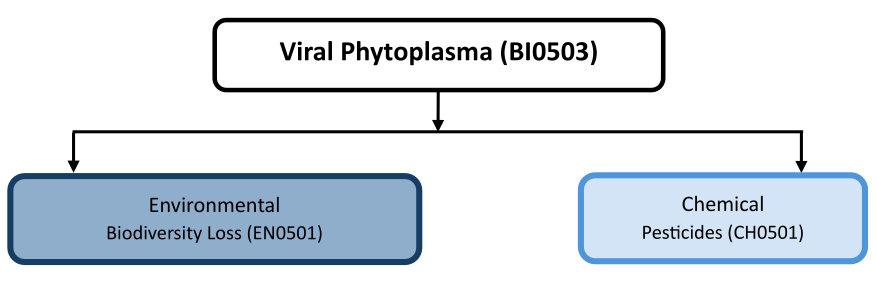
The figure below summarises common interactions between viral phytoplasma and other hazards. This information should be used with caution and not be solely relied upon in Disaster Risk Management, particularly as some interactions may not have been included. Note that hazardous events occurring together or locally in space or time may not necessarily cause, amplify or be otherwise related to each other. Specific examples of multi-hazard context can be found in the ‘Hazard drivers’ and ‘Impacts’ sections above.
Multi-hazard diagram
Risk Management
The use of certified disease-free planting materials is critical as these pathogens can spread through planting materials. Thus, investments in strengthening the seed systems should be a priority, particularly in developing countries. In addition, to prevent local spread, control of the insect vectors should also be considered.
Monitoring
The section and the table below offer an overview of monitoring for viral phytoplasma. This information can be used for forecasting within a national early warning system (EWS). Since EWS capacities and processes differ across countries, the most current and specific information regarding EWS should be obtained from the appropriate national or regional agency/authority responsible for disaster management.
| Which institution(s) produce(s) Disaster Risk Data/Information? | There are several early warning systems for plant pests and diseases including viruses, phytoplasmas and viroids, particularly at regional levels, for example for Europe (Peter et al., 2011) and North America (Meissner et al., 2015). At global level, the pest reporting system of IPPC can be considered the most official resource for reports of the occurrence of quarantine plant pests including diseases (IPPC, 2025). Although such reports are deposited well after the establishment of a pest these can be considered as early warning resources for other concerned countries. |
| How is the Hazard Observed/Monitored/Forecast? | Through official reports of countries; published scientific articles or network news. |
References
Arora, Y.K. and R.C. Sinha, 1988. Plant pathogenic mycoplasmas: morphological and biochemical characteristics. In: Mycoplasma Diseases of Crops, pp. 3-28. Accessed 9 March 2025.
Britannica, 2019. Mycoplasma bacterium genus. Accessed 9 March 2025.
Britannica, 2020. Viroid: infectious particle. Accessed 9 March 2025.
Cleanroom Technology, 2008. Mycoplasmas - the perfect parasite. Accessed 9 March 2025.
FAO / IPPC, 2016. ISPM 27 Diagnostic protocols for regulated pests. DP 12: Phytoplasmas. Accessed 9 March 2025.
FAO / IPPC. Food and Agriculture Organization of the United Nations (FAO). Accessed 9 March 2025.
FAO / IPPC, 1999. Convention Text. Food and Agriculture Organization (FAO), International Plant Protection Convention (IPPC). Accessed 9 March 2025.
FAO / IPPC, 2021. Adopted Standards (ISPMs). Food and Agriculture Organization (FAO), International Plant Protection Convention (IPPC). Accessed 9 March 2025.
Gergerich, R.C., Dolja, V.V., 2006. Introduction to Plant Viruses, the Invisible Foe. The Plant Health Instructor. DOI: 10.1094PHI-I-2006-0414-01. Accessed 4 November 2020.
Gyamera, E.A., Domfeh, O., Ameyaw, G., 2023. Cacao Swollen Shoot Viruses in Ghana. Plant disease. 2023. 107: 1263-1278. DOI: epdf/10.1094/PDIS-10-22-2412-FE. Accessed 9 March 2025.
Hammond, R.W., Owens, R.A., 2006. Viroids: new and continuing risks for horticultural and agricultural crops. APSnet Features. Accessed 9 March 2025.
Meissner, H., Fritz, J., Kohl, L., Moylett, H., Moan, M., Emerine, S., Kaye, A., 2015. PestLens: an early-warning system supporting US safeguarding against exotic plant pests. Bull. OEPP 45: 304–310.
Petter F., Suffert, M, Roy, A.S., Griessinger, D., Mcmullen, M., 2011. Highlights on some EPPO activities in plant quarantine. Bulletin of Insectology, 2011. (Supplement): S285 – S286.
Nakashima, K., Murata, N., 1993. Destructive plant diseases caused by mycoplasma-like organisms in Asia. Outlook on Agriculture, 22:53-58.
Rubio, L., Galipienso, L., Ferriol, I., 2020. Detection of plant viruses and disease management: relevance of genetic diversity and evolution. Frontiers in Plant Science, 11:1092. Accessed 9 March 2025.
WTO, 1998. Understanding the WTO Agreement on Sanitary and Phytosanitary Measures. World Trade Organization (WTO). Accessed 9 March 2025.