
Bacterial Plant Disease
A bacterial plant disease is the occurrence of plant diseases caused by bacterial microorganisms over large areas with significant impacts on crop and forest productivity or natural habitat (adapted from FAO, 2018).
Primary reference(s)
FAO, 2018. The Impact of Disasters and Crises on Agriculture and Food Security: 2017. Food and Agriculture Organization of the United Nations (FAO). Accessed 12 February 2025.
Annotations
Additional scientific description
A bacterium is a single-celled, microscopic organism that lacks a nucleus (University of California, 2019). Plant diseases caused by bacterial pathogens place major constraints on crop and forest production and cause significant annual losses on a global scale (Sundin et al., 2016).
The Food and Agriculture Organization of the United Nations (FAO) estimates that each year, plant diseases cost the global economy around USD 220 billion (FAO, 2019).
Numerous bacterial diseases affect crop production in many countries and regions. These include fire blight in fruit trees, bacterial wilt in banana, bacterial blight in rice and crown gall in many perennial plants. In some cases, the epidemics caused by bacteria can cause significant economic burden on crops (FAO, 2018). An assessment to identify the key globally significant plant pathogenic bacteria indicated that the top ten include Pseudomonas syringae pathovars, Ralstonia solanacearum, Agrobacterium tumefaciens, Xanthomonas oryzae pv. Oryzae, Xanthomonas campestris pathovars, Xanthomonas axonopodis pathovars, Erwinia amylovora, Xylella fastidiosa, Dickeya (dadantii and solani) and Pectobacterium carotovorum (and Pectobacterium atrosepticum) (Mansfield et al., 2012).
When conditions are conducive, many of these species and many others can cause significant damage to plant production and natural landscape including forestry. For example, Xylella fastidiosa is a bacterial disease with many subspecies that in recent years has managed to establish itself in areas along the Mediterranean coast, where it is attacking economically important crops such as olive, citrus, stone fruits, grapevines and forest trees such as oak (FAO, 2020).
- In 2013, Italian researchers made a troubling discovery: one of the world's most destructive plant diseases, normally found in the Americas, had made its way to Italy's olive trees. With no known cure, the pathogen has already affected more than 10 million trees in the south-eastern tip of Italy. If not properly contained, it threatens to spread across the entire Mediterranean basin. The Italian government contracted national research institutes and the International Centre for Advanced Mediterranean Agronomic Studies (CIHEAM) to survey and contain X. fastidiosa. Other Mediterranean countries are at great risk if the disease spreads further (FAO, 2020).
- The disease threatens to spread to the Near East and North Africa region. To help smallholders protect their crops and livelihoods, the FAO is supporting efforts in Near East and North African countries to raise awareness of the threat and implement technologies and techniques that can help prevent, detect and contain this deadly disease (FAO, 2020).
- Not only olive trees but also more than 500 other plant and forest tree species are hosts for the various strains of the bacterium. If not prevented, smallholders in the Near East and North African region could have their livelihoods devastated and national economies destabilized by the potential spread into the region. Because of these risks, the FAO has launched a project to support Near East and North African countries in their efforts to prevent the introduction and spread of this disease (FAO, 2020).
Metrics and numeric limits
Not available.
Key relevant UN convention / multilateral treaty
The International Plant Protection Convention (1997) is an intergovernmental treaty signed by over 180 countries, aiming to protect the world’s plant resources from the spread and introduction of pests, and promoting safe trade (FAO, 2011). The Convention introduced International Standards for Phytosanitary Measures (FAO, no date) as its main tool to achieve its goals, making it the sole global standard setting body for plant health. The IPPC is one of the ‘Three Sisters’ recognized by the World Trade Organization’s (WTO) Sanitary and Phytosanitary Measures (SPS) Agreement, along with the
The International Standards for Phytosanitary Measures (ISPMs) are standards adopted by the Commission on Phytosanitary Measures (CPM), which is the governing body of the International Plant Protection Convention (IPPC). The first International Standard for Phytosanitary Measures (ISPM) was adopted in 1993 (FAO, 2024).
The Codex Alimentarius (FAO and WHO, no date a; FAO and WHO, no date b).
The WTO Agreement on the Application of Sanitary and Phytosanitary Measures (SPS Agreement) (WTO, 2025).
Drivers
Although most bacteria existing in the soil and natural environments are beneficial, some cause significant diseases in plants under favourable conditions. Disruption of ecosystems, deficiencies in biosecurity and phytosanitary systems, and negligence of crop hygiene contribute to the build-up and spread of the inoculum of bacteria, causing substantive economic damage to crops and natural habitats. Prevention of spread is always easier than responding to outbreaks and control. Control of the diseases caused by bacteria is achieved by following the principles of sustainable plant production and integrated pest management practices.
Impacts
Plant disease outbreaks may cause food security challenges especially if the staple food crops are affected. They can also result in market or price instability. One good example is the cacao swollen shoot virus causing some significant losses in West Africa in recent years.
Regarding the impact, numerous global estimations have been made mostly indicating a range of 20 - 30% of crop loss (Savary et al., 2019). It is estimated economic losses caused by plant diseases may reach USD 220 billion (Agrios, 2005). Bacterial diseases are important contributors to these losses.
Multi-hazard context
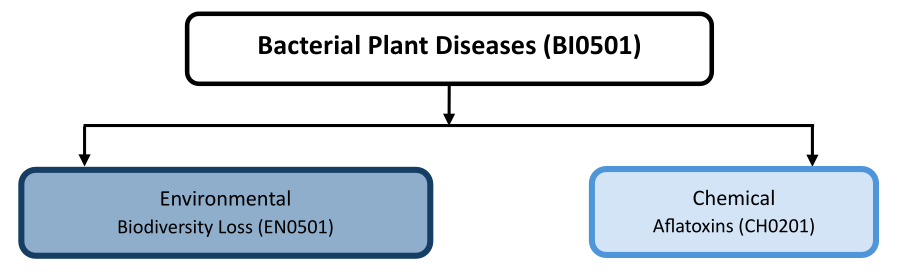
The figure below summarises common interactions between bacterial plant diseases and other hazards. This information should be used with caution and not be solely relied upon in Disaster Risk Management, particularly as some interactions may not have been included. Note that hazardous events occurring together or locally in space or time may not necessarily cause, amplify or be otherwise related to each other. Specific examples of multi-hazard context can be found in the ‘Hazard drivers’ and ‘Impacts’ sections above.
Multi-hazard diagram
Risk Management
The International Plant Protection Convention (IPPC) is the international forum providing space for intergovernmental discussions and negotiations on managing the risks resulting from spread of plant diseases (as well as other biological agents threatening plants). It provides facilities for establishment of international standards, capacity building and reporting for the purpose of minimizing risks of spread of these agents (IPPC, 2024).
Disease management approaches include focusing on diversified productions, use of pathogen-free certified planting materials, use of resistant varieties, regular surveillance, crop and forest hygiene and rapid containment and response at initial stages. Some bacteria are transmitted by insect vectors; thus, control of these vectors is important for disease management. Bacteria in agricultural environments can mutate and produce new strains that might be more aggressive than before. Therefore, monitoring and development of resistant varieties to emerging strains is critical for integrated management of the diseases caused.
Countries are expected to adhere the international standards and strengthen their phytosanitary capacity and biosecurity systems. Their capacity for preparedness, monitoring and rapid response should also be strengthened. In addition, international cooperation should be established or strengthened to address the regional or global challenges related to management of invasive and transboundary plant pests and disease, particularly those that are airborne.
Monitoring
The section and the table below offer an overview of monitoring for bacterial plant disease. This information can be used for forecasting within a national early warning system (EWS). Since EWS capacities and processes differ across countries, the most current and specific information regarding EWS should be obtained from the appropriate national or regional agency/authority responsible for disaster management.
| Which institution(s) produce(s) Disaster Risk Data/Information? | There are several monitoring systems particularly at regional level, such as those for Europe (Peter et al, 2011) and North America (Meissner et al., 2015). At the global level, the pest reporting system of IPPC can be considered as the most official resource for reports of occurrence of quarantine plant pests including the diseases (IPPC, 2025). |
| How is the Hazard Observed/Monitored/Forecast? | Through official reports of countries, published scientific articles or network news |
References
Agrios, G.N., 2004. Plant Pathology. 5th Edition - December 27, 2004 Imprint: Academic Press. Auth Language: English Elsevier. Hardback ISBN: 9780120445653.- eBook ISBN: 978008047378. Accessed 27 May 2025.
FAO, 2011. International Plant Protection Convention 1997. Food and Agriculture Organization of the United Nations (FAO). Accessed 27 May 2025.
FAO, 2018. The Impact of Disasters and Crises on Agriculture and Food Security. Food and Agriculture Organization of the United Nations (FAO). Accessed 27 May 2025.
FAO, 2019. New standards to curb the global spread of plant pests and diseases. Food and Agriculture Organization of the United Nations (FAO). Accessed 27 May 2025.
FAO, 2020. Saving Mediterranean Olives from a Destructive Disease. Food and Agriculture Organization of the United Nations (FAO). Accessed 27 May 2025.
FAO, 2024. Adopted Standards (ISPMs). Food and Agriculture Organization of the United Nations (FAO). Accessed 27 May 2025.
FAO and WHO, no date. About Codex Alimentarius. Food and Agriculture Organization of the United Nations (FAO) and World Health Organization (WHO). Accessed 27 May 2025.
Mansfield, J., Genin, S., Magori, S., Citovsky, V., Sriariyanum, M., Ronald, P., Dow, M., Verdier, V., Beer, S.V., Machado, M.A., Toth, I., Salmond, G., Foster, G.D., 2012. Molecular Plant Pathology. Volume13, Issue6, pp:614-629. DOI: 10.1111/j.1364-3703.2012.00804.x. Accessed 27 May 2025.
Savary, S., Willocquet, L., Pethybridge, S.J., Esker, P., McRoberts, N., Nelson, A., 2019. The global burden of pathogens and pests on major food crops. Nat Ecol Evol 3, 430–439. Accessed 27 May 2025.
Sundin, G.W., Castiblanco, L.F., Yuan, X., Zeng, Q., Yang, C.H., 2016. Bacterial disease management: challenges, experience, innovation and future prospects: Challenges in Bacterial Molecular Plant Pathology. Mol Plant Pathol. 17(9):1506-1518. doi: 10.1111/mpp.12436. Epub 2016 Aug 8. PMID: 27238249; PMCID: PMC6638406. Accessed 27 May 2025.
University of California, 2019. Statewide Integrated Pest Management Programme. Glossary. Accessed 27 May 2025.
WTO, 2025. The WTO Agreement on the Application of Sanitary and Phytosanitary Measures (SPS Agreement). Accessed 27 May 2025.