
Airborne Diseases
Airborne transmission of infectious agents refers to the transmission of disease caused by the dissemination of very small droplets that remain infectious when suspended in air over long distances and time, and potentially cause significant morbidity and mortality (adapted from WHO, 2020).
Primary reference(s)
WHO, 2020. Transmission of SARS-CoV-2: implications for infection prevention precautions. World Health Organization (WHO). Accessed 26 March 2025.
Annotations
Additional scientific description
The descriptor 'through the air' can be used in an overarching way to characterize an infectious disease where transmission involves the pathogen travelling through or being suspended in the air (WHO, 2024a). Acute respiratory infections (ARIs) are the leading cause of morbidity and mortality from infectious diseases worldwide, particularly affecting the youngest and oldest people in low and middle-income nations (WHO, 2014). These infections, typically caused by viruses, bacteria, fungi, parasites or mixed viral-bacterial infections, can be contagious and spread rapidly. Three main types of organism can cause infectious-related airborne diseases: viruses, bacteria, and fungi. The pathogens that cause respiratory infections include COVID-19, influenza, measles, Middle East respiratory syndrome (MERS), severe acute respiratory syndrome (SARS), and tuberculosis, among others (WHO, 2024a). Some of the common pathogens that may spread via airborne transmission include:
- Anthrax
- Aspergillosis
- Blastomycosis
- Chickenpox
- Adenovirus
- Enteroviruses
- Rotavirus
- Influenza
- Rhinovirus
- Neisseria meningitidis
- Streptococcus pneumoniae
- Legionellosis
- Measles
- Mumps
- Cryptococcosis
- Tuberculosis
- Bordetella pertussis
- Severe acute respiratory syndrome (SARS)
- Middle East respiratory syndrome
- Coronavirus disease 2019 (COVID-19)
Metrics and numeric limits
Metrics and numeric limits are available for some of the individual airborne diseases. The global burden of airborne diseases, particularly respiratory infections, is substantial, with millions of deaths and illnesses annually.
Key relevant UN convention / multilateral treaty
The International Health Regulations (2005), 3rd ed. (WHO, 2016).
Drivers
The microorganisms transmitted by an airborne route may be spread via fine mist, dust, aerosols, or liquids. The aerosolized particles are generated from a source of infection, such as an infected patient or animal. Disease-causing pathogens are organisms that spread from one infected person to another through coughing, talking, and sneezing (WHO, 2014). In addition, aerosols may be generated from biological waste products that accumulate in garbage cans, caves, and dry arid containers. In aerosolization, microorganisms that are less than 100 micrometres in size float in the air (Ather et al., 2023).
Impacts
Acute respiratory diseases are acute upper or lower respiratory tract diseases, frequently infectious in aetiology, that can result in a spectrum of illnesses, ranging from asymptomatic or mild infection to severe or fatal disease. The severity depends on the causative pathogen, and on environmental and host factors (WHO, 2014).
Multi-hazard context
The figure below summarises common interactions between airborne diseases and other hazards. This information should be used with caution and not be solely relied upon in Disaster Risk Management, particularly as some interactions may not have been included. Note that hazardous events occurring together or locally in space or time may not necessarily cause, amplify, or be otherwise related to each other. Specific examples of multi-hazard context can be found in the ‘Hazard drivers’ and ‘Impacts’ sections above.
Multi-hazard diagram
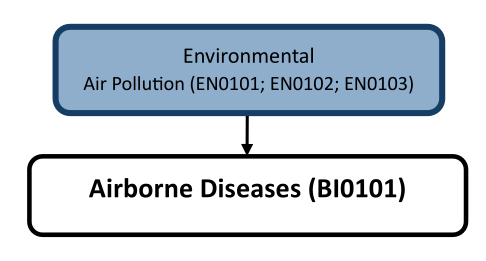
Group gatherings in enclosed spaces (e.g., classrooms, conferences) are an important route for the spread of respiratory diseases such as COVID-19. Among the different routes for the disease to spread, indoor activities (e.g., aeroplanes, cruise ships, bars, family gatherings, classrooms) have been characterized as potential super spreading events and such events were the major drivers of the COVID-19 pandemic (Dixit et al., 2023).
Risk Management
Airborne diseases pose significant challenges to global health. However, with awareness, education, and the implementation of preventive measures, the spread of these diseases can be mitigated. Vigilance, timely vaccinations, and adherence to hygiene protocols are essential in controlling and preventing the transmission of airborne diseases.
Infection prevention and control (IPC) is a practical, evidence-based approach to preventing patients and health workers from being harmed by avoidable infections (WHO, no date b). Effective IPC requires constant action at all levels of the health system, including policymakers, facility managers, health workers and those who access health services. IPC is unique in the field of patient safety and quality of care, as it is universally relevant to every health worker and patient, at every health care interaction. Defective IPC causes harm and can kill. Without effective IPC it is impossible to achieve quality health care delivery (WHO, no date b).
IPC and water, sanitation and hygiene (WASH) are central to public health emergencies, including outbreak response and containment. IPC also constitutes the foundations of safe essential health services and resilient communities and health systems, ensuring quality care, and protecting against health care-associated infections and anti-microbial resistance. The success of ensuring IPC measures are implemented for outbreak response, in health facilities and communities, is dependent upon maintaining IPC operational readiness to rapidly respond to cases and putting in place at least the IPC minimum requirements at the national and health care facility levels as soon as possible. Over the past decade, the landscape of respiratory viruses has evolved significantly, exemplified by the profound impact of the recent COVID-19 pandemic (WHO, 2024c).
Infection prevention and control (IPC) is a scientific approach and set of practices designed to prevent harm caused by infection to patients and health workers. Use of appropriate IPC measures is essential for the protection of patients, healthcare workers, and the wider community. Correct implementation of the necessary IPC measures is an essential aspect of safe and successful management of airborne diseases (WHO, no date b). IPC affects all aspects of health care, including hand hygiene, surgical site infections, injection safety, antimicrobial resistance and how hospitals operate during and outside of emergencies. Programmes to support IPC are particularly important in low- and middle-income countries, where health care delivery and medical hygiene standards may be negatively affected by secondary infections. Much of the work done on IPC is hidden, as by its nature it prevents issues rather than treating them after the fact (WHO, no date b).
The first WHO Global Patient Challenge laid the foundations for the IPC Global Unit, which works to support country capacity-building for IPC action. Through this programme, WHO provides technical assistance for developing local IPC policies and guidelines, performs in-country assessments, convenes meetings focused on guideline development and provides ongoing support for health care providers (WHO, 2005).
WHO also makes a global annual call to action for health workers through the SAVE LIVES: Clean Your Hands campaign held each May (WHO, no date c). This campaign seeks to educate health workers and patients on the importance of effective hand washing, the need for which has become more acute with the COVID-19 pandemic (WHO, no date c).
Vaccines are available for various airborne diseases, including measles and influenza, which reduce the risk of getting diseases by working with the body’s natural defences to build protection. The Global Vaccine Action Plan 2011–2020, endorsed by the 194 Member States of the World Health Assembly in May 2012, is a framework to prevent millions of deaths by 2020 through more equitable access to existing vaccines for people in all communities (WHO, 2013). The Global Vaccine Action Plan was the product of the Decade of Vaccines Collaboration, an unprecedented effort that brought together development, health and immunisation experts and stakeholders (WHO, 2013). The SAGE Global Vaccine Action Plan (GVAP) 2011-2020 review and lessons learned report, provides an overall assessment of the plan’s successes and challenges. It also proposed 15 recommendations for the development, content and implementation of the next decade’s global immunization strategy (WHO, 2020).
Monitoring
Various surveillance systems for individual airborne diseases are available.
For example, the globally coordinated surveillance of influenza, timely sharing of influenza virus data and associated information, and innovative research are key to addressing the problem of influenza. Global influenza surveillance has been conducted through the World Health Organization (WHO) Global Influenza Surveillance and Response System (GISRS) since 1952. GISRS is a system fostering global confidence for over half a century, through effective collaboration and sharing of viruses, data and benefits based on Member States' commitment to a global public health model (WHO, 2024b). The aim of GISRS is to protect people from the threat of influenza by functioning: as a global mechanism of surveillance, preparedness and response for seasonal, pandemic and zoonotic influenza; as a global platform for monitoring influenza epidemiology and disease; and as a global alert for novel influenza viruses and other respiratory pathogens (WHO, 2024b).
WHO supports countries to conduct all-hazards strategic risk assessment in the contexts of health emergencies and disasters, which results in the development of a country risk profile. Empowered with the country risk profile, inclusive of a seasonal risk calendar, countries can anticipate potential emergencies before they occur to trigger early alerts and inform early actions (WHO, 2021).
WHO's Early Warning, Alert and Response System (EWARS) has been designed to improve disease outbreak detection in emergency settings, such as in countries in conflict or following a natural disaster. It is a simple and cost-effective way to rapidly set up a disease surveillance system. EWARS is deployed during an emergency as an adjunct to the national disease surveillance system. WHO works with Ministries of Health and health sector partners to train local health workers to use the system. After the emergency, EWARS should re-integrate back into the national system (WHO, no date a).
References
Ather B., Mirza, T.M., Edemekong, P.F., 2025. Airborne Precautions. 2023 Mar 13. In: StatPearls [Internet]. Treasure Island (FL): StatPearls Publishing; 2025 Jan–. PMID: 30285363. Accessed 26 March 2025.
Cole, L., Kramer, P.R., 2015. Bacteria, Virus, Fungi, and Infectious Diseases. Human Physiology, Biochemistry and Basic Medicine. 2016:193–6. doi: 10.1016/B978-0-12-803699-0.00040-2. Epub 2015 Oct 30. PMCID: PMC7173549. Accessed 26 March 2025.
Dixit ,A.K., Espinoza, B., Qiu, Z., Vullikanti, A., Marathe, M.V., 2023. Airborne disease transmission during indoor gatherings over multiple time scales: Modeling framework and policy implications. Proc Natl Acad Sci U S A. 2023 Apr 18;120(16):e2216948120. doi: 10.1073/pnas.2216948120. Epub 2023 Apr 10. PMID: 37036987; PMCID: PMC10119995. Accessed 24 May 2025.
WHO, 2005. Launch of the Global Patient Safety Challenge: Clean Care is Safer Care. World Health Organization (WHO). Accessed 25 May 2025.
WHO, 2013. Global Vaccine Action Plan 2011-2020. World Health Organization (WHO). Accessed 24 May 2025.
WHO, 2016. International Health Regulations (2005), 3rd ed. World Health Organization (WHO). Accessed 26 March 2025.
WHO, 2020. Global Vaccine Action Plan Monitoring, Evaluation & Accountability: Secretariat Annual Report 2020. World Health Organization (WHO). Accessed 13 February 2025.
WHO, 2021. Strategic toolkit for assessing risks (STAR): a comprehensive toolkit for all-hazards health emergency risk assessment. World Health Organization (WHO). Accessed 13 February 2025.
WHO, 2024a. Global technical consultation report on proposed terminology for pathogens that transmit through the air. World Health Organization (WHO). Accessed 24 May 2025.
WHO, 2024b. Influenza: Global Influenza Surveillance and Response System (GISRS). World Health Organization (WHO). Accessed 26 March 2025.
WHO no date a. Early Warning, Alert and Response System (EWARS). World Health Organization (WHO). Accessed 26 March 2025.
WHO, no date b. Infection Prevention and Control. World Health Organization (WHO). Accessed 26 March 2025.
WHO, no date c. World Hand Hygiene Day SAVE LIVES: Clean Your Hands. World Health Organization (WHO). Accessed 24 May 2025.