
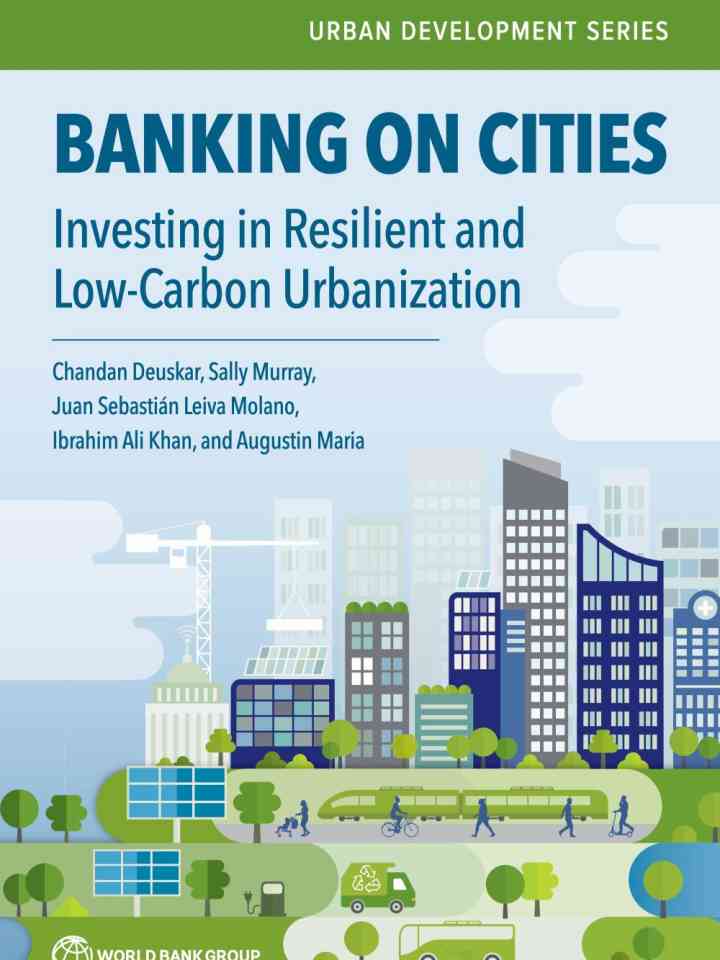
Banking on cities: Investing in resilient and low-carbon urbanization
Source
The publication provides an assessment of key resilient and low-carbon investment costs in major urban sectors in all low- and middle-income countries to 2050These include investments in urban transportation, energy-efficient buildings, solid waste management, water and wastewater, flood protection, and heat resilience.
Some of the key take away from the publication include:
- Local governments can improve their funding flows, investment efficiency, and financing readiness to make investments in resilient, low-carbon urban development more achievable. They can
- Improve the capture of direct revenues (for example, user fees) and indirect benefits (for example, increased land values and monetized emission reductions) from resilient and low-carbon investments.
- Integrate resilience and low-carbon goals into investment planning and build technical capacity to prepare investments.
- Raise investment efficiency by using data to target and optimize investments, aligning private incentives with climate goals, and steering efficient spatial growth through investment location decisions and land use policies.
- Enhance their creditworthiness and build their financial expertise.
- Groups of local governments can pool their smaller infrastructure projects to leverage economies of scale to make investments more attractive to private financiers.
- National governments have a critical role to play.
- National technical assistance can enable cities to prepare, implement, fund, and finance climate-smart investments effectively.
Explore further
Themes
Urban risk and planning
ISBN/ISSN/DOI
978-1-4648-2223-0 (ISBN)
Number of pages
172 p.
Publication year
2025