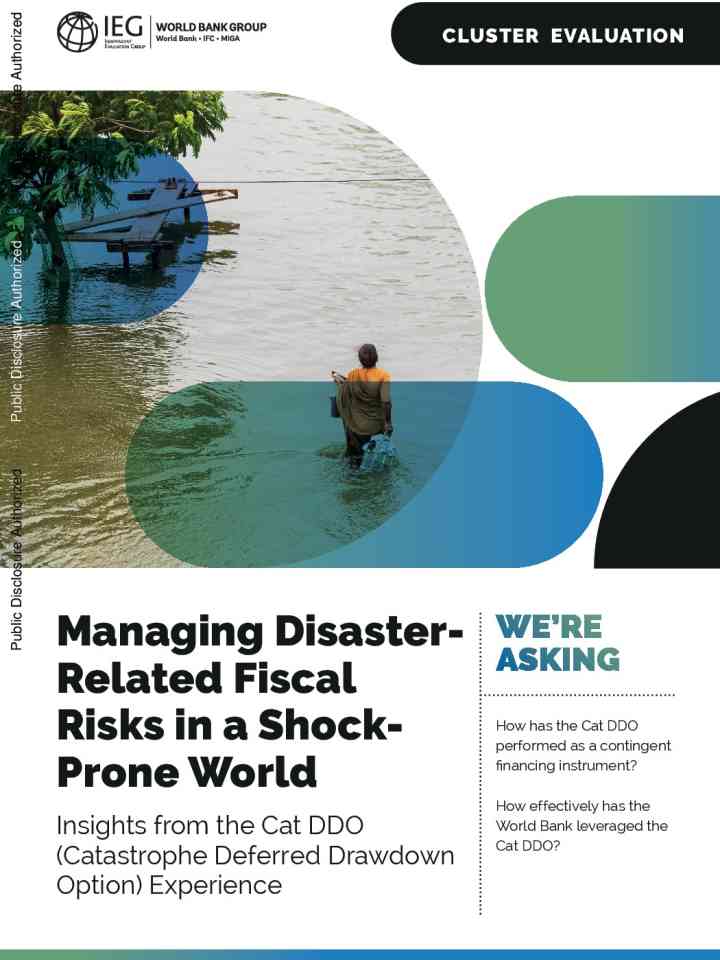
Managing disaster-related fiscal risks in a shock-prone world: Insights from the Cat DDO (Catastrophe Deferred Drawdown Option) experience
This evaluation addresses gaps related to the catastrophe deferred drawdown option (Cat DDO). espite its growing adoption, empirical evidence on the Cat DDO’s effectiveness remains limited, particularly regarding its role in post-disaster financing and its influence on broader fiscal risk management (FRM). Disasters have become a growing source of fiscal risk, particularly for developing economies, with annual global losses exceeding $180–200 billion and total costs surpassing $2 trillion when indirect impacts are included (UNDRR, 2025). Governments frequently finance disaster response through budget reallocations, reserve drawdowns, or emergency borrowing, often exacerbating fiscal stress and debt vulnerabilities.
The World Bank’s catastrophe deferred drawdown option (Cat DDO) was designed to address this challenge by providing rapid, prearranged liquidity following disasters while promoting stronger fiscal preparedness. As a contingent credit line triggered by events such as a state of emergency declaration, the Cat DDO is also linked to policy actions that typically support improvements in disaster risk management (DRM), positioning it as both a financing instrument and a mechanism for building institutional capacity. This evaluation uses a case-based causal approach across four countries—Malawi, the Philippines, Romania, and St. Vincent and the Grenadines—drawing on document review, interviews, and cross-case analysis to assess performance, identify enabling conditions, and examine the World Bank’s support in strengthening disaster-related FRM.
Explore further