Wildfires have created instability within risk transfer markets. Here’s a path forward
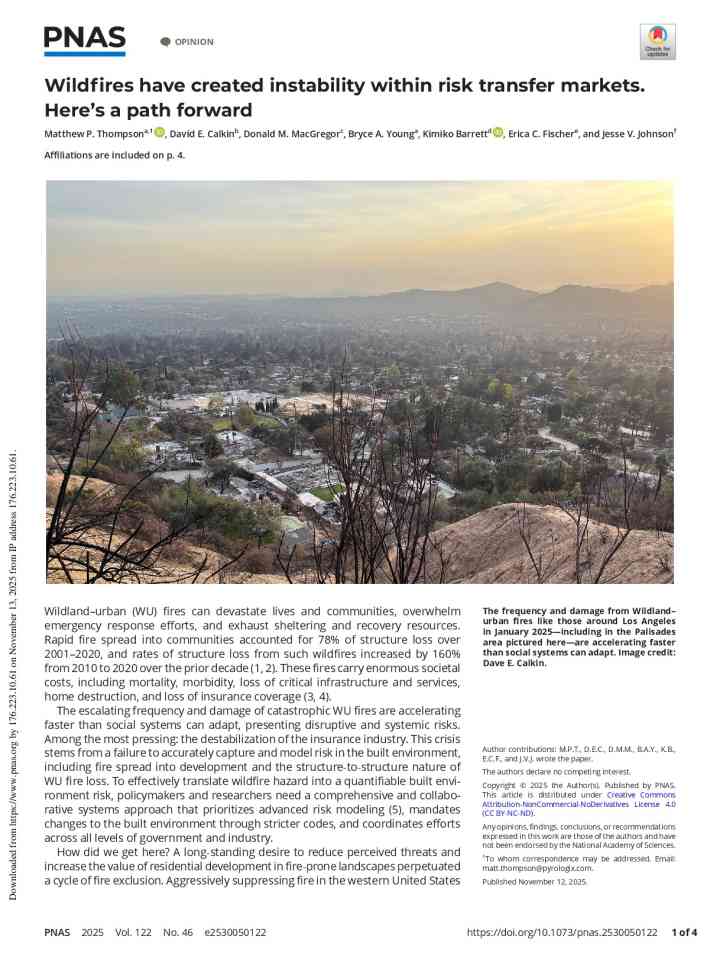
This study finds that most risk models and data are for wildfires, but Wildland-Urban (WU) fires are different because vulnerabilities propagate and compound losses—the structures and nearby vegetation become the primary fuel sources driving the fire’s expansion. That makes risk in these extreme events harder to assess, as it depends on a complex interplay of hazards, exposures, and vulnerabilities through structure-to-structure ignition. Assessing WU fire risk requires information that is not available.
For enhanced understanding of WU risk to translate into effective risk management, a much broader set of issues beyond data, science, technology, and engineering must be addressed. The authors argue that a systems approach is necessary, beginning with improving linkages between entities working in this space and understanding the built environment as a system with complex interacting hazards and vulnerabilities. To effectively address WU fire risk, a comprehensive, multisector effort is needed, involving collaboration from local to federal levels and across both public and private sectors.
Explore further