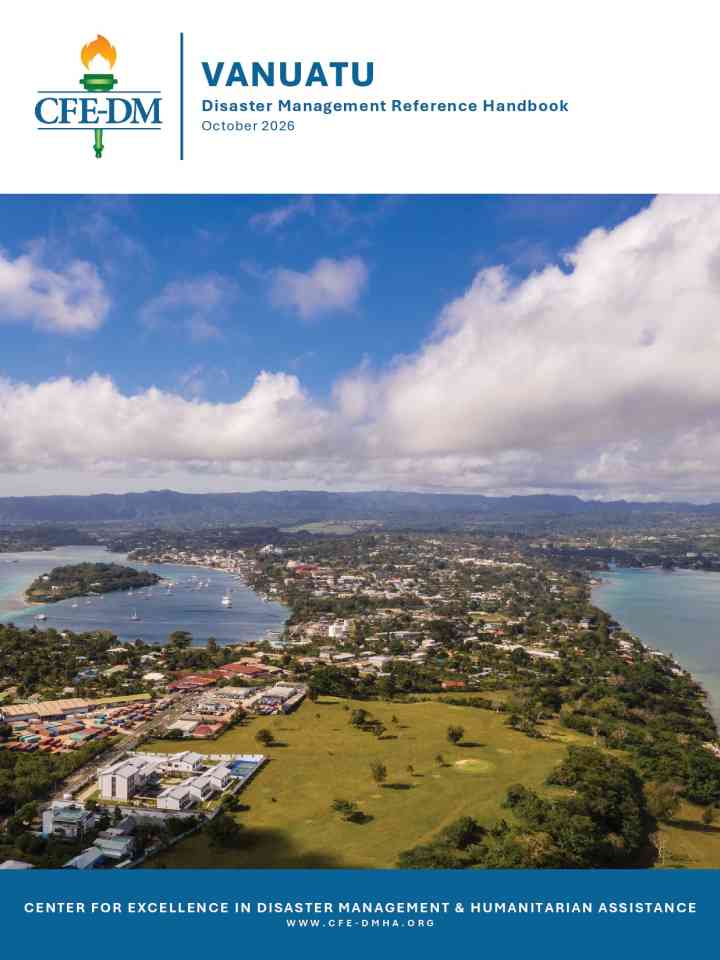
Vanuatu: Disaster management reference handbook
This Disaster Management Reference Handbook provides a comprehensive profile of Vanuatu’s national DM structure, policies, plans, and institutions, as well as background information on the country, its natural hazards, and details of past cooperation with international partners for disaster preparedness and response. Vanuatu consistently ranks near the top of countries with the highest natural disaster risk in the world, based on factors related to exposure to a range of natural hazards, societal vulnerability, and coping capacity. The risk natural hazards pose is compounded by the country’s location, dispersed island geography and population, fragmented infrastructure, limited natural resources, fragile economy, and disaster management (DM) capabilities that are resource constrained. Most of Vanuatu’s population live in rural areas across 65 inhabited islands, a settlement pattern that is a challenge to humanitarian access. Outside of the country’s two urbanized areas, Port Vila and Luganville, responders must be prepared to work in an environment that is logistically constrained.
Vanuatu has significantly strengthened its DM architecture in recent years. The DRM Act of 2019 provided a comprehensive legal basis for DRR, preparedness, response, subnational coordination, and accessing international assistance. Under the law, NDMO and the NEOC are central to preparedness and emergency response. Meanwhile, much of Vanuatu’s DM capacity remains inherently local. Ultimately, Vanuatu’s DM system is strongest when local knowledge and action, national coordination, and international support reinforce one another. For outside responders, the task is not to recreate that system when a disaster occurs.
Explore further