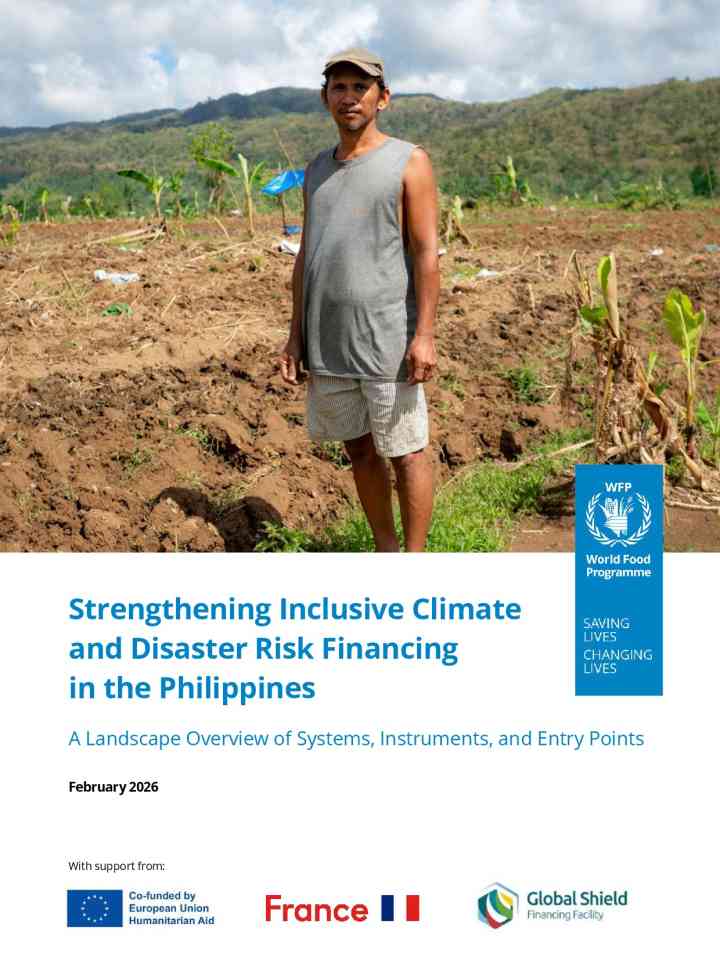
Strengthening inclusive climate and disaster risk financing in the Philippines: A landscape overview of systems, instruments, and entry points
This publication outlines the evolving landscape of climate and disaster risk financing and insurance (CDRFI) in the Philippines, emphasising its central role in strengthening disaster risk reduction, food system resilience, and support for vulnerable populations. It presents an overview of why predictable, pre‑arranged financing is essential for mitigating the impacts of typhoons, floods, droughts, and other hazards, and explains how risk layering, legal reforms such as RA 12287, and ongoing updates to the National Disaster Risk Financing and Insurance Strategy shape the national approach. The report describes the current mix of macro‑, meso‑ and micro‑level financial instruments, the institutional and data challenges that hinder timely delivery, and the opportunities for integrating CDRFI with social protection and local government systems.
The publication recommends strengthening policy coherence, institutional alignment, and operational capacity to ensure that risk financing reaches households and food system actors quickly and predictably. It calls for clearer mandates across finance, insurance, agriculture, social protection, and disaster management institutions; improved interoperability of hazard, exposure, and loss data; and expanded use of anticipatory and pre‑disaster financing mechanisms. The report further encourages testing and scaling innovation models—such as end‑to‑end fund‑flow simulations, linked agricultural insurance and credit schemes, and the use of social protection systems as delivery channels—to generate practical evidence and enhance system readiness.
Explore further