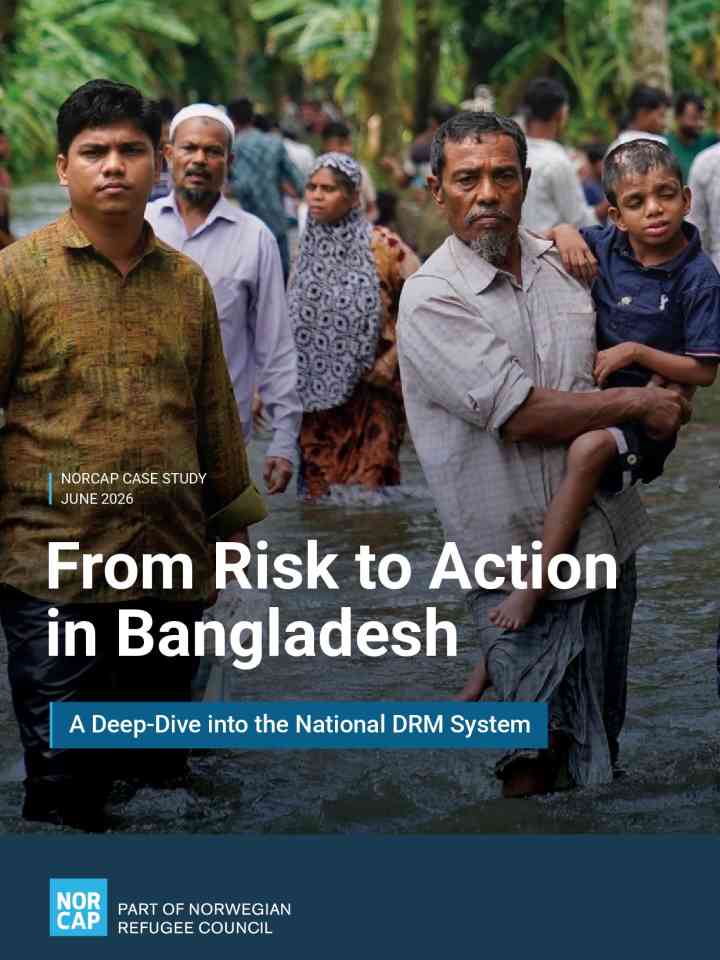
From risk to action in Bangladesh: A deep-dive into the National DRM system
This study applies NORCAP’s regional scoping framework, a risk-to-action chain that follows risk as it moves through a system from information, to decisions, to finance, to action, to impact. The framework’s premise is that in an institutionally mature country, the most consequential weaknesses are rarely found inside any single stage; they tend to emerge at the interfaces between them, where risk information must hand off to decisions, decisions to financing, and financing to delivery. The analysis examines these handoffs through three lenses: whether risk information is decision-grade, what anticipatory action reveals when used as a system stress test, and whether current arrangements are fit for compound and slow-onset risks rather than only the cyclones and floods Bangladesh manages well.
The paper concludes that Bangladesh does not need another conceptual framework for DRM; it needs stronger conversion at the interfaces of the framework it already has.
- Make risk information decision-grade, not just technically sound
- Treat anticipatory action as a governance reform tool, not only a project modality
- Expand pre-arranged finance through public systems and social protection
- Operationalize SOD at the local level through readiness, drills and measurable accountability
- Continue the transition from single hazard management to comprehensive risk management
Explore further