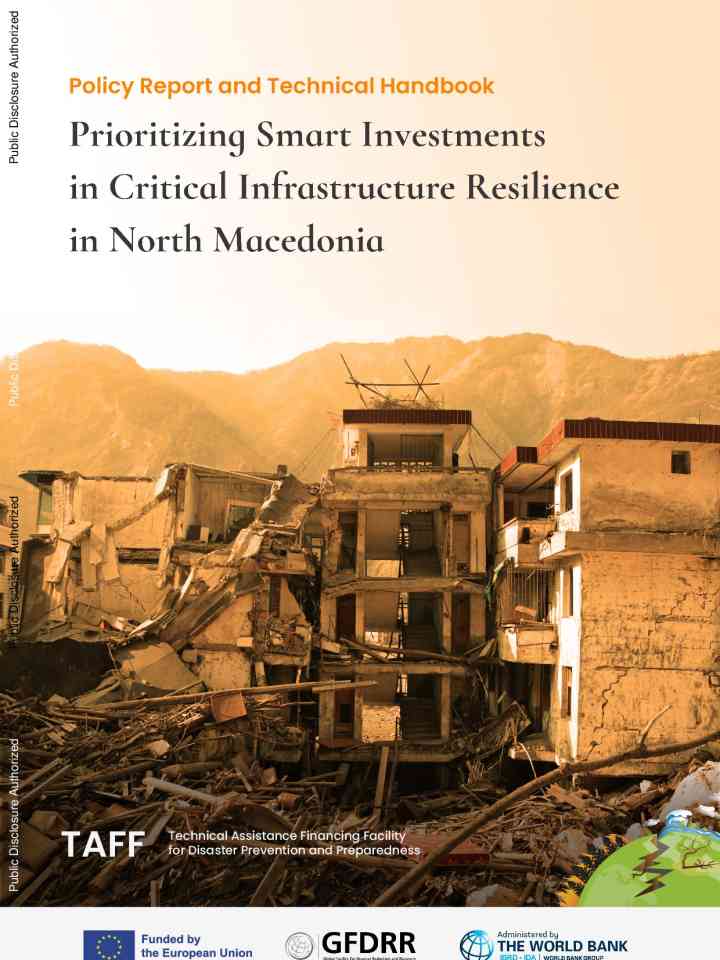
Prioritizing smart investments in critical infrastructure resilience in North Macedonia: a policy report and technical handbook
This report presents a scalable, data-driven methodology to help North Macedonia transition from reactive crisis management to proactive risk reduction and investment planning. The framework enables public authorities to transform asset registries into an economically justified investment pipeline through a practical, risk-informed approach that can be implemented using portfolio screening workbooks and, in the future, integrated into advanced digital tools, including AI-supported rapid screening and automated risk detection technologies. The assessment applies a three-stage methodology comprising: (i) portfolio-scale seismic rapid screening using “traffic light” risk categories, (ii) a semi-quantitative multi-criteria analysis (MCA) incorporating compounding hazards and critical operational indicators, and (iii) a benefit-cost analysis (BCA) based on the Triple Dividend of Resilience (TDR).
The study delivers a rapid, data-driven prioritisation of critical public assets, including fire stations, PRD offices, and primary and secondary schools, at both national and local levels. From an initial portfolio of 532 assets assessed for exposure to seismic and climate-related hazards, 277 assets underwent detailed risk-informed screening and prioritisation. At the municipal level, 17 assets in Gazi Baba and 22 assets in Bitola were evaluated, producing preliminary priority lists for further assessment. Although data limitations restricted the application of the BCA at the national level and yielded only partial local-level results, an Excel-based screening tool has been developed to support future quantitative analyses as data availability improves. The assessment demonstrates that rapid, risk-informed screening can provide an effective basis for resilience-focused decision-making and can be scaled up to support broader infrastructure investment planning.
Explore further