
Predictive preparedness and recurrent shock reduction in Somalia: The roles of adaptive governance and institutional fragmentation
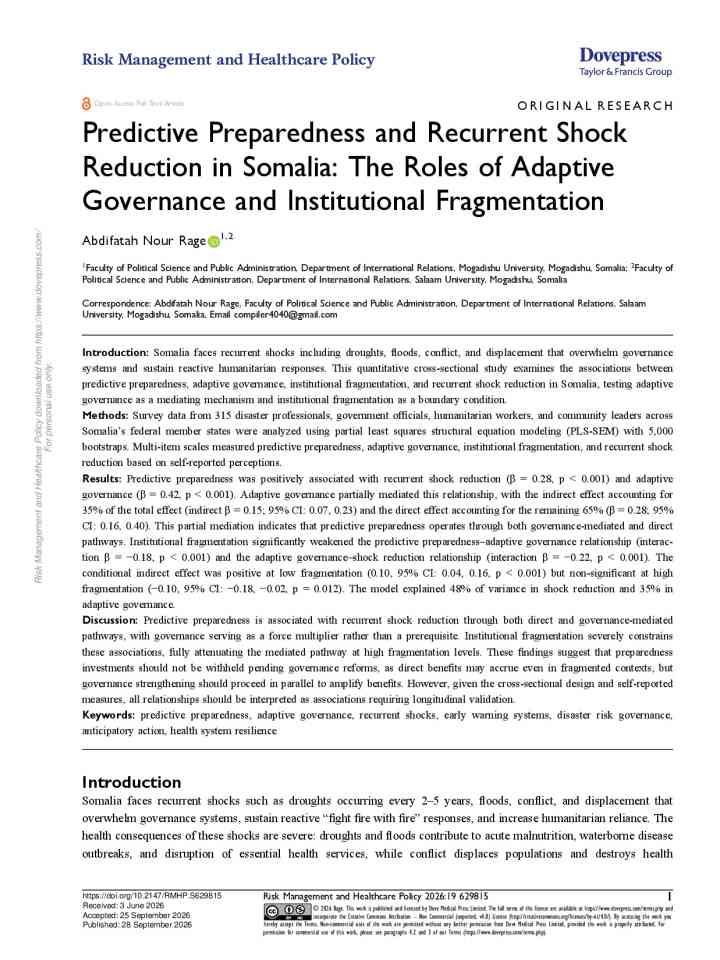
This paper examines the associations between predictive preparedness, adaptive governance, institutional fragmentation, and recurrent shock reduction in Somalia through a quantitative, cross-sectional study. Survey data were collected from 315 disaster professionals, government officials, humanitarian workers, and community leaders across Somalia's federal member states. The study focuses on Somalia due to its recurrent shocks, fragmented governance, and expanding early warning systems.
Key findings include:
- Predictive preparedness was positively associated with recurrent shock reduction, and with adaptive governance.
- Adaptive governance partially mediated the relationship between predictive preparedness and recurrent shock reduction, with the indirect effect accounting for 35% of the total effect, and the direct effect for the remaining 65%.
- Institutional fragmentation significantly weakened both the predictive preparedness–adaptive governance and adaptive governance–shock reduction relationships.
- At low fragmentation, the conditional indirect effect was positive but non-significant at high fragmentation.
- The authors recommend that "preparedness investments should not be withheld pending governance reforms, as direct benefits may accrue even in fragmented contexts, but governance strengthening should proceed in parallel to amplify benefits."
Explore further
Themes
Preparedness
Governance
Country and region
Somalia
ISBN/ISSN/DOI
10.2147/RMHP.S629815 (DOI)
Number of pages
31 p.
Publication year
2026