Precipitation observing network gaps limit climate change impact assessment
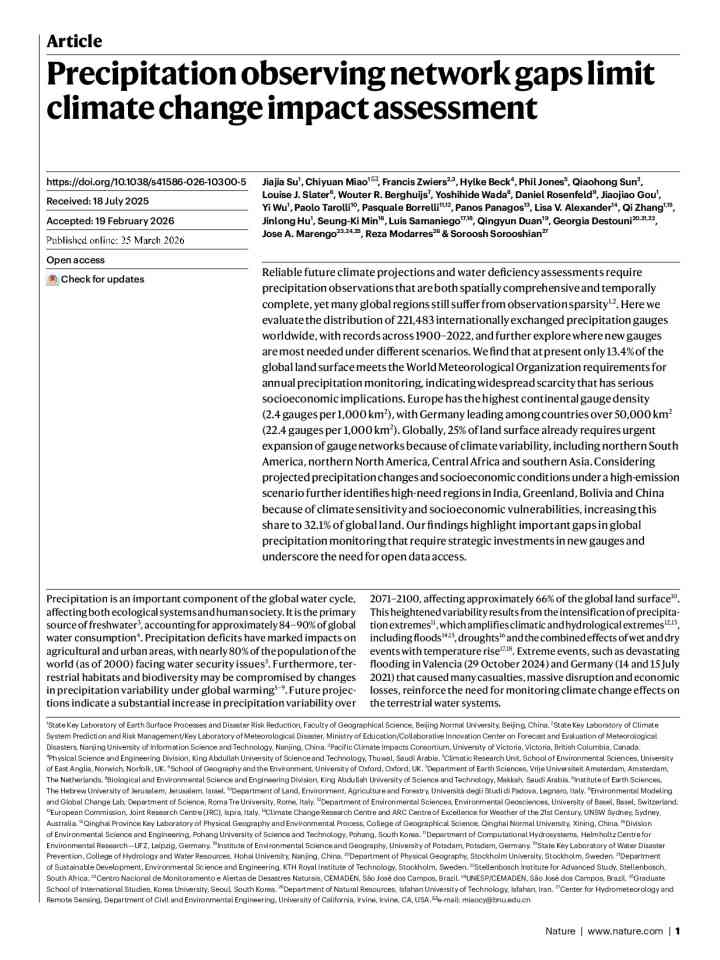
The article shows that the global network of precipitation gauges is far too sparse to reliably monitor climate change and water risks. Despite the critical role of precipitation in water supply, agriculture, and extreme events like floods and droughts, only 13.4% of global land meets World Meteorological Organization standards for monitoring, and just 1.9% meets standards for long-term data. Large regions—particularly in Africa, South America, and parts of Asia—lack sufficient coverage, and about a quarter of the world already urgently needs more gauges, rising to over 30% under high-emissions climate scenarios. These gaps are driven by declining station coverage since the 1980s, limited data sharing, and uneven investment, and they significantly weaken climate models, early warning systems, and risk assessments. The study identifies priority areas for new monitoring, including tropical regions with high rainfall variability, rapidly changing high-latitude regions, and vulnerable urban areas, while emphasizing that future climate change and socioeconomic pressures will further increase the need for dense, reliable observation networks. Overall, the paper argues that expanding and improving global precipitation monitoring—along with better data access—is essential for accurate climate science and effective disaster risk reduction.
Explore further