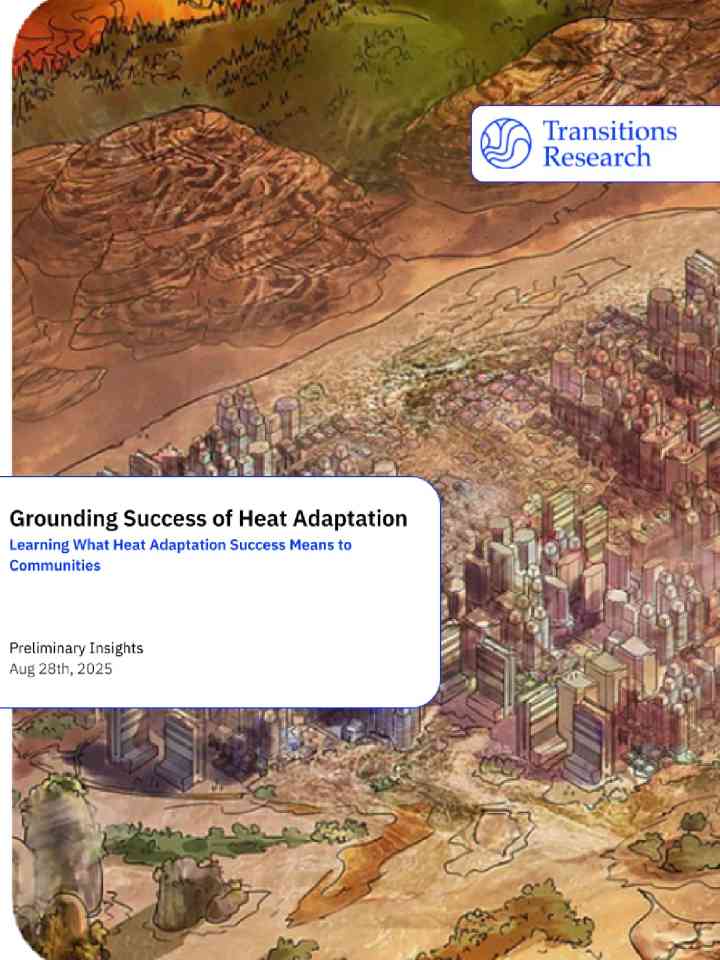
Grounding success of heat adaptation: Learning what heat adaptation success means to communities
This publication explores how success in heat adaptation should be defined, measured, and evaluated by centering the lived experiences of communities most affected by extreme heat. It highlights findings from workshops convened by Transitions Research and the Adaptation Research Alliance, which brought together practitioners, researchers, and community representatives to discuss new ways of assessing adaptation outcomes. The report emphasizes that traditional monitoring and evaluation approaches often miss what communities value most—such as comfort, safety, agency, and equity—because they focus on easily measurable outputs like infrastructure or attendance rather than meaningful, long-term outcomes.
The discussions revealed a growing consensus that success in heat adaptation must shift from event-based, technocratic metrics to systems-oriented, community-led approaches. Participants identified key principles for rethinking evaluation, including valuing subjective and perception-based data, embedding equity in assessment frameworks, and emphasizing legitimacy, ownership, and sustainability of interventions. The publication calls for integrated, cross-sectoral metrics that capture co-benefits such as health, productivity, and climate mitigation. It concludes with an invitation to researchers and practitioners to collaborate in building a community of practice that advances community-driven evaluation systems—transforming monitoring and evaluation into a learning process that strengthens adaptive capacity over time.
Explore further