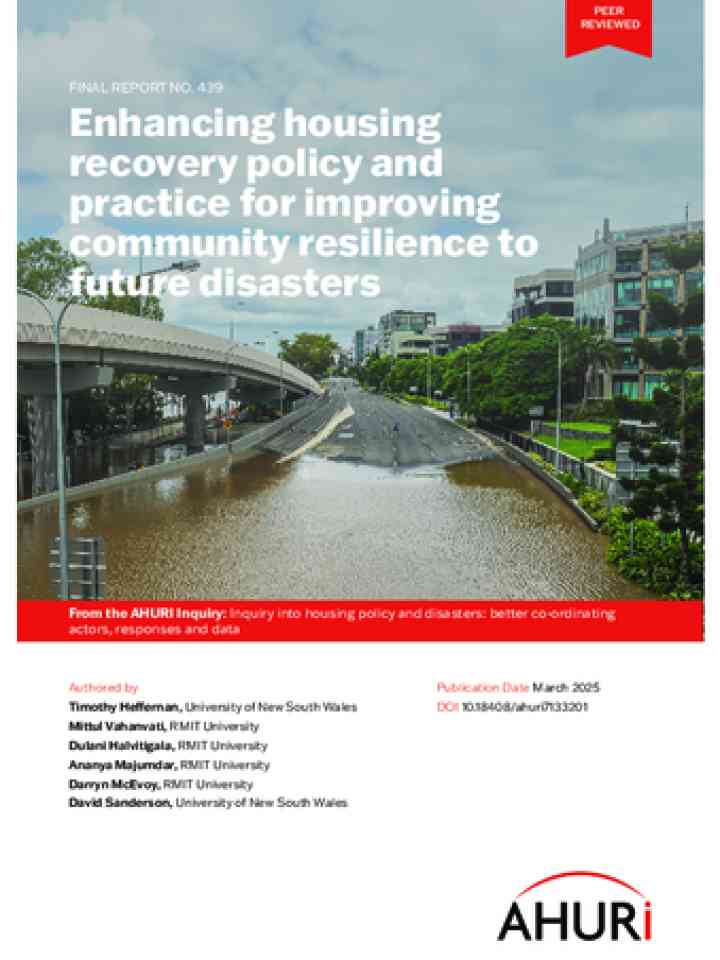
Enhancing housing recovery policy and practice for improving community resilience to future disasters
This research explores the housing policies that can improve community preparedness and responses to disasters. This research is part of the AHURI Inquiry, Housing policy and disasters: better co-ordinating actors, responses and data. The threat to housing in Australia from hazards such as bushfires, floods and cyclones is increasing, with replacement costs escalating. A Climate Council of Australia report found that one in 25 Australian homes (around 500,000 homes) is at high risk of becoming effectively uninsurable by 2030. This means new short-term relief strategies and longer-term housing recovery solutions need to be developed.
The research examined seven case studies of disaster recovery (from bushfire, flood and cyclones) in Australia. It found effective housing policies need to provide immediate responses, such as relief and temporary housing; as well as future-focused responses, such as ensuring communities are better prepared for disasters, and taking steps to prevent and mitigate their impacts. They combine technical responses (such as land use planning and building design), social resilience (citizen inclusion), cross-sector collaboration, financial resources and political support.
- All levels of Australian government have a role in responding to disasters
- Flood-affected residents experienced more issues with their temporary and permanent housing assistance than residents who were affected by bushfires.
- Providing housing that is effective, timely and equitable is a significant challenge. Options depend on the existing mix of housing, accommodation and modular structures in a region or that can be quickly obtained. Community diversity and unique needs add further complexity, meaning planning and review are essential.
- The insurance industry plays an important role: Housing reconstruction costs have historically been covered by the insurance sector. However, underinsurance is a challenge and is likely to increase. More frequent floods and bushfires will lead to home insurance premiums that are unaffordable to many (or in the most at-risk areas, no longer available).
Explore further