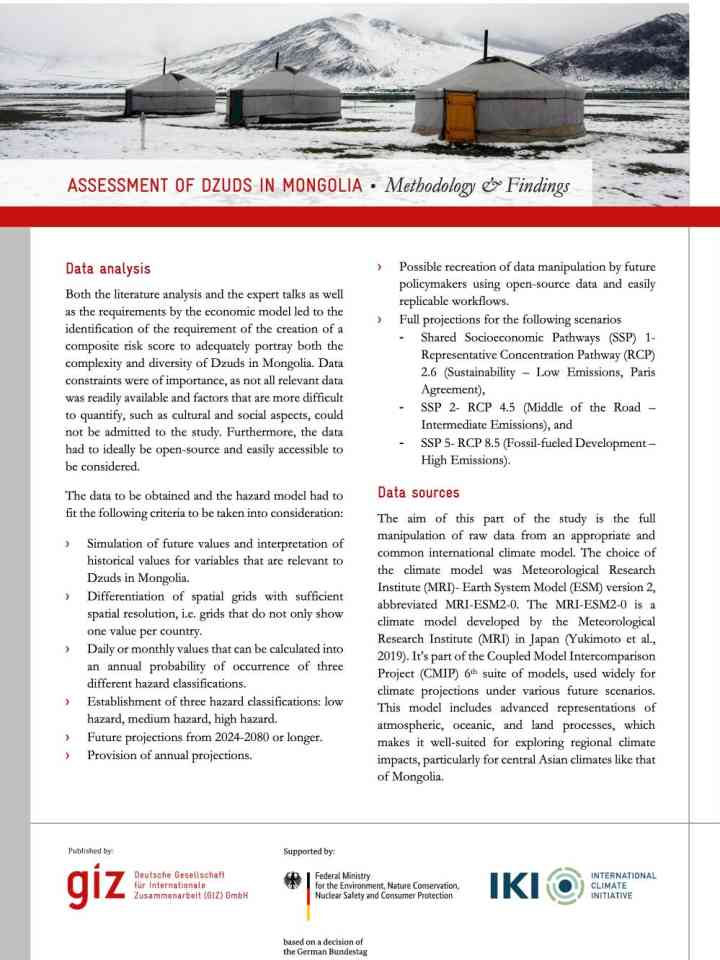
Assessment of dzuds in Mongolia
This technical report presents the methodology for analysing the probability of occurrence and severity of dzuds in Mongolia as well as findings for the period 2024-2100. The reasoning behind drought and temperature having a slightly higher weighting is that these are commonly referred to as the two main drivers of dzud.
The findings correspond to international projections and estimations that dzuds will deteriorate in Mongolia, in particular if global efforts are not increased to fight the effects of climate change, which can be seen for the SSP5-8.5 scenario in the second half of the century. The effects become particularly visible beyond 2050 due to cumulative emissions and delayed responses in climate system. Furthermore, there exists an assumption that the rising temperatures forecasted in SSP5-8.5 lead to a decrease in dzud risks in the shorter term, but this effect is drastically overturned in the second half of the century.
Explore further