
United Nations Office for South-South Cooperation
UNOSSC
UN & International Organizations
Mission
The UN Office for South-South Cooperation:
- Mainstreams South-South cooperation across the UN system and throughout the international development community by leveraging its global reach as well as its policy and institutional capacities to assist UN agencies and developing countries in strengthening their South-South cooperation capacities. It works to support countries’ efforts to manage, design and implement South-South cooperation policies and initiatives through the identification, sharing and transfer of successful Southern-generated development solutions. It also advocates for Support to South-South initiatives, including through its organization of the UN Day for South-South cooperation;
- Engages a wide range of partners, including Member States, UN entities, multilateral bodies and private-sector and civil society organizations in order to provide the most efficient, effective and comprehensive support for South-South cooperation;
- Innovates by continually seeking, showcasing and transferring forward-thinking Southern development solutions to development partners to meet the critical development challenges of today;
- Enables countries of the South – emerging, middle income and least developed – to work together to use their wealth of resources, tangible and intangible, in support of national, regional and global development efforts;
- Serves as the secretariat to the High-level Committee (HLC) on South-South Cooperation, a subsidiary body of the General Assembly, which provides policy directives and guidance and reviews worldwide progress in South-South cooperation. In this context, it monitors trends in South South cooperation among UN agencies as well as globally, preparing reports for various intergovernmental bodies, including the report of the Secretary-General on the state of South-South cooperation; and
- Manages the UN Fund for South-South Cooperation and the Pérez-Guerrero Trust Fund for Economic and Technical Cooperation among Developing Countries.
Items: 15
The training aims to provide a foundation for engaging multi-level governments and diverse stakeholders, particularly the most at-risk groups in disaster risk reduction, health emergency, and disaster risk management.
This training aims to build the capacities of urban practitioners and stakeholders to understand and apply practical tools and approaches that support more resilient, risk-informed, inclusive, and health-prepared urban environments.
This training provides an opportunity for local authorities and urban development practitioners to mutually learn and share experience in transitioning to managing complex risks and a resilient future.
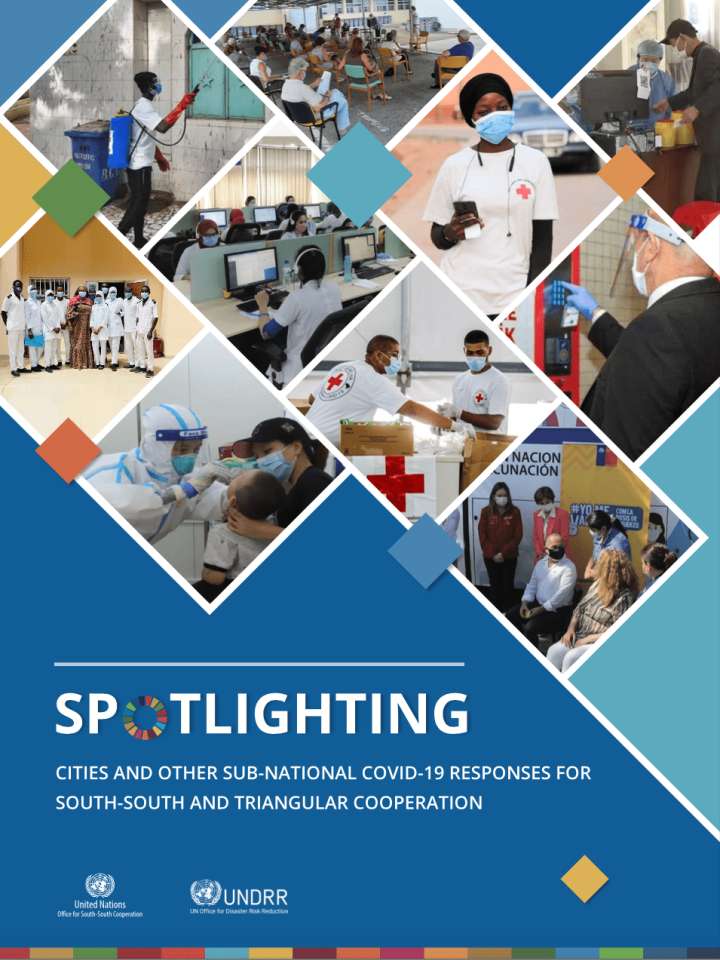
Spotlighting the Innovative Experiences of Cities in Action for COVID-19 Responses (UNOSSC-UNDRR, 2022) is a knowledge product on the experiences of provinces, cities, districts, and communities of the Global South responding to the COVID-19 pandemic.
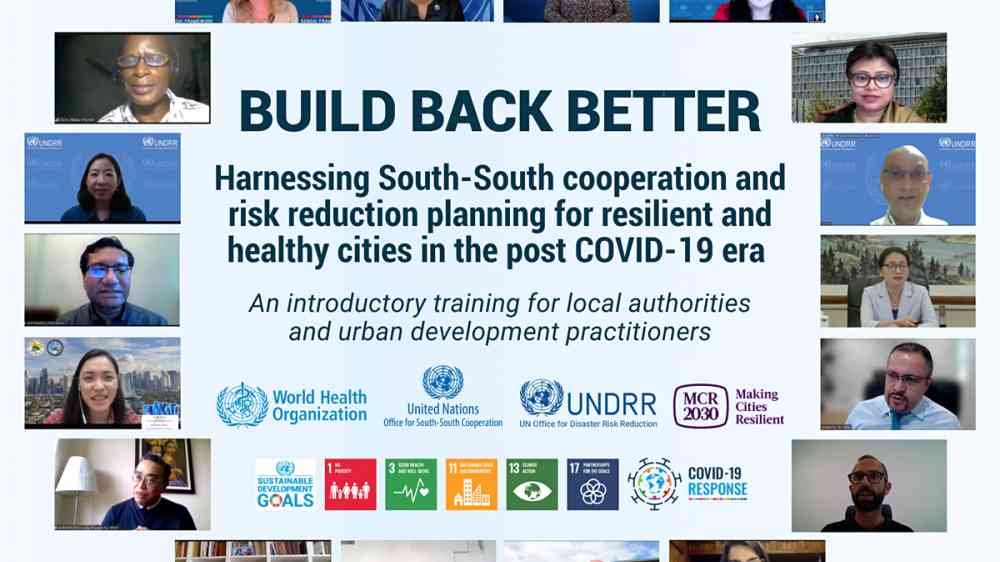
Geneva, Switzerland/ New York, USA / Incheon, Korea
Date and Time
8 – 29 June 2021 (Tuesdays, 4 weeks)
7:30 am (New York) and 8:30 pm (Incheon)
This training provides an opportunity for local authorities and urban development practitioners to mutually learn and share experience in transitioning to managing complex risks and resilient future. It builds upon prior editions held in 2020 & 2021.
Course Background
Cities and their residents are at the epicentre of the COVID-19 pandemic. More than half of humanity live in urban settings.
Voluntary Commitments
The organization has no registered commitments.
The Sendai Framework Voluntary Commitments (SFVC) online platform allows stakeholders to inform the public about their work on DRR. The SFVC online platform is a useful toolto know who is doing what and where for the implementation of the Sendai Framework, which could foster potential collaboration among stakeholders. All stakeholders (private sector, civil society organizations, academia, media, local governments, etc.) working on DRR can submit their commitments and report on their progress and deliverables.