
Items: 6
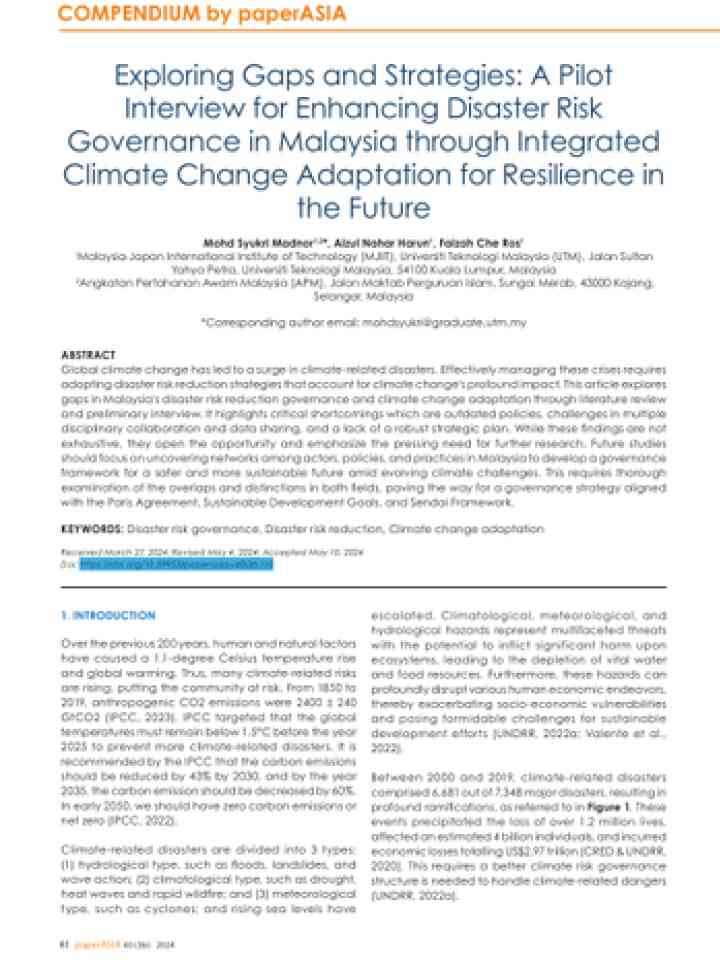
This article explores gaps in Malaysia's disaster risk reduction governance and climate change adaptation through literature review and preliminary interview.

The project “Strengthening the disaster risk reduction capacity to improve the safety and security of communities by understanding disaster risk (SeDAR)” in Malaysia was launched in June 2018.
Introduction
Disaster managers today are demanded to plan and implement evidence-based disaster risk management and risk reduction measures for building resilience of their communities and countries for sustainable development.
The Malaysia-Japan International Institute of Technology (MJIIT) of Universiti Teknologi Malaysia (UTM) Kuala Lumpur with the support of Japan International Cooperation Agency (JICA) will be organizing the UTM Disaster Risk Reduction Day
The MDRM programme develops Disaster Risk Management professionals with adequate set of skills, and utilizes its strong partnership with DRM-related agencies, NGOs and local governments.
APSEC 2009 is an international conference focusing on topics related to structural engineering and construction. The 1st APSEC conference was held in 1989 in the historical city of Malacca.
Voluntary Commitments
The organization has no registered commitments.
The Sendai Framework Voluntary Commitments (SFVC) online platform allows stakeholders to inform the public about their work on DRR. The SFVC online platform is a useful toolto know who is doing what and where for the implementation of the Sendai Framework, which could foster potential collaboration among stakeholders. All stakeholders (private sector, civil society organizations, academia, media, local governments, etc.) working on DRR can submit their commitments and report on their progress and deliverables.
Contact information
Fax:
+90-216 332 90 94