
Why a strong taxonomy matters for adaptation finance
Climate-related disasters are intensifying, while current emissions reductions are still not enough to limit global warming. Growing risks to infrastructure, ecosystems, and economies underscore the urgency of strengthening adaptation measures and bridging financing gaps.
Adaptation is essential for building resilience to physical climate risks. Key actions include investing in climate-resilient infrastructure, early warning systems, and sustainable agricultural practices. Long-term development planning should fully integrate climate resilience to ensure that both new and existing systems can endure mounting threats. Policymakers must adopt a holistic approach: acting at the upstream level when national climate strategies are designed or reviewed, at the midstream level as plans are translated into budgets and investments, and at the downstream level during project preparation and implementation.
Adaptation Finance Lagging Behind Mitigation and Actual Needs
The 2015 Paris Agreement called for balancing mitigation and adaptation finance. To address the heavy imbalance in climate finance, with mitigation accounting for around 90% of global flows in 2022, the Glasgow Climate Pact at COP26 urged developed countries to at least double their collective provision of adaptation finance to developing countries by 2025, compared to 2019 levels (approximately $19 billion-$20 billion). This would bring the annual target for adaptation finance to around $40 billion by 2025, though this still falls far short of estimated needs in developing countries.
Data on adaptation finance come from three main sources: the Climate Policy Initiative (CPI), the OECD's Development Assistance Committee (DAC), and the United Nations Environment Programme (UNEP). CPI captures the widest range of flows-public and private, domestic and cross-border-and reports that adaptation finance rose from $35 billion in 2008 to $76 billion in 2022. Yet this remains well below the $1.3 trillion for mitigation in the same year. DAC focuses on official cross-border flows to developing countries (including mobilized private capital), showing that adaptation finance reached $32.4 billion in 2022, up from $24.6 billion in 2021-still modest compared with $70 billion for mitigation. UNEP, based on DAC data but with a narrower adaptation definition, estimated adaptation finance at $28 billion in 2022, up from $22 billion in 2021. The table presents data from the three sources for 2021 and 2022.
Table: Adaptation Finance Data
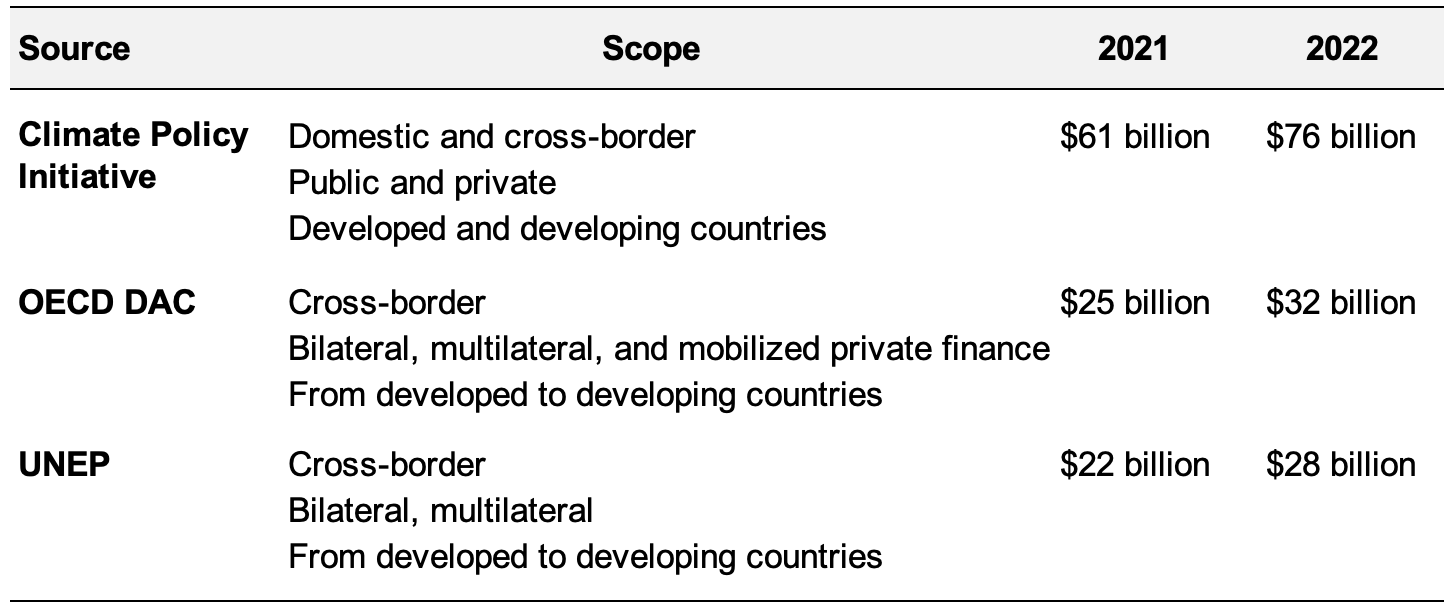
Source: Author
These figures contrast greatly with the estimated adaptation finance needs in developing countries, which are 10-18 times larger than current international public adaptation finance flows.
CPI projects annual investment needs of about $212 billion for 2024-2030 and $239 billion for 2031-2050. Given current finance levels, this implies an annual gap of around $136 billion. UNEP, meanwhile, estimates annual needs ranging from $187 billion to $359 billion. With actual finance at only $28 billion in 2022, the annual gap is estimated at $159 billion to $331 billion.
Need for National Adaptation Taxonomies
Significant gaps in adaptation finance persist. Private sector engagement remains limited because the benefits from adaptation materialize only after a disaster and in the form of avoided losses. This lack of clear and direct financial returns affects the bankability of such investments. Moreover, adaptation investments tend to have the characteristics of a public goods, limiting the private sector's ability to fully capture the benefits. As a result, the concept remains underdeveloped. Many public projects are not clearly recognized as adaptation efforts and often lack a strong focus on adaptation, reducing their effectiveness. To close this gap, well-defined conceptual frameworks are essential-not only to scale up finance but also to help the private sector identify viable solutions and investment opportunities.
The Intergovernmental Panel on Climate Change (IPCC)'s concept of representative key risks offers a useful framework for identifying cross-cutting climate threats and setting adaptation priorities at the national and subnational levels. A robust understanding of physical climate risks-drawing on the IPCC's framework of hazard, exposure, and vulnerability-is also vital for informed decision-making by both public and private actors.
Emerging global corporate disclosure standards, such as those developed by the International Sustainability Standards Board, are beginning to incorporate physical risk and adaptation considerations. However, adaptation-related disclosures remain more fragmented and location-specific than those related to mitigation-largely due to the absence of universally accepted metrics (such as for greenhouse gas emissions) and methodologies (such as the Greenhouse Gas Protocol). Here, the IPCC's conceptual model offers a valuable foundation for assessing physical climate risks. Further guidance is needed to help companies apply these concepts effectively under evolving disclosure regimes. Stronger disclosure practices will better protect entities against physical climate risks and encourage the private sector to contribute to more resilient economies.
Taxonomies can also play a central role in aligning financial flows with adaptation goals. Building on the EU Taxonomy, the Climate Bonds Initiative is developing a Resilience Taxonomy and certification frameworks. While these efforts offer valuable direction for scaling up adaptation finance, they also face common challenges, including limited data availability, difficulties in assessing adaptation outcomes, and the need for consistency across sectors and jurisdictions. Continued dialogue and refinement of these frameworks will be essential.
Given the highly context-specific nature of physical risks, and the perception that adaptation investments yield limited returns, national governments must take the lead in setting adaptation goals, formulating structured adaptation plans, and coordinating investments. Strengthening global climate resilience will require transparent and measurable criteria for assessing physical climate risks, increased adaptation finance, and greater sharing of solutions and best practices across countries.