1. Home
  2. Knowledge Base | PreventionWeb
  3. Themes

Inclusion

Ensuring an all-of-society engagement and partnership for DRR through empowerment and inclusive, accessible and non-discriminatory participation, paying special attention to people disproportionately affected by disasters, especially the poorest.

Here are five ways countries ensure persons with disabilities are not left behind when the next disaster strikes.

Latest Inclusion additions in the Knowledge Base

Uploaded on
Documents and publications

Southasiadisasters.net issue no. 125 - February 2015:

This issue focuses on the important theme of children, cities and disasters in India. It tries to highlight all the aspects of building the resilience of children, especially in urban centres to the

All India Disaster Mitigation Institute
Update

Under a new 15-year action plan adopted in Sendai, the governments of more than 180 countries agreed on seven global goals aimed at 'substantially' reducing global disaster mortality, victims and economic losses in terms of global gross domestic product by 2030...

Japan Times Ltd., the
Update

UNICEF supports a post 2015 framework on disaster risk reduction that puts children at the centre of its agenda. 'Global experience shows that the impact of disasters is felt most in the poorest and most disadvantaged countries ― and by the poorest and most disadvantaged people – particularly children - within these countries.'

United Nations Children's Fund (UNICEF)
Update

The outcome document aligns with many of the positions the International Federation of Red Cross and Red Crescent Societies (IFRC) has been advocating; it promotes coherence across systems, sectors and organizations related to sustainable development; recognizes that climate change is one of the drivers of disaster risk; and reaffirms the importance of international cooperation and partnerships...

International Federation of Red Cross and Red Crescent Societies (IFRC)
Update

'Our partnership will engage with governments and municipalities for a better urban planning to meet the needs of communities. The MoU signed today is an important milestone in our common efforts for healthier, safer and more resilient communities,' said Elhadj As Sy, IFRC Secretary-General...

International Federation of Red Cross and Red Crescent Societies (IFRC)
Update

'Disasters, many of which are exacerbated by climate change and (are) increasing in frequency and intensity, significantly impede progress towards sustainable development,' the Sendai framework said. 'It is urgent and critical to anticipate, plan for and reduce disaster risk in order to more effectively protect persons, communities and countries… and thus strengthen their resilience,' it added...

World Economic Forum (WEF)
Update

'Young people and children are not coming to [intergovernmental negotiations] to be cool,' said Ahmad Alendhawi, UN Special Envoy for Youth, explaining that boosting youth participation has been a major shift in the way the United Nations is doing business...

United Nations News Centre
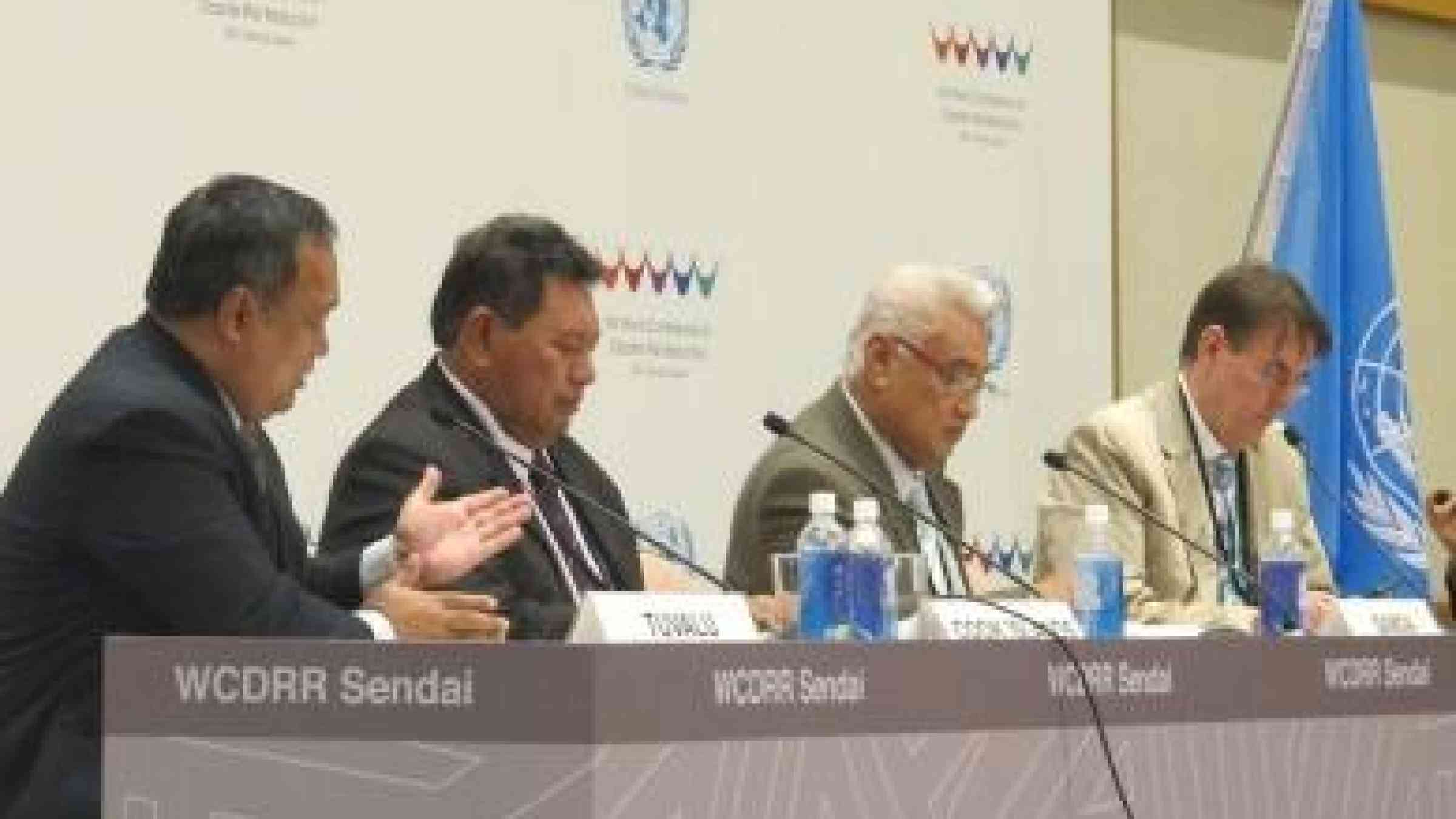
by UN/Nan Zehng Pacific Island leaders brief press at Third World Conference on Disaster Risk Reduction in Sendai, Japan. Left to right: Ambassador Aunese Makoi Simati of Tuvalu; Foreign Minister Tai Tura of the Cook Islands, and Faamoetauloa Tumaalii, Minister of Natural Resources and Environment of Samoa
Update

Aunese Makoi Simati, Tuvalu's Ambassador to the UN: “The issue of disaster risk reduction is very close to our hearts – from [Sendai] to Christchurch and the Pacific Islands, we are all in the most disaster-prone region on earth”...

United Nations News Centre
Uploaded on