Ensuring an all-of-society engagement and partnership for DRR through empowerment and inclusive, accessible and non-discriminatory participation, paying special attention to people disproportionately affected by disasters, especially the poorest.
Here are five ways countries ensure persons with disabilities are not left behind when the next disaster strikes.
This position paper was developed on behalf of the Global Facility for Disaster Risk Reduction (GFDRR), an international partnership managed by the World Bank and funded by 25 global partners, to help high-risk, low-capacity developing countries better
World Bank, the
Global Facility for Disaster Reduction and Recovery, the (GFDRR)
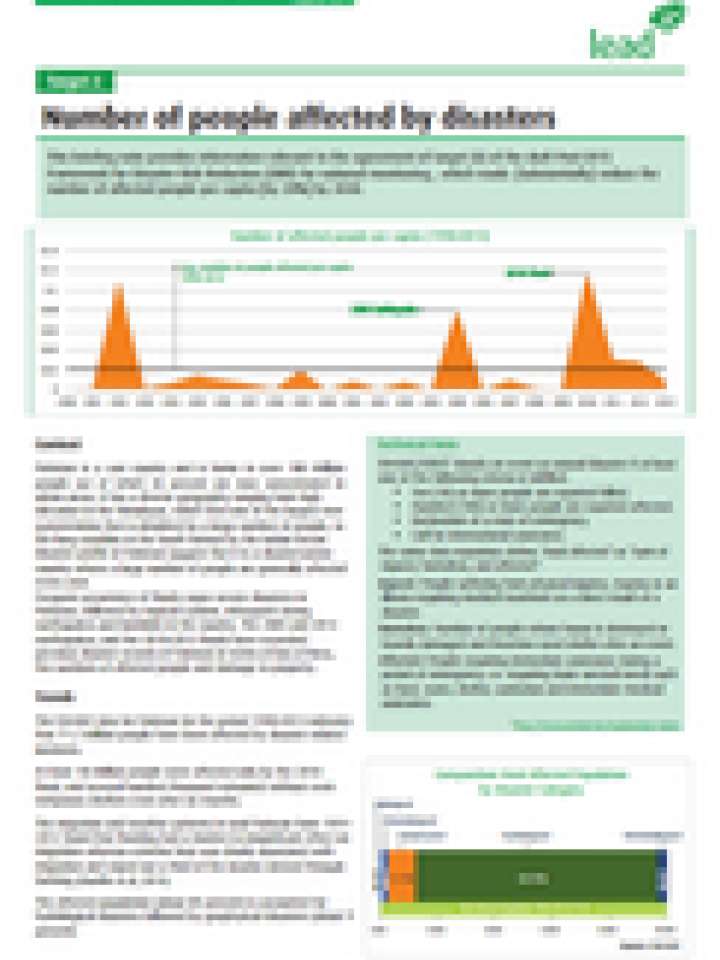
This briefing note provides information relevant to the agreement of target (ii) of the draft post-2015 framework for disaster risk reduction (DRR), which reads: [substantially] reduce the number of affected people per capita [by 20%] by 2030 and its two
This declaration of children and youth for the resilience of Latin America and the Caribbean was submitted at the fourth thematic session of the regional platform for disaster risk reduction (DRR) in the Americas (RP14).
United Nations Office for Disaster Risk Reduction – Regional Office for the Americas and the Caribbean
15-year-old Luvsansharav 'Luvsa' was one of three youth speakers who addressed an international audience of young leaders and dignitaries, including Ban Ki Moon... In his speech, Luvsa [explained] that he believes children should be encouraged to take part in disaster risk reduction, with national youth councils being established across the world to work with schools and governments to make it easier for children to take part in the process...
This toolkit introduces the ICLEI ACCCRN Process (IAP), which enables local governments to assess their climate risks in the context of urbanisation, poverty and vulnerability and formulate corresponding resilience strategies. The IAP toolkit draws on the
In their new book, 'Leadership Dispatches: Chile’s Extraordinary Comeback from Disaster', Wharton professors Michael Useem and Howard Kunreuther and Erwann Michel-Kerjan, executive director of Wharton’s Risk Management and Decision Processes Center examine how the South American nation’s leaders made that happen...
Wharton Risk Management and Decision Processes Center
The policy brief draws on lessons learned from the Fukushima earthquake and elaborates on solutions for displaced populations trapped in uncertainty. It provides recommendations regarding: (i) durable solutions which systematically need to be established through ongoing re-examinations of policies, laws and institutions; (ii) social and psychological consequences as a key topic just as (re-)construction of physical infrastructure and environmental remediation; and (iii) displaced people, for them to exercise agency and take ownership of the process.
United Nations University - Institute for the Advanced Study of Sustainability (UNU-IAS)
According to Kenyan NGO Youth Empowerment Support Services (YESS), many herders are being pushed to the edge of survival by climate-related pressures. In a November report from YESS on land sales by the Maasai tribe in Kajiado County, which borders Nairobi, researchers warned that pastoralist communities are struggling to make a living as drought decimates water sources and grazing, making it harder to sustain animals...