1. Home
  2. Knowledge Base | PreventionWeb
  3. Hazards

Tornado

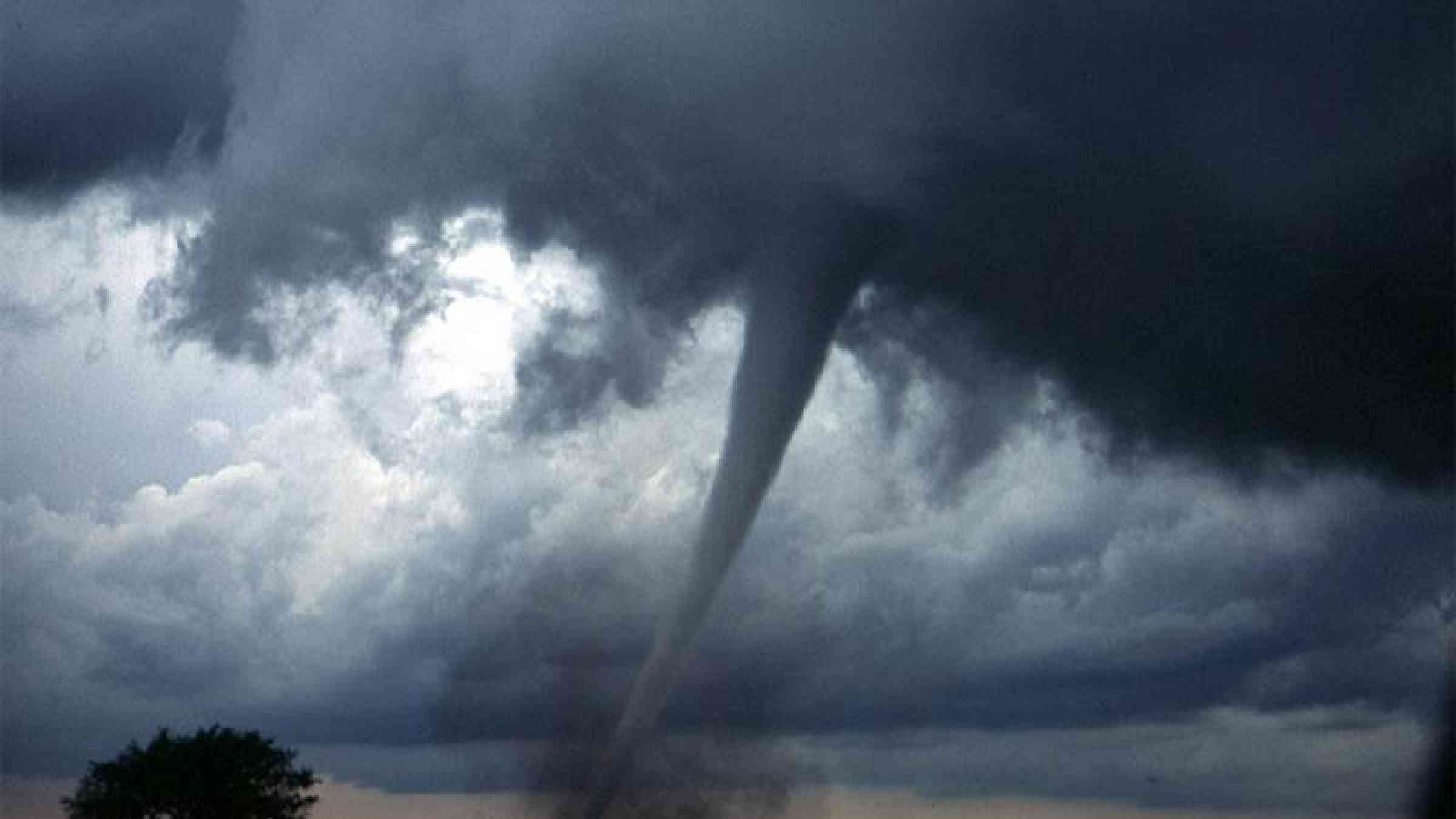
A tornado is a rotating column of air, extending from the base of a cumuliform cloud, and often visible as a condensation funnel in contact with the ground, and/or attendant circulating dust or debris at the ground (WMO, 2017).

The strength of a tornado can be estimated from the degree of damage caused using the Enhanced Fujita scale (Wind Science and Engineering Center, 2004; National Weather Service, no date).

Tornadoes kill fewer than 100 per year on average but they can be very destructive and cause huge economic losses. The United States is a major hotspot with about 1,000 tornadoes every year, causing 80 deaths and more than 1,500 injuries on average (National Geographic, 2019).

Owing to the unpredictable nature of tornados, protecting the public is focused on education and outreach which provide information on the tornado as a threat, how to identify a tornado and practical measures on how individuals can protect themselves, and how to find and watch warning systems that alert the public (CDC, 2020).

Since the advent of Doppler Radar, lead times for tornado warnings have increased from when a tornado first touches the ground to upwards of 14 to 20 minutes or more beforehand (WMO, 2017b; National Geographic, 2019).

Risk factors

  • Lack of early warning systems and preparedness programmes.
  • Even when warning systems are in place, the aged and children have higher mortality rates.
  • Populations living in mobile homes are at greater tornado risk. The rate of serious injury for mobile homes occupants is 85.1 per 1,000 compared to 3 per 1,000 for occupants in standard homes.

Vulnerable areas

  • The most tornado-prone areas in the world are in North America, in particular the Great Plains in the United States and south-central Canada.
  • Tornado Alley, a region that includes eastern South Dakota, Nebraska, Kansas, Oklahoma, northern Texas and eastern Colorado, is home to the most powerful and destructive of these storms.
  • The United States gets 75 per cent of all the world’s tornadoes, followed by Canada and Bangladesh.
  • Australia, New Zealand, South Africa, India, Argentina and the Russian Federation are also prone to strong tornadoes.
  • Communities living in poorly built houses close to potential flying objects are in particular danger. People outdoors when tornadoes occur are at higher risk of mortality.

The Enhanced Fujita Tornado Scale

The Fujita Scale is named for Dr TT (Ted) Fujita, who made the first systematic study of tornado forces; it was replaced by the Enhanced Fujita (EF) Scale in February 2007.

Risk reduction measures

  • Monitoring systems to observe thunderstorms with radar and receive reports on tornadoes.
  • A hazard map to identify risk and vulnerability.
  • A warning/communication system to alert people in the path of a tornado.
  • Underground shelters to protect people.
  • Avoiding mobile home settlements in risky zones.
  • Education and awareness about tornadoes, warnings and safe action.

Latest Tornado additions in the Knowledge Base

Uploaded on
Scene from Codrington town in Barbuda after the category 5 hurricane in September 2017 (UN Photo/Rick Bajornas)
Press release

The UN Secretary-General’s Special Representative for Disaster Risk Reduction, Mr. Robert Glasser, today announced that next year will see the start of worldwide monitoring of disaster losses from extreme weather events and earthquakes through the Bonn office of the UN Office for Disaster Risk Reduction (UNISDR).

United Nations Office for Disaster Risk Reduction (UNDRR)
Research briefs

Tornadoes are generally overlooked in Europe despite the fact that they cause damage worth millions of pounds. A new study attempts to change public opinion on European tornadoes with the aim of showing their actual occurrence in Europe. Awareness raising can be achieved through meteorological collaboration and citizen science contribution.

Conversation Media Group, the
Update

Meteorologists normally issue tornado warnings based on radar depictions or spotter reports, which can be just minutes before a tornado touches down. A new experimental forecast model has the potential to dramatically improve predictions of extreme weather at specific locations up to three hours in advance.

National Oceanic and Atmospheric Administration
Update

The World Meteorological Organization has announced « world records » for the highest reported historical death tolls from tropical cyclones, tornadoes, lightning and hailstorms. It marks the first time the official WMO Archive of Weather and Climate Extremes has broadened its scope from temperature and weather records to address the impacts of specific events.

World Meteorological Organization (WMO)
Educational materials

Climate Game is an interactive online game that takes you on a quest to conquer a virgin island covered by green trees and thick forests. Harvest, utilise and plant trees. Manage your income to develop island infrastructure but mind the consequences of

Centre for Systems Solutions - CRS
Update

While the Weather Research and Forecasting Innovation Act of 2017 calls for improving the prediction of tornadoes beyond one hour, research suggests that lead times in the one hour range may make the public less likely to respond with the same sense of urgency.

Forbes Media LLC
Research briefs

New research provides the first ever threat calculation of tornadoes across the European continent. The study found that between 1950 and 2015, tornadoes in Europe have caused nearly one billion euros worth of damage, over 300 deaths, and over 4400 injuries.

University of Manchester
Documents and publications

The social and economic impact of tornadoes in Europe is analyzed using tornado reports from the European Severe Weather Database between 1950 and 2015. Despite what is often assumed by the general public and even by meteorologists and researchers

American Meteorological Society
Uploaded on