1. Home
  2. Knowledge Base | PreventionWeb
  3. Hazards

Avalanche

An avalanche is a mass of snow and ice falling suddenly down a mountain slope and often taking with it earth, rocks and rubble of every description (WMO, 1992).

Thousands of avalanches occur every year, killing an average of 500 people worldwide. Avalanches occur when massive slabs of snow break loose from a mountainside and shatter like broken glass as they race downhill. These moving masses can reach speeds of 130 km/hour within about five seconds. They cannot always be predicted but the weather conditions, which make them more likely, can be forecast in advance. Most accidents now occur because people ignore warnings. The majority of avalanche incidents are due to slab avalanches with skiers involved. Avalanches are bigger, travel greater distances and are triggered earlier in the year. These changes can be attributed clearly to rising temperatures, which have reached 0.2 to 0.4 degrees annually in some parts of the Himalayas.

New simulations can improve avalanche forecasting.

Avalanche protection and control measures include early warning which is key (EAWS). By way of controlled explosions, artificial avalanche triggering aims temporarily to safeguard possible starting zones (SLF). Defensive structures prevent the formation of avalanches. In order circumstances, when an avalanche is released, it can be diverted or intercepted by a dam. Other means of protection against avalanches include physical structures for buildings and snow sheds (SLF).

Avalanche risk factors

  • Quick changes in weather, snowpack and terrain.
  • Increasing human populations: winter sports lovers at ski resorts and developers building in vulnerable locations.
  • Climate change.

Vulnerable areas

  • Human settlements in avalanche-prone zones.
  • Rural mountainous villages with no early warning systems.
  • Human settlements with no forest cover.
  • Skiing populations and tourists not educated in avalanche risk.

Risk reduction measures

  • Not constructing buildings, roads, etc. in avalanche hazard areas.
  • Early warning systems at local and national levels.
  • Information on avalanches, their impacts and risks for tourism information offices.
  • Tree planting to protect against the release of avalanches.
  • Building codes and appropriate materials to reinforce resilience.
  • Raising awareness, educating and training residents and visitors on what to do before, during and after an avalanche.
Latest Avalanche additions in the Knowledge Base

Uploaded on
Update

The boreholes that will be drilled by the team of international scientists will be used to reconstruct the eruption history of the most active regions in the Antilles over the last million years...

Centre National de la Recherche Scientifique
Update

The training and equipment is provided within the frame of Swiss funded Disaster Risk Reduction project 'Prevention and Preparedness at local level'...

Swiss Agency for Development and Cooperation, Federal Department of Foreign Affairs
Update

Speaking at France’s first-ever conference on hazards, the UN disaster risk reduction chief, Margareta Wahlström, yesterday commended the French government for its efforts to implement disaster risk reduction nationally, saying that the country could be a model for others in Europe.

United Nations Office for Disaster Risk Reduction - Regional Office for Europe & Central Asia
Documents and publications

This map shows the worldwide distribution of natural disasters that occurred in 2011, according to Munich Re, NatCatSERVICE.

With more than 25,000 entries, NatCatSERVICE is one of the leading global databases for natural catastrophes. Every year between

Münchener Rückversicherungs-Gesellschaft (Munich Re)
Update

'Ice avalanches from collapsing glaciers are not common in populated areas, but that may change as global temperatures rise. The Ossetia avalanche alerted researchers to the urgency of gaining a better understanding of the processes that control such flows'...

University of Nottingham
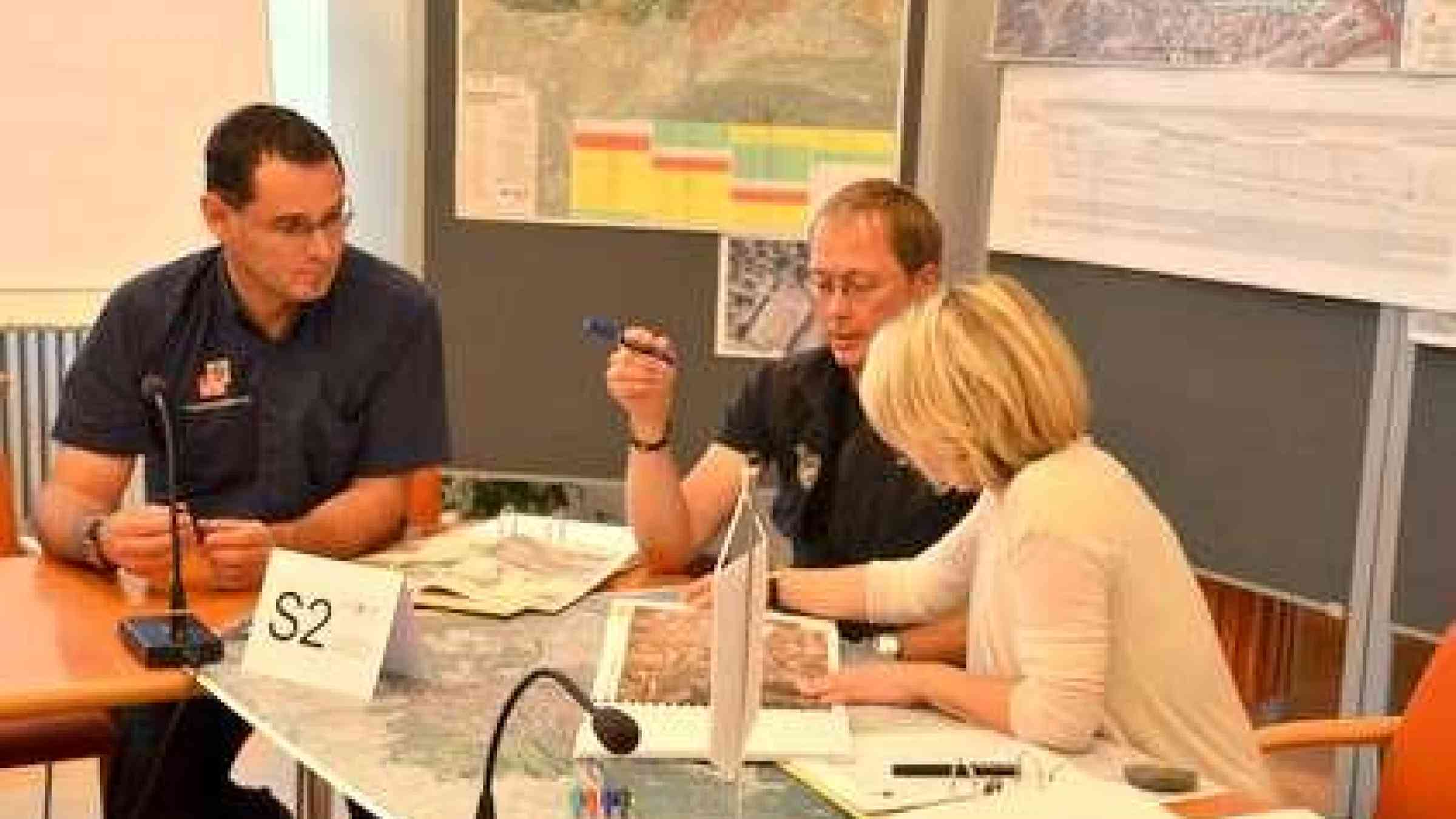
Community risk assessment workshop in Lienz, Austria. (Credit: Andreas Kohler)
Update

In Tyrol, Austria, a poster showing a green valley with snow-capped mountains in the distance greeted delegates to a conference on climate change – a beautiful summer scene which hides a potential nightmare scenario for winter tourism in the alps.

United Nations Office for Disaster Risk Reduction - Regional Office for Europe & Central Asia
Documents and publications

This volume shows that Austrian mountain research is taking up the challenge of global change for mountain regions. One of the specific themes includes: living in the mountains is living with risk. Natural hazards such as earthquakes, mass movements

Institute for Mountain Research: Man and Environment
by Flickr user cnmarcos Creative Commons BY-NC-SA 2.0, http://www.flickr.com/photos/cnmarcos/3171049301/
Update

Los medios de comunicación que han participado en la mesa redonda de las Jornadas técnicas sobre riesgos en montaña de A Lurte han reclamado la necesidad de contar con una predicción local...

Radio Huesca
Uploaded on