Research briefs

Keep up to date with the latest research on disaster risk and resilience on the PreventionWeb knowledge base.

Explore cutting-edge research on disaster risk reduction and resilience through PreventionWeb's dedicated research briefs section. Our platform curates and highlights the most recent academic studies, providing valuable insights into disaster risk management. Each research brief distills key findings from peer-reviewed journals and academic publications.

Submit a research brief.

These briefs are designed to keep you informed about the latest scientific advances. Links to the full publications are always included, ensuring easy access to in-depth knowledge. Please note that this section exclusively features academic research, distinct from reports by international organizations or Non-Governmental Organisations.

Uploaded on
Research briefs

Improved mapping gives decision makers a new tool for protecting infrastructure as Arctic warms

Los Alamos National Laboratory
A thermometer showing high temperatures. A city is blurred in the background.
Research briefs

The European climate agency recently reported this new record, with global temperatures close to 1.5 degrees Celsius (2.7 degrees Fahrenheit) above pre-industrial times.

Washington University in St. Louis
Big crack in a road following an earthquake.
Research briefs

Geophysicists from Freie Universität Berlin among the researchers investigating human-induced earthquakes.

Freie Universität Berlin
Research briefs

Three decades of data have informed a new Nebraska-led study that shows how the depletion of groundwater — the same that many farmers rely on for irrigation — can threaten food production amid drought and drier climes.

University of Nebraska-Lincoln
Research briefs

USGS scientists and our partners recently revealed the latest National Seismic Hazard Model, showing that nearly 75% of the United States could experience a damaging earthquake, emphasizing seismic hazards span a significant part of the country.

United States Geological Survey (USGS)
Research briefs

Eleven years ago, researchers estimated that about 2 million people around the world were dying from fungal infections annually. My latest estimate puts the figure today at nearly double that: around 3.8 million deaths.

Conversation Media Group, the
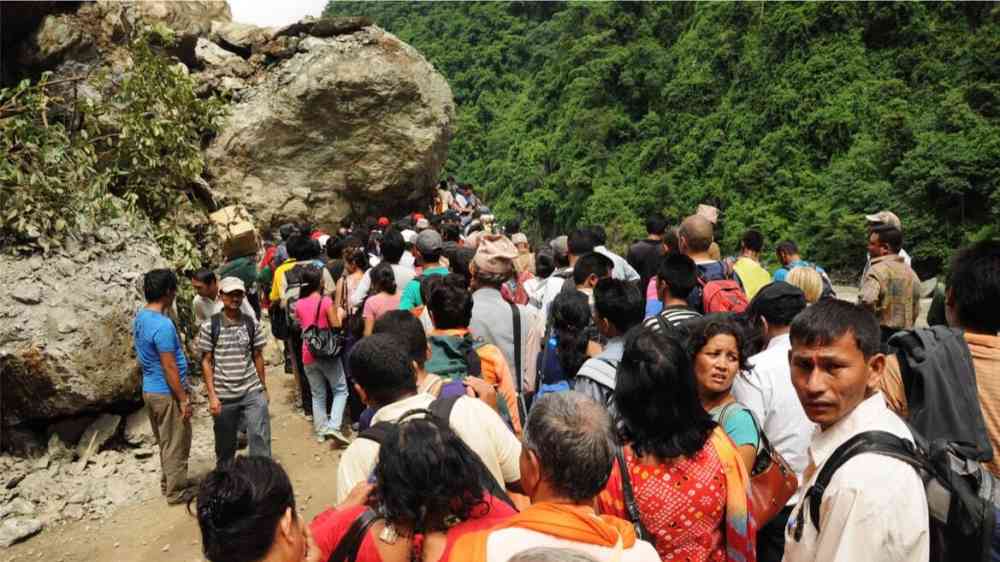
Nepalis wait as engineers remove a boulder fallen on the road due to a landslide
Research briefs

A new paper in the journal Environmental Earth Sciences (KC et al. 2023) shows that there has been a huge increase in the number of recorded landslides in Nepal since the Gorkha earthquake in 2015.

Earth Observatory of Singapore - Nanyang Technological University
Open data
Research briefs

The Washington State University-led research draws on the expertise of climate and social scientists to show how data on different characteristics of climate variability can be used to study the effectiveness of various human responses to climate change.

Washington State University