Research briefs

Keep up to date with the latest research on disaster risk and resilience on the PreventionWeb knowledge base.

Explore cutting-edge research on disaster risk reduction and resilience through PreventionWeb's dedicated research briefs section. Our platform curates and highlights the most recent academic studies, providing valuable insights into disaster risk management. Each research brief distills key findings from peer-reviewed journals and academic publications.

Submit a research brief.

These briefs are designed to keep you informed about the latest scientific advances. Links to the full publications are always included, ensuring easy access to in-depth knowledge. Please note that this section exclusively features academic research, distinct from reports by international organizations or Non-Governmental Organisations.

Uploaded on
Marine heatwaves during winter could have dire impacts on New Zealand fisheries and herald more summer storms
Research briefs

New research led by CMCC researcher Marie-Lou Bachèlery, harnesses the power of artificial intelligence (AI) to predict extreme Atlantic Niño and Benguela Niño events up to 3 months in advance.

Centro Euro-Mediterraneo sui Cambiamenti Climatici (CMCC)
Research briefs

As global temperatures warm, the Southern Ocean – between Antarctica and other continents – will eventually release heat absorbed from the atmosphere, leading to projected long-term increases in precipitation over East Asia and the Western US.

Cornell University
Research briefs

A new UCLA-led study shows that the 2022 eruption of underwater volcano Hunga Tonga-Hunga Haʻapai did not warm the planet as was expected but actually reduced temperatures over the Southern Hemisphere by 0.1 C.

University of California, Los Angeles
Research briefs

An international team of geoscientists, marine geologists, climatologists, and environmental specialists has found that lingering El Niño events have increased in frequency over the past 7,000 years.

PhysOrg, Omicron Technology Ltd
Research briefs

Using sensors, SLF researchers have collected data directly beneath gliding avalanches for the first time. This will allow them to better determine the timing and extent of a gliding avalanche.

WSL Institute for Snow and Avalanche Research (SLF)
Research briefs

A combination of water management practices has contributed to notable groundwater gains in Central Arizona despite the region dealing with long-term water stress, according to a study.

The University of Texas at Austin
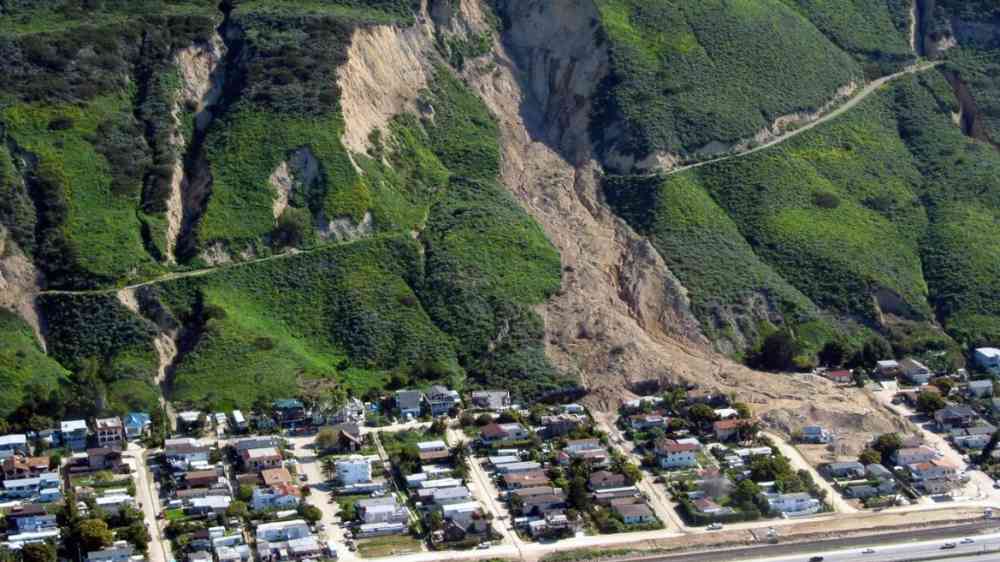
Rock and soil cover destroyed houses in La Conchita, California after a landslide tore through the community in 2005.
Research briefs

Researchers from the Leibniz Centre for Agricultural Landscape Research (ZALF), together with international partners, have developed a new framework that significantly improves landslide prediction using machine learning methods.

Leibniz Centre for Agricultural Landscape Research (ZALF)
Research briefs

A new study led by the Woods Hole Oceanographic Institution (WHOI) uses satellite data to help uncover what caused the deluges that hit Rio Grande do Sul in 2024 and examine how it impacted some of the state's most vulnerable residents.

Woods Hole Oceanographic Institution