Research briefs

Keep up to date with the latest research on disaster risk and resilience on the PreventionWeb knowledge base.

Explore cutting-edge research on disaster risk reduction and resilience through PreventionWeb's dedicated research briefs section. Our platform curates and highlights the most recent academic studies, providing valuable insights into disaster risk management. Each research brief distills key findings from peer-reviewed journals and academic publications.

Submit a research brief.

These briefs are designed to keep you informed about the latest scientific advances. Links to the full publications are always included, ensuring easy access to in-depth knowledge. Please note that this section exclusively features academic research, distinct from reports by international organizations or Non-Governmental Organisations.

Uploaded on
Earthquake wave and circle vibration
Research briefs

An international study published in Communications Earth & Environment used advanced earthquake simulations to better anticipate the rupture process of large earthquakes.

PhysOrg, Omicron Technology Ltd
Aerial photography of solar photovoltaic bases in desert areas
Research briefs

Scientists from the Chinese Academy of Sciences have developed a new forecasting tool called iDust that improves predictions of dust storms, offering significant benefits for solar energy production.

Institute of Atmospheric Physics, Chinese Academy of Sciences
The Mekong river at a low water level due to drought
Research briefs

New research shows that saltwater intrusion is on the rise globally. Researchers found in most cases that the salt front is moving further upstream, primarily due to sea level rise and reduced river discharge, making rivers saltier.

Utrecht University
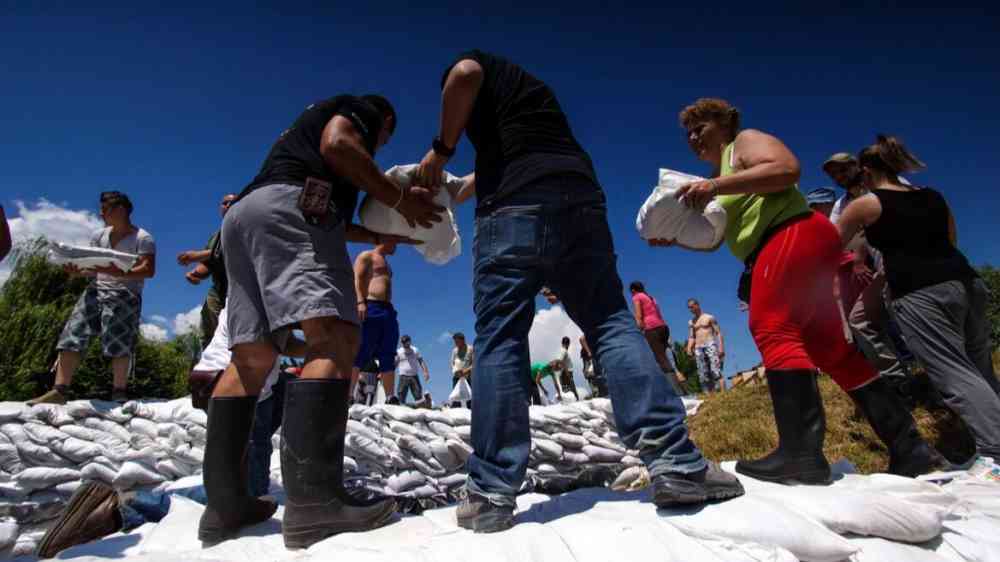
Hungarians stack sandbags to protect against the Danube floods
Research briefs

Tightly connected communities tend to be more resilient when facing extreme events such as earthquakes, hurricanes, floods or wildfires. Research suggests that community cohesion helps boost the community's ability to withstand disasters.

Stevens Institute of Technology
earthquake
Research briefs

Scientists develop a novel soil-reenforcing material by recycling waste fluids from geothermal energy harvesting plants.

Shibaura Institute of Technology (SIT)
Research briefs

Researcher has created a sophisticated numerical computer model to help scientists and environmental experts understand how water moves in estuaries during extreme weather events.

University of Houston
Research briefs

Until now, scientists have not been able to predict warming of the ocean surface in the South Atlantic Ocean. But now, by using artificial intelligence they show that El Niño phenomenon in the region can be predicted up to 3 to 4 months ahead.

Bjerknes Centre for Climate Research
Research briefs

New research from the Coastal Research Collaborative (CRC) at the University of Hawai‘i (UH) at Mānoa determined that 81% of O‘ahu’s coastline could experience erosion by 2100, with 40% of this loss happening by 2030.

University of Hawai'i at Manoa