Why disaster risk management needs an offline-first communication layer

On 6 February 2023, earthquakes devastated southern Türkiye and northern Syria. In several of the hardest-hit Turkish cities, mobile communications deteriorated sharply in the immediate aftermath as damaged base stations, power outages and extraordinary traffic loads reduced signal availability and call success.
I was a middle school student in Istanbul, stuck on one question: why does communication depend on infrastructure that can fail when it is needed most?
When the towers went silent
In the first days after the earthquakes, damaged base stations, power cuts and network congestion left many survivors unable to call for help or tell their families they were alive. Some people trapped in collapsed buildings reached rescuers via social media during brief moments when they could get a signal. Many others could not.
What struck me was a simple imbalance: the phones survived; the towers did not.
Every modern smartphone supports short-range technologies, such as Bluetooth, that require no mobile tower, SIM card, or data plan. In an emergency, this represents an untapped communication network sitting in millions of pockets.
The earthquakes were natural hazards. The communication disruption that followed exposed a weakness in system design – and design choices can be changed.
Building Crisis Connect
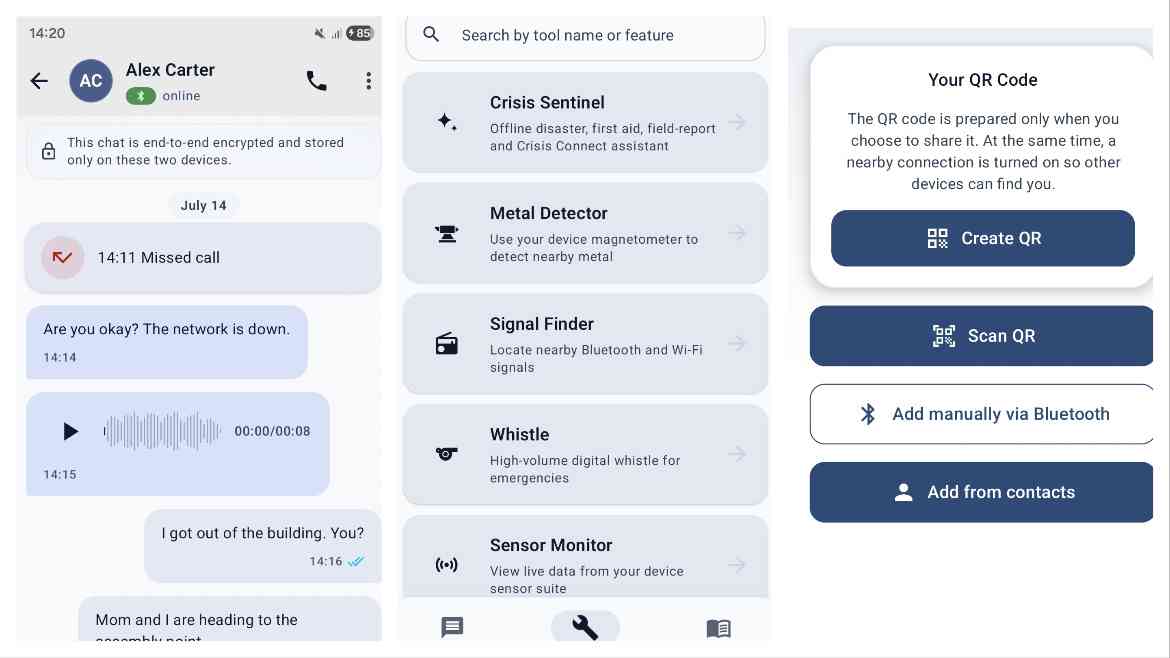
Two years later, in April 2025, I started building Crisis Connect, a free mobile app that lets phones communicate directly over Bluetooth when internet and cellular networks are down.
Nearby phones can relay messages for one another, allowing a message to travel beyond the range of a single direct Bluetooth connection. This multi-hop mesh mode can be enabled when needed. It is disabled by default to reduce battery consumption, maintain connection stability and give users control over when their devices participate in message relaying.
The app supports encrypted messaging, live location sharing, SOS broadcasts and voice calls. Its offline mode works without an account or central server.
The design starts before an emergency. Users connect with family members, neighbours or teammates by scanning a QR code or establishing a nearby Bluetooth connection. Those connections are then designed to keep working when internet and cellular services are unavailable.
I built Crisis Connect alone, between classes, over about a year. I am 17 now. The app is available on the App Store and Google Play, and the code is fully open source. I believe emergency tools should be free and open to scrutiny by anyone.
What I learned
Building the technology was the easier half. The lessons that stayed with me were about people and preparedness:
- Offline-first tools only work if people prepare in advance: An emergency app downloaded after the network fails is of little use. Communication tools belong in preparedness checklists, next to the flashlight and whistle – part of a “digital go-bag” prepared before a crisis.
- Two phones make a link; a neighbourhood can make a network: Mesh communication becomes more useful as more nearby devices participate. Community-level adoption – across streets, schools, apartment buildings and volunteer teams – is more valuable than scattered individual downloads.
- Honesty builds trust: Offline communication has real limits, including walls, rubble, battery life, Bluetooth range and the number of nearby participating devices. Overpromising the capabilities of emergency technology can undermine trust. Users need clear information about what a tool can and cannot do.
- Open source is a resilience feature: Emergency communication should not depend on one company’s servers or goodwill. Open code allows agencies, researchers and communities to verify, adapt and sustain the tools they rely on.
What the DRR community can do
My message to disaster risk management professionals is simple: treat communication as lifeline infrastructure and plan for redundancy, just as we do for water, power and shelter.
In practice, this means:
- adding offline communication tools to household and community preparedness guidance, and adding one step to drills: send a message to a neighbour with mobile data and Wi-Fi turned off;
- piloting device-to-device communication in places where the density of users can strengthen mesh networks, including schools, apartment buildings and volunteer networks; and
- supporting open, auditable technology for emergencies so that no community’s safety depends on a single vendor.
Smartphone mesh communication will not replace satellite links, emergency radio or official early warning systems – nor should it try to. It can help fill a gap during the first hours after impact, when survivors need to reach nearby people and communication infrastructure is damaged, overloaded or unavailable.
Test, learn and improve
Crisis Connect is free on the App Store and Google Play, and documentation is available at crisisconnect.network.
If you work on community preparedness and want to test offline messaging in a drill or pilot, I would like to hear what works – and what breaks. This project gets better with every conversation.

Emirhan Duman is a 17-year-old high school student and software developer from Istanbul, Türkiye. He is the founder of Crisis Connect, a free, open-source app that enables encrypted communication over Bluetooth mesh networks when internet and cellular infrastructure fail. He is currently seeking pilot collaborations with disaster management organisations.