
Maternal resilience in Tamil Nadu offers lessons for disaster risk reduction

From Madurai's drought-scorched villages to Chennai's smog-choked cities, mothers like Shabeena* battle heatwaves and pollution daily in the Indian state of Tamil Nadu.
"My body has nothing left to feed her," she says, as her 8-month-old turns away.
Climate hazards threaten maternal health, demanding urgent disaster risk reduction (DRR) strategies. In 2024, I surveyed 391 mothers and conducted six in-depth interviews across 38 vulnerable districts. Their stories reveal a critical truth: maternal resilience must be central to global disaster risk reduction strategies.
Social stresses from climate extremes
Extreme heat has left mothers depleted, intensifying caregiving challenges indoors:
"The heat drains me. Even when I sit, sweat trickles down my back. There is no relief."
One mother described nights spent awake, fanning her infant to ease heat-induced distress, her own exhaustion mounting. Persistent air pollution worsened the child's respiratory health:
"No matter how much I sweep, dust settles on everything - our food, our clothes, the air we breathe," another mother shared." said the Chennai mother, "My baby coughs all night-the air feels thick with factory smoke."
Mothers bear the burden of mounting hazards
| Impact | Statistic | Source |
| Infant Sleep Disturbances | 91% report issues | Wiley, 2023 |
| Infant Heat Rashes | 14.5% of infants, 26.8% of toddlers affected | PMC, 2010 |
| Maternal Anxiety Disorders | 1 in 5 women affected | J Clin Psychiatry, 2019 |
| Mental Health Access | Only 22% without intervention | Obstetrics & Gynecology, 2015 |
Our research at Harvard Medical School reveals how climate hazards harm mothers' mental health.
In homes with poor ventilation, high pollution, or no cooling, mothers face increased depression, stress, and anxiety, making it harder to care for infants. Without support, only 22% of women with perinatal depression access care, though targeted interventions can boost access two- to fourfold, highlighting the urgent need for climate-adapted mental health programs. These figures show how environmental hardships silently fracture maternal well-being.
Mothers raising children with disabilities face amplified struggles. Latha*, from Madurai, shared:
"Trapped is exactly how I feel. There is no escape from the heat, or the village's blame. I stopped going to the well - neighbours' stares made me feel like a failure."
Facing judgment, many mothers withdrew into isolation: "I used to have friends. Now, it's just these walls."
Seeing mothers like Latha isolated and blamed left me determined to advocate for their dignity in DRR frameworks.
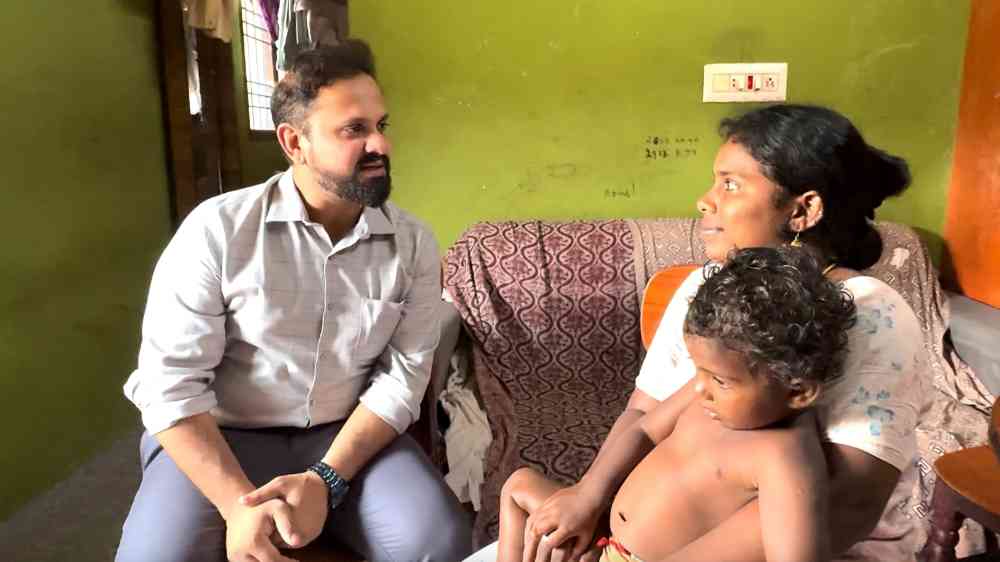
Dr. Saravanan Thangarajan discussing with a mother from Tamil Nadu, India.
Amid climate hardships, communities innovate
Despite adversity, Tamil Nadu's mothers have innovated grassroots resilience strategies:
- WhatsApp early-warning networks: Community alerts on heatwaves and blackouts, scalable to 10,000 households by 2026 with state and non-governmental organisation support.
- Clay cooling pots: Low-tech vessels protecting infant water during outages, scalable to 5,000 households.
- Family support networks: Sisters or cousins often take turns watching children, giving mothers a rare moment to rest. Family visits act as lifelines, stitching moments of resilience into days weighed down by heat and exhaustion.
These innovations offer replicable blueprints for DRR worldwide but need systemic investment to thrive.
Acting for maternal resilience, aligned with the Sendai Framework
Tamil Nadu's lessons demand strategic actions across the Sendai Framework priorities:
- Priority 1 - Understanding Disaster Risk: Map climate-health vulnerabilities among mothers through expanded surveys, partnering with local NGOs to collect data in real time.
- Priority 2 - Strengthen Disaster Governance: Integrate maternal health into climate adaptation budgets, allocating funds for heat-resistant maternity clinics by 2027.
- Priority 3 - Invest in Disaster Resilience: Expand cooling solutions for rural households, targeting 5,000 homes by 2026 using state and donor funds.
- Priority 4 - Strengthen Disaster Preparedness: Train healthcare workers to detect climate-related maternal stress early, integrating Tele-MANAS - India's national dial-in mental health network - services in 100 clinics by 2026.
Building maternal resilience strengthens community resilience-a cornerstone of effective DRR.
Using Tamil Nadu's experience to offer global lessons
Tamil Nadu's crisis mirrors the challenge in Bangladesh and other Low- or Middle-Income Countries (LMICs), where poverty, gender inequity, and climate hazards endanger maternal health, exacerbating issues like infant sleep disturbances and maternal anxiety.
DRR practitioners globally can adapt Tamil Nadu's WhatsApp model to deliver timely alerts in similar contexts.
Shabeena's silent struggle is a call to action: investing in maternal resilience is not charity - it is a cornerstone for community survival in every future climate emergency. Survival must not depend on chance: it demands targeted, inclusive action, transforming vulnerability into strength for generations.
DRR practitioners can take action
To address climate-related maternal mental health decline, we propose the following as an action-oriented, practical pathway to resilience:
- Map maternal climate-health risks, in partnership with Non-governmental organisations (NGOs).
- Fund heat-resistant maternity clinics by 2027.
- Subsidise cooling for 5,000 rural homes by 2026.
- Train healthcare workers in 100 clinics for stress detection.
*Pseudonyms are used to ensure participant privacy, in line with ethical research standards
Dr. Saravanan Thangarajan is a global health strategist, disaster resilience advisor, and Harvard-trained evaluation expert with experience across 7+ countries. He advises the World Health Organization, UN agencies, and the Wellcome Trust on climate-health integration, maternal mental health, and disaster risk reduction in vulnerable settings. His leadership has impacted over 11 million lives through policy reform, community-based preparedness, and health systems strengthening. From leading Tamil Nadu’s COVID-19 response to embedding disaster resilience into Vietnam’s medical curricula, Dr. Thangarajan bridges frontline realities with global DRR frameworks to advance equity, climate adaptation, and inclusive development in low- and middle-income countries.