UNDRR Logo
My account
Navigation loading…
Your experience on PreventionWeb

Please help us improve PreventionWeb by taking this brief survey. Your input will allow us to better serve the needs of the DRR community.

See the survey

Last updated 15 Nov 2018

Pakistan floods 2010-2011

Upload your content
Image
Pakistan floods 2010
Shutterstock

Introduction

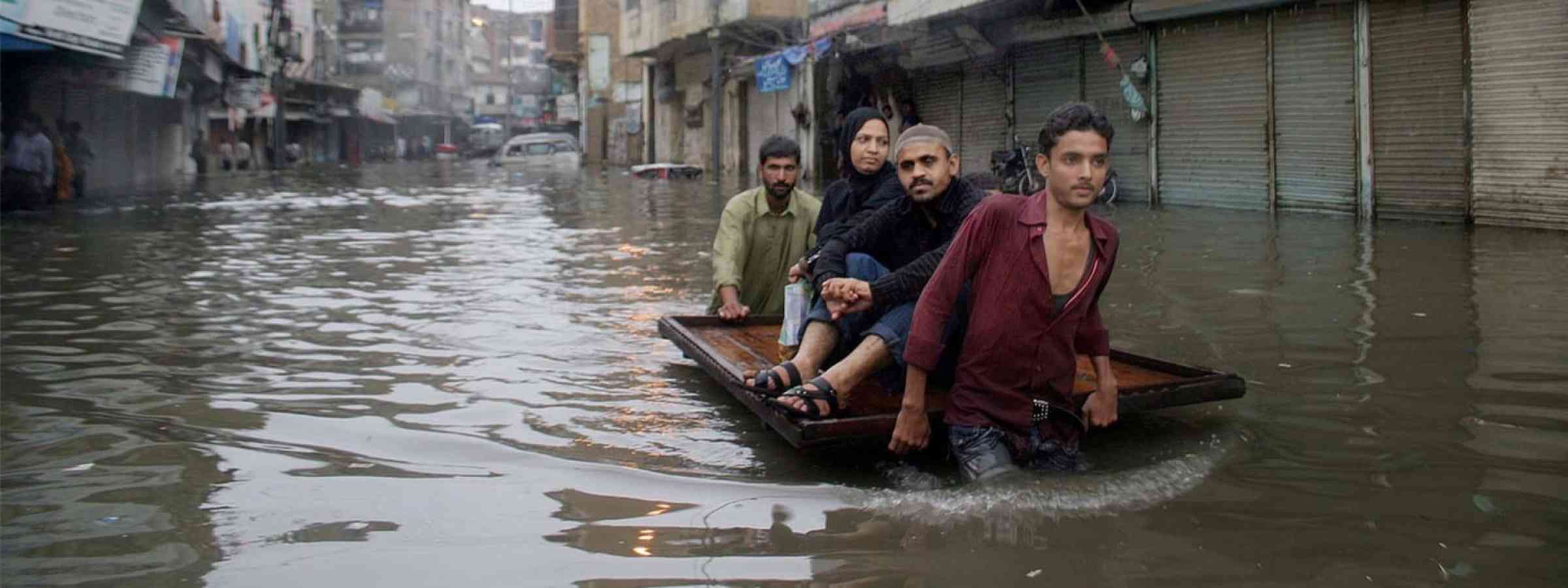
In July 2010, heavy monsoon rains affected millions of people by submerging approximately one-fifth of Pakistan's land area.

The 2010 floods in Pakistan began in late July, resulting from heavy monsoon rains in the Khyber Pakhtunkhwa, Sindh, Punjab and, Balochistan regions of Pakistan, which affected the Indus River basin. Approximately one-fifth of Pakistan's total land area was affected by the floods, with the Khyber Pakhtunkhwa province facing the brunt of the damage and casualties (above 90% of all the deaths occurred in the province). Nationwide, there were 1,985 deaths. According to Pakistani government data, the floods directly affected about 20 million people, mostly by destruction of property, livelihood and infrastructure.
Related links
Pakistan floods 2022
India-Pakistan floods 2014
Hazards
Flood
Country and region
Pakistan

Knowledge base

Photo copyright Flickr user, Oxfam NZ
Update
22 November 2010
New report on Pakistan floods urges preventive steps to protect millions from climate displacement

'The massive flooding in Pakistan is a wake-up call that starkly highlights the real threats we face from climate-related disasters' said Michel Gabaudan, president of Refugees International. 'It is in our best interest to plan now for the massive human displacement they cause and protect those most at risk'...

Refugees International
Documents and publications
22 November 2010
Confronting climate displacement: learning from Pakistan's floods

This report explores what climate-induced displacement looks like and outlines steps to ensure that U.S. and international agencies address the threat that climate change poses to economic, political and human security. It calls for the international

Refugees International
Update
8 November 2010
UN to help strengthen Pakistan's disaster risk reduction strategies

During her visit to Pakistan this week, the UN Under-Secretary General and Executive Secretary of UNESCAP will be convening a High Level Meeting in collaboration with the Government of Pakistan and the UN Country Team to support the country's disaster risk reduction strategies and recovery and reconstruction plans, particularly regarding flood...

OnePakistan.com
Update
13 October 2010
Pakistan hopes to build back better after floods

'It's important to keep in mind that disasters cannot be prevented but better preparedness can help reduce the damage and mitigate the worst impact,' Pakistan's Ambassador to Thailand, Sohail Mahmood said on the International Day for Disaster Reduction...

Thomson Reuters Foundation, trust.org
Update
5 October 2010
Pakistan: Lady health workers in flood-affected villages

In Pakistan, lady health workers play an increasingly important role in bridging gaps between the health sector and local communities for flood-affected people. People in the camps move regularly, especially in unregistered camps. The demand for information and health interventions change weekly...

World Health Organization (WHO)
Aftermath of floods in Pakistan. Copyright Oxfam
Update
29 August 2010
Pakistan floods one month on: Planning for reconstruction must begin

'In some areas, disaster risk reduction strategies had been implemented properly over the last few years. Early warning systems were in place, boats were provided and communities were mobilized in time to rescue hundreds of thousands of people. The challenge ahead now is to help the state to do this on a far bigger scale' said Neva Khan, Oxfam's Country Director in Pakistan...

Oxfam International Secretariat
Update
24 August 2010
Pakistan: Awaiting new floods

'We are concerned whether the barrage will be able to withstand the tremendous flow of the water,' said Prof Qamar-Uz-Zaman Chaudhry, head of the Pakistan Meteorological Department and a member of the government's task force on climate change referring to the high water level at the Kotri Barrage...

The New Humanitarian
Update
13 August 2010
Recent weather disasters: Are jet streams to blame?

In Pakistan millions of lives have been set adrift by floods, in Russia wheat crops have been shrivelled by drought and devoured by fire. Some scientists think the floods and the fires could be linked by a persistent pattern of waves in the high-altitude flows of air called jet streams...

The New Humanitarian
Photo by Flickr user SFTHQ, Creative Commons Attribution 2.0 Generic, http://www.flickr.com/photos/sfthq/4882596322/in/set-72157624578317711/
Update
12 August 2010
AP: Long, hot summer of fire, floods fits predictions

In an interview with the Associated Press, Salvano Briceno of the UNISDR pointed to aggravating factors in the latest climate catastrophes: China's failure to stem deforestation; Russia's poor forest management; and the settling of poor Pakistanis on flood plains and dry riverbeds...

Associated Press
Update
10 August 2010
Pakistan floods shows threat from warmer world: scientists

'Pakistan, like any flood-prone country, needed early warning systems, better storage of drinking water, even to move people from vulnerable areas,' said Andrew Ash, who leads a climate adaptation programme for Australia's state-funded research body the CSIRO in a report by Reuters...

Thomson Reuters Foundation, trust.org

Pagination

Showing results 51–60 on this page

  • Previous
  • 1
  • …
  • 5
  • 6
  • 7
  • Next

Is this page useful?

Yes No
Report an issue on this page

Thank you. If you have 2 minutes, we would benefit from additional feedback (link opens in a new window).

PreventionWeb is the global knowledge sharing platform for disaster risk reduction (DRR) and resilience.

  • Newsletter
  • Submit your content
  • Blog pitches
  • Submission and publishing policy
  • About PreventionWeb
  • Contact us

Hazards

  • Avalanche
  • Cold Wave
  • Cyclone, Hurricane and Typhoon
  • Drought and Desertification
  • Earthquake
  • Epidemic and pandemic
  • Flood
  • Heatwave, extreme heat and heat stress
  • Insect infestation
  • Land subsidence
  • Landslide
  • Nuclear, biological, chemical (NBC)
  • Sea level rise
  • Technological hazard
  • Thunderstorm
  • Tornado
  • Tsunami
  • Volcano
  • Wildfire

Regions

  • Africa
  • Americas
  • Asia
  • Europe
  • Oceania

Themes

Understanding & managing risk

  • Preparedness
  • Early warning
  • GIS and mapping
  • Data and information management
  • Risk identification and assessment
  • Small Island Developing States
  • Earth Observation

Natural environment

  • Climate change
  • Environment and ecosystems
  • Food security and agriculture
  • Water

Cross-cutting

  • Systemic risk
  • Recovery

Human development

  • Capacity development
  • Children and youth
  • Civil society / NGOs
  • Community-based DRR
  • Cultural heritage
  • Gender
  • Human mobility
  • Inclusion
  • Social impacts and resilience

Science, knowledge & advocacy

  • Disaster risk communication
  • Traditional and Indigenous knowledges
  • Science-policy-practice interface

State, governance & economy

  • Financing DRR
  • Fragility and conflict
  • Governance
  • Insurance and risk transfer
  • Private sector

Infrastructure & critical services

  • Critical infrastructure
  • Education and school safety
  • Health and health facilities
  • Structural safety
  • Urban risk and planning
Loading