UN Plan of Action 2023 Progress Report

This page presents the main results of the UN Plan of Action 2023 Progress Report
The United Nations Plan of Action on Disaster Risk Reduction for Resilience (UN Plan of Action) is the contribution by the United Nations to ensure the implementation of the Sendai Framework contributes to a risk-informed and integrated approach to the achievement of the 2030 Agenda for Sustainable Development.
The 2023 UN Plan of Action Progress Report summarizes progress towards the three Commitments of the UN Plan of Action and the 2030 Recommendations of the United Nations Senior Leadership Group (UN SLG), as reported by UN entities, for the year 2023. It reflects on collective achievements, opportunities, challenges and gaps.
Progress on the implementation of the UN Plan of Action
A total of 40 UN organizations reported under the UN Plan of Action for 2023. The midterm targets have been reached or surpassed for nine out of 11 output indicators.
Commitments of the UN Plan of Action

Commitment 1
Strenghten system-wide coherence in support of the Sendai Framework and other agreements, through a risk/informed and integrated approach.
Commitment 2
Build UN system capacity to deliver coordinated, high-quality support to countries on disaster risk reduction.

Commitment 3
Ensure disaster risk reduction remains a strategic priority for UN Partners.
Commitment 1: Strengthen system-wide coherence in support of the Sendai Framework and other agreements through a risk-informed and integrated approach
| 22 risk-informed UN system policies supported by UN organizations |
| 27 risk-informed UN system guidelines supported by UN organizations |
| 29 DRR/resilience related inter-agency initiatives |
| 121 countries reporting the common DRR related indicators that are part of the Sendai Framework Monitor and SDG monitoring framework |

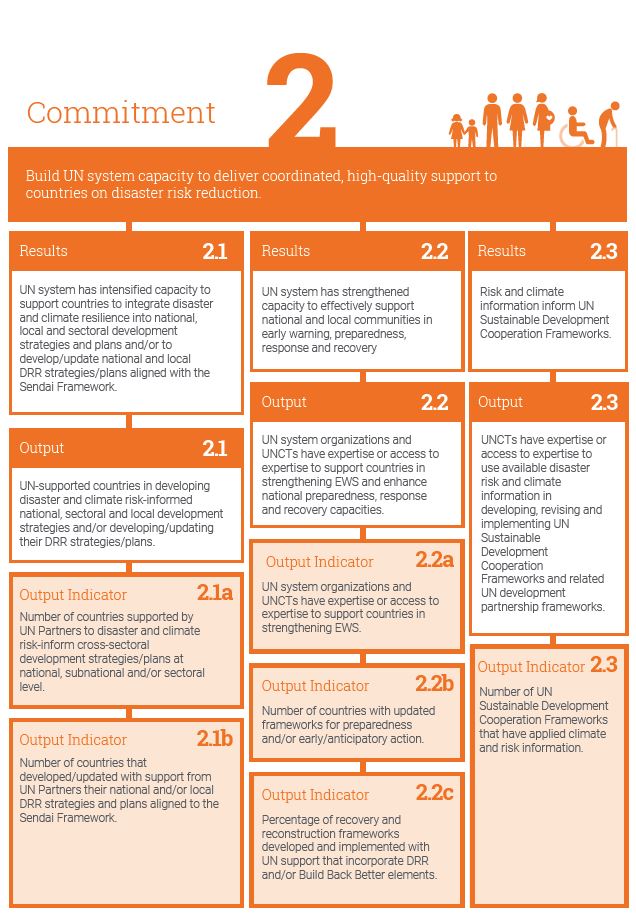
Commitment 2: Build UN system capacity to deliver coordinated, high- quality support to countries on disaster risk reduction.
| 136 countries supported to risk-inform national cross-sectoral development strategies/plans |
| 50 countries supported to risk-inform national sectoral development strategies/plans |
| 44 governments were supported in developing national DRR strategies |
| 52 governments were supported in developing local DRR strategies |
| 151 governments were supported with early warning system (EWS): 61 through global EWS; 145 through national EWS; 81 through regional EWS |
| 150 governments supported with national preparedness frameworks |
| 39 governments implemented the IASC's Emergency Response Preparedness approach |
| 95 governments supported with national preparedness frameworks |
| 151 countries supported in incorporating DRR and/or Build Back Better elements to recovery and reconstruction frameworks |
| 16 (all) Country Teams that signed UNSDCFs in 2023 applied climate and disaster risk information |
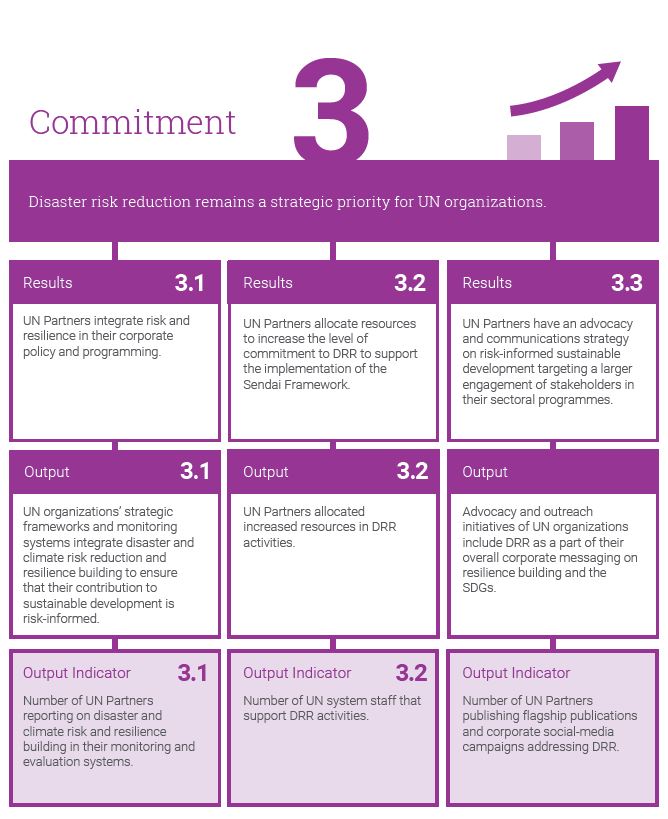
Commitment 3: Disaster risk reduction remains a strategic priority for UN organizations
| 24 UN organizations reported having disaster and climate risk and resilience indicators in their monitoring and evaluation systems |
| 8,022 UN staff members from 32 organizations and 133 UN Volunteers (UNVs) supported DRR activities |
| 22 UN Organizations produced flagship publications related to DRR |
| 19 UN Organizations conducted social-media campaigns related to DRR |
Accelerating disaster risk reduction through joint action
In 2023, the UN SLG adopted five recommendations to accelerate progress in the implementation of the UN Plan of Action by 2030. Progress was made across Risk-informing Humanitarian-Development-Peace Planning, Finance, Inclusion and Early Warning.
Risk-inform humanitarian, development and peace actions
- UNDRR and the UN Office for the Coordination of Humanitarian Affairs (OCHA) supported risk analysis and risk-informed planning workshops in six Humanitarian Programme Cycle (HPC) countries.
- Joint analysis exercises shaped CCAs in South Sudan and Haiti by integrating foresight elements.
- Opportunities for synergies between disaster risk reduction and peacebuilding were explored by the UN Department of Political and Peacebuilding Affairs (DPPA) and UNDRR in a Peace Dialogue under the Inter-Agency Standing Committee Task Force 4.
Invest in disaster risk reduction and reform the financial system to better consider risks
- A session on disaster risk reduction financing and investment shared experiences, technical knowledge and guidance to strengthen support to countries. Discussions informed updates to the CCA guidance for all UN Country Teams.
- The UN Department of Economic and Social Affairs (DESA), UN Development Programme (UNDP) and UNDRR developed guidance on Integrated National Financing Framework for DRR.
Boost inclusive disaster risk reduction and climate adaptation
- 59 countries shared disaggregated data following advocacy and capacity-building efforts from UN entities, advancing disaster statistics.
- Guiding questions for child-responsive DRR were included in the 2023 UN Plan of Action template to improve reporting.
- A session on mainstreaming child-responsive DRR was organized with UN DRR focal points. Good practices were shared, including the Today & Tomorrow Initiative by UNICEF.
- UNICEF developed a child-responsive disaster risk reduction video for the 2023 International Day for Disaster Risk Reduction, showcasing its importance in resilience building and advancing children’s rights.
Strengthen multi-hazard early warning systems
- The Early Warning for All (EW4All) initiative, led by UNDRR and the World Meteorological Ogranization (WMO) was launched in 21 countries, mainly Small island developing States (SIDS) and Least developed country (LDCs).
- Roadmaps for strengthening multi-hazard early warning systems built on existing mechanisms have been completed or are under way in 17 countries.
- UNDRR and WMO developed an EW4All dashboard to track progress and measure success.

Highlighted achievements
Explore selected activities and key achievements performed in the context of the UN Plan of Action.
Support to UN system-wide guidelines (Indicator 1.1)
UN organizations reported supporting a total of 27 UN system-wide guidelines in 2023 that integrate and demonstrate linkages between the Sendai Framework and other international frameworks. This support reflects on the significance and usefulness of these guidelines for the work of UN organizations on DRR, climate change adaptation and resilience building.
Achievements of inter-agency initiatives (related to Indicator 1.1)
In 2023, progress was reported for 15 inter-agency initiatives related to DRR:
- Capacity for Disaster Reduction Initiative (CADRI)
- Centre of Excellence for Disaster and Climate Resilience
- Climate Resilient Food Systems Alliance (CRFS)
- Climate Risk and Early Warning Systems (CREWS)
- Comprehensive Disaster and Climate Risk Management (CRM) (formerly the Target E Coherent Approach)
- Global Alliance for Disaster Risk Reduction and Resilience in the Education Sector (GADRRRES)
- Global Risk Assessment Framework (GRAF)
- International Recovery Platform (IRP)
- Making Cities Resilient 2030
- Partnership for Environment and Disaster Risk Reduction (PEDRR)
- Risk-Informed Early Action Partnership (REAP)
- Safe Hospitals Initiative
- Climate Resilience Initiative: Anticipate, Absorb, Reshape (A2R)
- United Nations Coalition on Combating Sand and Dust Storms
- UN-Water
In addition, the following existing inter-agency initiatives continued their support in implementing the Sendai Framework:
- Early Warnings for All (EW4ALL)
- Fighting Food Crises Along the HDP Nexus Coalition (HDP Nexus Coalition)
- Global Partnership using Space-based Technology Applications for Disaster Risk Reduction (GP-STAR)
- Integrated Urban Resilience in SIDS and Coastal Cities
- Inter-Agency Standing Committee (IASC)
- International Network for Multi-Hazard Early Warning Systems (IN-MHEWS)
- Partnership for Action on Green Economy (PAGE)
- Systematic Observations Financing Facility (SOFF)
- Water and Climate Coalition
Support to national disaster risk reduction strategies (Indicator 2.1.b)

By the end of 2023, 80 per cent of governments have been supported in developing or updating national DRR strategies. Progress must be accelerated to ensure full coverage of support over the next two years. This finding stresses the need to strengthen risk governance at the national and local levels, in line with the political declaration of the high-level meeting on the midterm review of the Sendai Framework (A/RES/77/289).
UNDP has downscaled climate change data through the Digital Climate Atlas of Serbia, making it accessible to local autonomous governments and other stakeholders. This platform supports evidence-based decision-making and vulnerability assessments for climate resilience and disaster risk reduction across key sectors such as agriculture, energy, and infrastructure.
The graph on the left-side, shows the number and percentage of governments supported in the development or updating of their national DRR strategy from 2019 to 2023, showcasing a slight deceleration over the last years.
Risk-informed UNSDCFs and CCAs (Indicator 2.3)
In 2023, disaster and climate risk reduction and resilience building elements were systematically integrated into UNSDCFs, CCAs, HNOs and HRPs, reflecting the growing recognition of the interconnectedness of climate, disaster risks and peace and security. This trend underscores the importance of linking climate, peace and security concerns in the UN's work, especially in fragile contexts.
The analysis of the Somalia Humanitarian Needs and Response Plan (HNRP) pointed to the positive effect of development actors’ involvement in the humanitarian planning processes and suggests that in-depth risk analysis and subsequent planning support leads to stronger planning documents.
All UNSDCFs signed in 2023 included DRR and resilience considerations, with 94 per cent incorporating these elements into the results framework in their outcomes, outputs and/or indicators, demonstrating the UN's commitment to embedding climate and disaster risk information across all stages of planning. This integration also extended to Humanitarian Needs and Response Plans (HNOs/HRPs/HNRPs), with 37 per cent fully incorporating DRR elements, showing that risk-informed planning is becoming more embedded in both humanitarian and development efforts.
| Country | Outcome | Output | Indicator | |
|---|---|---|---|---|
| 1 | Afghanistan | X | ||
| 2 | Bhutan | X | X | X |
| 3 | Burkina Faso | X | ||
| 4 | Cambodia | X | X | |
| 5 | Chad | |||
| 6 | Gambia | X | X | |
| 7 | Guinea | X | X | |
| 8 | Lesotho | X | X | |
| 9 | Madagascar | X | X | |
| 10 | Malawi | X | X | |
| 11 | Mauritania | X | X | |
| 12 | Mauritius | X | X | X |
| 13 | Papua New Guinea | X | X | X |
| 14 | Philippines | X | X | X |
| 15 | Senegal | X | X | |
| 16 | Seychelles | X | X | X |
| 16 | 10 | 10 | 13 |

Gender equality and inclusion
Seventeen out of the 31 UN organizations (55 per cent) reporting on gender equality and women’s empowerment and leadership confirmed that they had implemented DRR, resilience or recovery initiatives with a focus on gender equality and women’s empowerment and leadership in 2023.
Efforts should be made to further increase the sex, age and disability disaggregation of data collected to enable better targeting of disaster risk reduction, climate change adaptation and resilience building interventions.
The development of the Sendai GAP in 2023, available for download on the right, demonstrates the momentum towards accelerating gender-responsive DRR to substantially decrease gender-related disaster risk by 2030.
The Sendai GAP aims to accelerate progress towards the mutually reinforcing goals of gender equality and the prevention and reduction of disaster risk by ensuring DRR efforts are gender-responsive, and promote and support women’s empowerment and leadership.


View the latest achievements and the overall progress of the UN Plan of Action.