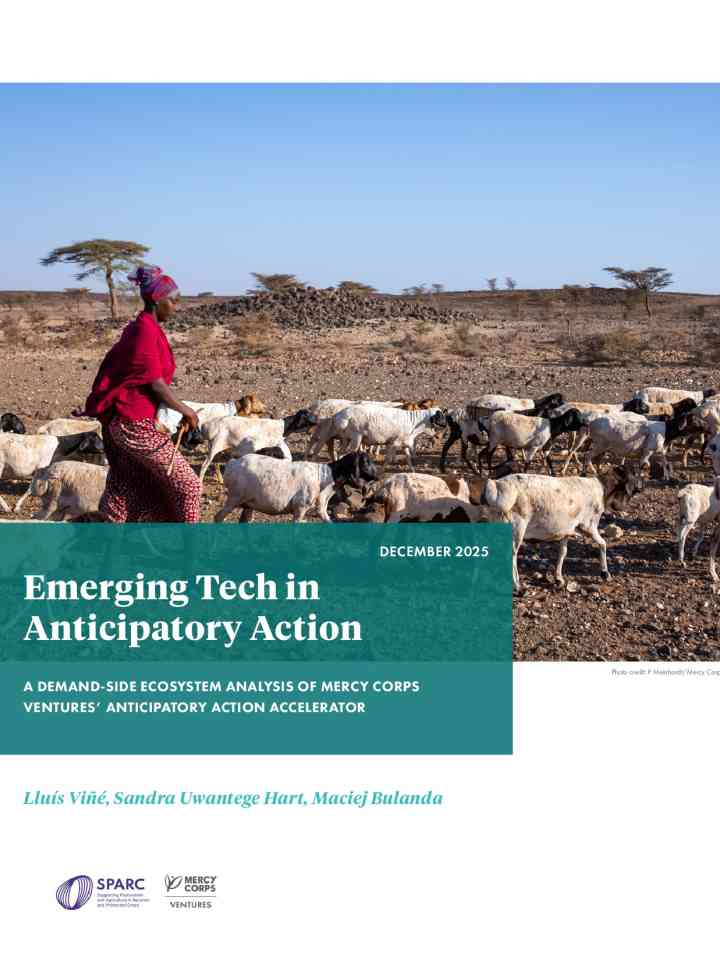
Emerging tech in anticipatory action: A demand-side ecosystem analysis of mercy corps ventures’ anticipatory action accelerator
This report examines the innovation ecosystem surrounding Anticipatory Action (AA) — a humanitarian approach that enables actors to respond before crises occur through science-based forecasts, pre-arranged financing, and pre-planned interventions. Using Mercy Corps Ventures’ Anticipatory Action Accelerator (AAA) as a central case study, it analyses how emerging technologies are being applied in AA, what structural conditions shape innovation in the field, and what role acceleration mechanisms can play in strengthening the ecosystem.
The study employs a mixed-methods design combining a complete quantitative analysis of 232 AAA applications from 57 countries with 10 semi-structured interviews with applicants, review panel judges, and AA and humanitarian innovation experts. Analysis is structured around the 6R humanitarian innovation ecosystem framework (Rush et al., 2021), examining Resources, Routines, Roles, Relationships, Rules, and Results.
Findings reveal a field that is expanding but structurally constrained. Applications are geographically concentrated in Eastern Africa, hazard coverage is dominated by flooding and drought, and 96% of proposals rely on artificial intelligence and machine learning — predominantly for forecasting. Most solutions are early-stage, end-user participation is rare, and nearly one-third of applications show inconsistencies between claimed maturity and active user numbers. At the ecosystem level, fragmented short-term funding, weak evidence generation, conceptual ambiguity around AA’s definition, and asymmetric power relations among actors collectively inhibit the transition from isolated pilots to integrated national systems.
The report argues that programs like the AAA can play a decisive role in addressing these gaps by acting as brokers that formalise cross-sector collaboration, as standard-setting platforms that clarify what constitutes AA, and as learning architectures that systematically generate and disseminate evidence. Four recommendations are advanced: broadening accessibility and inclusion, diversifying the innovation portfolio and support mechanisms, reinforcing the Accelerator’s brokering function, and institutionalising monitoring, evaluation, and learning. The study concludes that while accelerators cannot substitute for long-term government-led institutionalisation, they are well positioned to catalyse the conditions under which a more mature and coherent AA innovation ecosystem can emerge.
Explore further