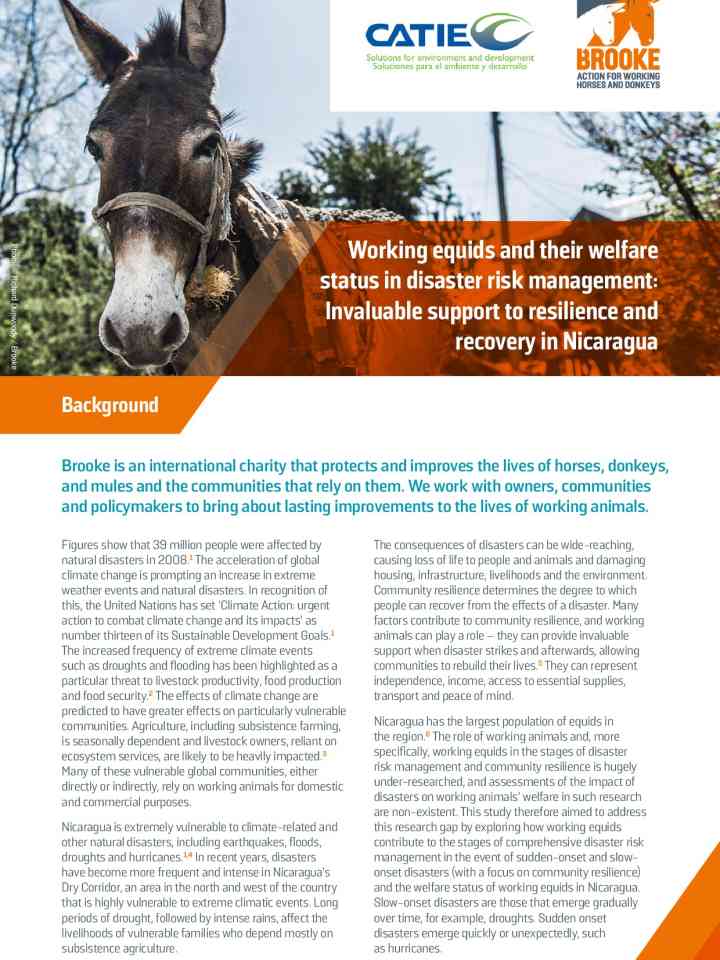
Working equids and their welfare status in disaster risk management: Invaluable support to resilience and recovery in Nicaragua
This publication examines the role of working equids (horses, donkeys, and mules) in disaster risk management in Nicaragua, highlighting both their critical contribution to community resilience and the challenges to their welfare. It shows that in disaster-prone, agriculture-dependent communities, equids are essential for transporting goods, water, people, and materials before, during, and after both slow-onset (e.g. drought) and sudden-onset (e.g. hurricanes) disasters. They support evacuation, access to markets and healthcare, and post-disaster recovery, making them a key yet often overlooked component of local resilience systems.
At the same time, the study finds that equids are largely excluded from disaster planning and face significant welfare risks, including injury, exhaustion, poor nutrition, and lack of shelter. Evidence shows that most households recognize these risks, yet limited resources and awareness constrain proper care. The report concludes that working animals should be more systematically integrated into disaster risk policies and planning, while also calling for more research on their role and welfare to better support both animal and human resilience.
Explore further