Building a resilient society
Source
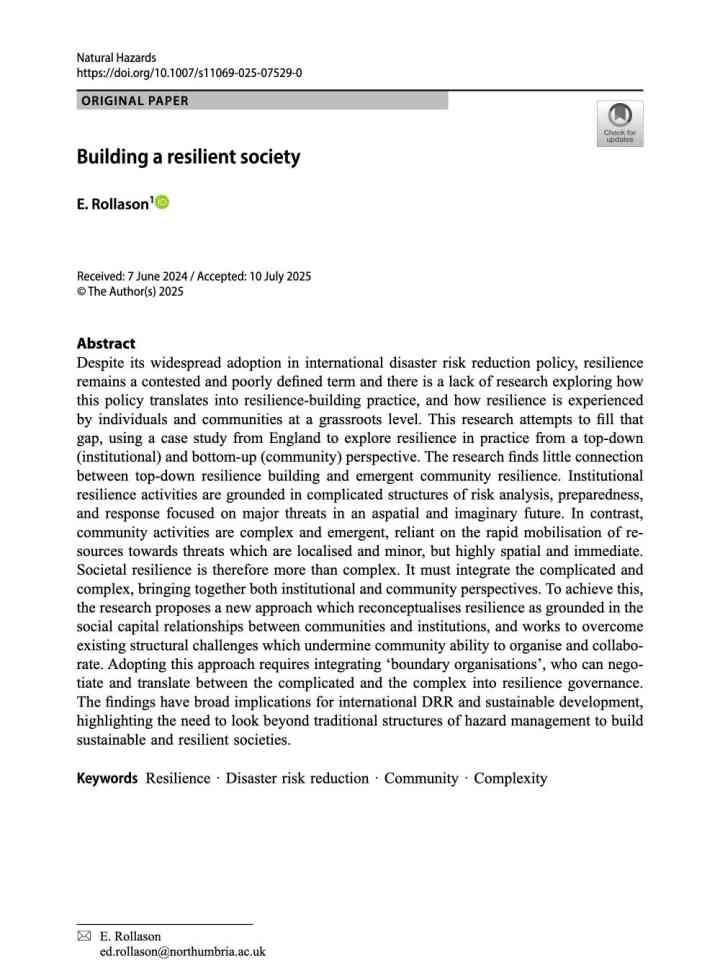
The aim of this research is to examine how the concept of resilience, despite its prominence in disaster risk reduction policy, is interpreted and implemented in practice. It seeks to bridge the gap between policy and lived experience by exploring resilience from both institutional (top-down) and community (bottom-up) perspectives through a case study in England.
This research proposes a new model for conceptualising a resilient society. To achieve this we must:
- Recognise that resilience is not a characteristic or property, but a function of how a system operates in distributing resources to meet threats.
- Focus resilience-building not on threats, but on enhancing community assets which enable a community's ability to respond resiliently.
- Recognise that traditional emergency management organisations are unsuited to building links with communities (co called linking capital) and instead integrate boundary organisations into the formal governance structures and practices of resilience building.
Explore further
Themes
Community-based DRR
Country and region
United States of America
ISBN/ISSN/DOI
10.1007/s11069-025-07529-0 (DOI)
Number of pages
28 p.
Publication year
2025