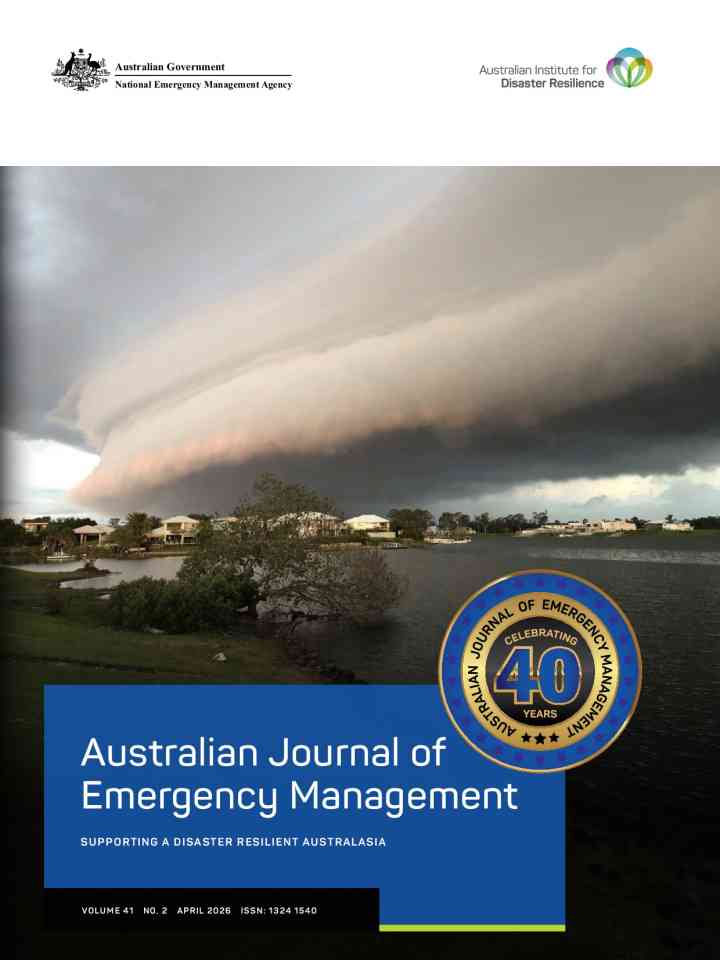
Australian Journal of Emergency Management (Vol. 41, No. 2, April 2026)
This issue provides a historical and critical overview of the development of emergency management in Australia from the 1970s to the present. It traces the shift from a civil defence model focused on war scenarios to a broader, all-hazards emergency management approach, examining institutional changes, major disasters, policy evolution, and the growing role of research, community engagement, and risk management. The author combines personal experience with sector-wide analysis to highlight how emergency management systems, structures, and priorities have evolved over time.
The findings show that emergency management in Australia has significantly improved in terms of professionalism, research integration, and capacity to handle routine emergencies, it still struggles with large-scale, complex crises. Increasing bureaucratisation, centralisation, and focus on procedures have reduced flexibility and community involvement, sometimes undermining resilience. Persistent issues—such as poor inter-agency coordination, limited inclusiveness, and inadequate community engagement continue to reappear despite decades of reform. The study concludes that future effectiveness depends on better integrating communities, improving adaptability, and addressing systemic risks in an era of “permacrisis” driven by climate change and interconnected hazards.
Explore further