My account
Navigation loading…
Your experience on PreventionWeb

Please help us improve PreventionWeb by taking this brief survey. Your input will allow us to better serve the needs of the DRR community.

See the survey

European Union

EU
Regional Intergovernmental Organizations
Propose an edit Upload your content

Mission

The EU was set through the process of European integration launched on 9 May 1950 when France officially proposed to create “the first concrete foundation of a European federation.” Six countries (Belgium, Germany, France, Italy, Luxembourg and the Netherlands) joined from the very beginning. Today, after four waves of accessions (1973: Denmark, Ireland and the United Kingdom; 1981: Greece; 1986: Spain and Portugal; 1995: Austria, Finland and Sweden), the EU has 15 Member States and is preparing for the accession of other eastern and southern European countries. Its main agencies are: European Parliament, Council of the Union, European Commission, Court of Justice, Court of Auditors, European Central Bank, European Economic and Social Committee, Committee of the Regions, European Investment Bank, European Ombudsman.
Show more
Latest additions
Items: 163
Documents and publications
5 July 2010
Building back better for next time

This document reports on an initiative which objective is to build the resilience of communities and nations to disasters by strengthening national and local institutions, mechanisms and capacities for disaster risk reduction.

European Union
United Nations Office for Disaster Risk Reduction - Regional Office for Asia and Pacific
This document reports on an initiative which objective is to build the resilience of communities and nations to disasters by strengthening national and local institutions, mechanisms and capacities for disaster risk reduction.
Documents and publications
18 December 2009
EU actions on environment and climate change in the world: press pack

Background material in view of COP15:

This document presents the EU’s fight against climate change hand-in-hand with an ambitious energy policy, covering the main environmental issues such as biodiversity loss, deforestation and forest governance

European Union
Background material in view of COP15:
Documents and publications
16 December 2009
Town watching handbook for disaster education: enhancing experiential learning

This hanbook aims at being used as a tool to reduce urban risk in small and medium sized cities by local schools, students, teachers, parents, resident associations and local government members.

European Union
United Nations Office for Disaster Risk Reduction - Regional Office for Asia and Pacific
This hanbook aims at being used as a tool to reduce urban risk in small and medium sized cities by local schools, students, teachers, parents, resident associations and local government members.
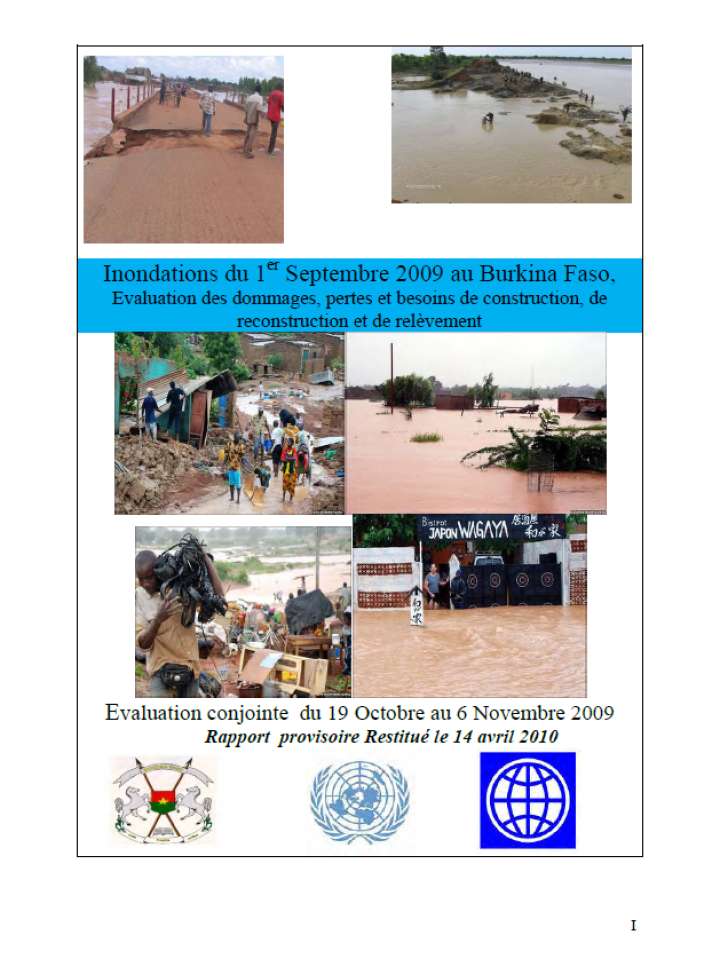
Floods 2009 Burkina Faso Assessment of Damage Loss and Construction Reconstruction and Rehabilitation Needs
Documents and publications
6 December 2009
2009 Floods in Burkina Faso - Assessment of damage, losses, reconstruction and recovery needs

This post-disaster needs assessment provides estimates of the damages and losses, and the costs for reconstruction and recovery following the 2009 floods in Burkina Faso. 

Burkina Faso - government
World Bank, the
United Nations - Headquarters
Global Facility for Disaster Reduction and Recovery, the (GFDRR)
United Nations Development Programme (UNDP)
Economic Commission for Latin America and the Caribbean (ECLAC/CEPAL)
European Union
This post-disaster needs assessment provides estimates of the damages and losses, and the costs for reconstruction and recovery following the 2009 floods in Burkina Faso. 
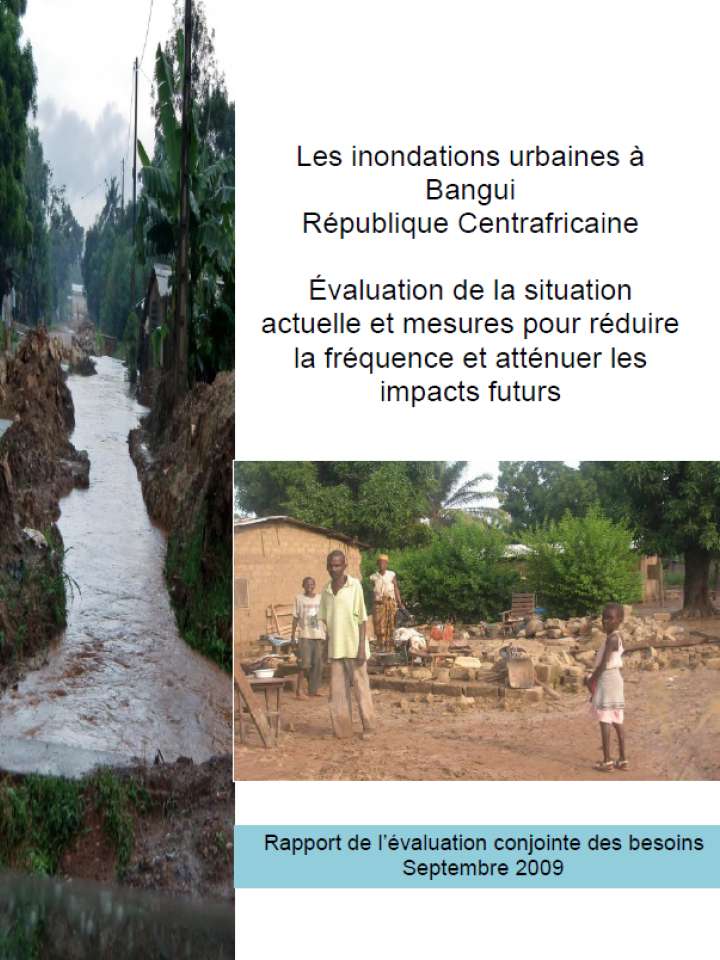
Floods 2009 Central African Republic Joint Needs Assessment Report
Documents and publications
6 December 2009
Urban flooding in Bangui, Central African Republic - Joint Needs Assessment to assess and mitigate the impacts of recurrent flooding

This joint needs assessment report provides estimates of the impacts and costs of reconstruction and recovery in Central African Republic following the 2009 floods in Bangui.

Central African Republic - government
World Bank, the
Global Facility for Disaster Reduction and Recovery, the (GFDRR)
United Nations Development Programme (UNDP)
United Nations Children's Fund (UNICEF)
European Union
United Nations Office for the Coordination of Humanitarian Affairs
Agence Française de Développement
This joint needs assessment report provides estimates of the impacts and costs of reconstruction and recovery in Central African Republic following the 2009 floods in Bangui.
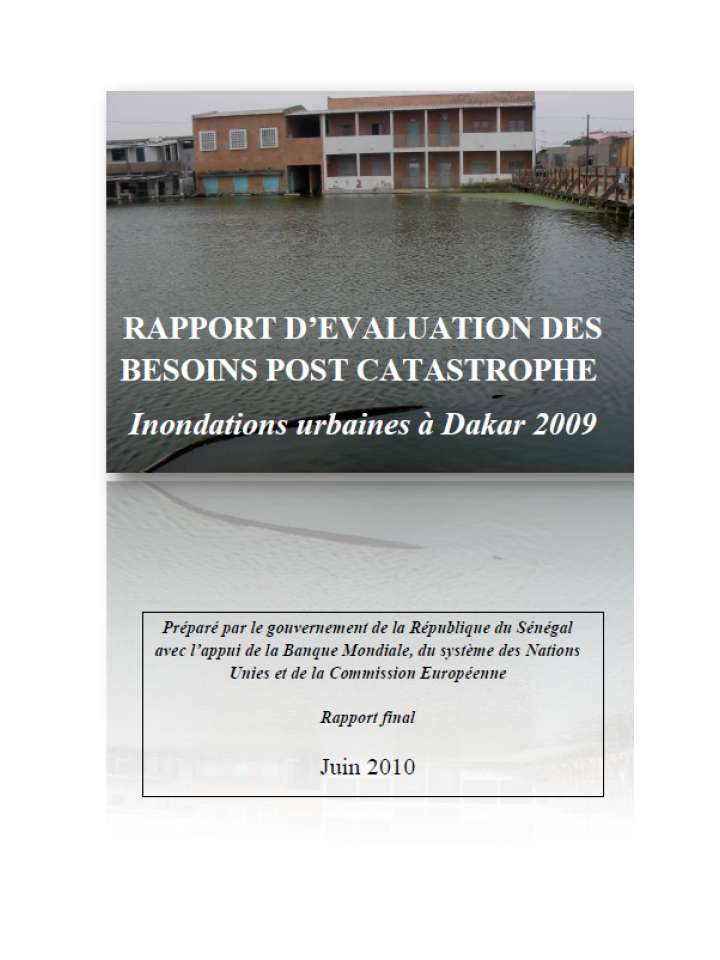
Floods 2009 Senegal Post Disaster Needs Assessment -FR
Documents and publications
6 December 2009
Post Disaster Needs Assessment - Urban floods in Dakar, Senegal 2009

This post-disaster needs assessment estimates the costs of recovery and reconstruction resulting from the impacts of the August 2009 floods in Dakar, Sengal.

Senegal - government
Global Facility for Disaster Reduction and Recovery, the (GFDRR)
United Nations Development Programme (UNDP)
European Union
This post-disaster needs assessment estimates the costs of recovery and reconstruction resulting from the impacts of the August 2009 floods in Dakar, Sengal.
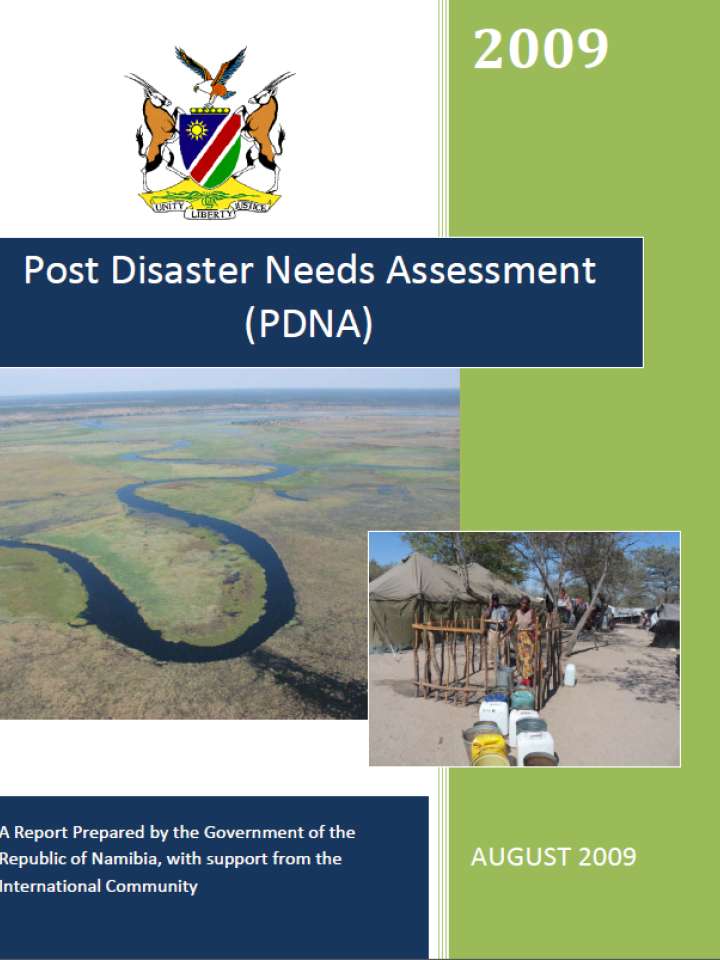
Floods 2009 Namibia Post Disaster Needs Assessment (PDNA)
Documents and publications
26 November 2009
Namibia 2009 Floods Post Disaster Needs Assessment

This Post Disaster Needs Assessment (PDNA) assesses damage and losses incurred as a result of 2009 floods, and provides an assessment of recovery and reconstruction options that could provide resilience to future events such as droughts and floods.

Namibia - government
World Bank, the
Global Facility for Disaster Reduction and Recovery, the (GFDRR)
United Nations Development Programme (UNDP)
European Union
This Post Disaster Needs Assessment (PDNA) assesses damage and losses incurred as a result of 2009 floods, and provides an assessment of recovery and reconstruction options that could provide resilience to future events such as droughts and floods.
Update
10 December 2009
The humanitarian challenges: A European Commission's perspective

The outgoing EU Development and Humanitarian Aid Commissioner, Karel De Gucht addresses the future of international aid 'We will need not only to strengthen our activities in the area of disaster risk reduction (DRR) but also to change the way we provide our humanitarian aid', she stated...

European Union
The outgoing EU Development and Humanitarian Aid Commissioner, Karel De Gucht addresses the future of international aid 'We will need not only to strengthen our activities in the area of disaster risk reduction (DRR) but also to change the way we provide our humanitarian aid', she stated...

Pagination

  • Previous page ‹ Previous
  • «
  • Page 13
  • Page 14
  • Page 15
  • Page 16
  • Page 17
  • Page 18
  • Current page 19
  • Page 20
  • Page 21
  • Next page Next ›

More content for this organization may be available on PreventionWeb or on the site search.

Voluntary Commitments

The organization has no registered commitments.

The Sendai Framework Voluntary Commitments (SFVC) online platform allows stakeholders to inform the public about their work on DRR. The SFVC online platform is a useful toolto know who is doing what and where for the implementation of the Sendai Framework, which could foster potential collaboration among stakeholders. All stakeholders (private sector, civil society organizations, academia, media, local governments, etc.) working on DRR can submit their commitments and report on their progress and deliverables.

Contact information

[email protected]

Is this page useful?

Yes No
Report an issue on this page

Thank you. If you have 2 minutes, we would benefit from additional feedback (link opens in a new window).

PreventionWeb is the global knowledge sharing platform for disaster risk reduction (DRR) and resilience.

  • Newsletter
  • Submit your content
  • Blog pitches
  • Submission and publishing policy
  • About PreventionWeb
  • Contact us

Hazards

  • Avalanche
  • Cold Wave
  • Cyclone, Hurricane and Typhoon
  • Drought and Desertification
  • Earthquake
  • Epidemic and pandemic
  • Flood
  • Heatwave, extreme heat and heat stress
  • Insect infestation
  • Land subsidence
  • Landslide
  • Nuclear, biological, chemical (NBC)
  • Sea level rise
  • Technological hazard
  • Thunderstorm
  • Tornado
  • Tsunami
  • Volcano
  • Wildfire

Regions

  • Africa
  • Americas
  • Asia
  • Europe
  • Oceania

Themes

Understanding & managing risk

  • Preparedness
  • Early warning
  • GIS and mapping
  • Data and information management
  • Risk identification and assessment
  • Small Island Developing States
  • Earth Observation

Natural environment

  • Climate change
  • Environment and ecosystems
  • Food security and agriculture
  • Water

Cross-cutting

  • Systemic risk
  • Recovery

Human development

  • Capacity development
  • Children and youth
  • Civil society / NGOs
  • Community-based DRR
  • Cultural heritage
  • Gender
  • Human mobility
  • Inclusion
  • Social impacts and resilience

Science, knowledge & advocacy

  • Disaster risk communication
  • Traditional and Indigenous knowledges
  • Science-policy-practice interface

State, governance & economy

  • Financing DRR
  • Fragility and conflict
  • Governance
  • Insurance and risk transfer
  • Private sector

Infrastructure & critical services

  • Critical infrastructure
  • Education and school safety
  • Health and health facilities
  • Structural safety
  • Urban risk and planning
Loading