UNDRR Logo
My account
Navigation loading…
  • Add
  • Your experience on PreventionWeb

    Please help us improve PreventionWeb by taking this brief survey. Your input will allow us to better serve the needs of the DRR community.

    See the survey

    Centre for Climate Change Economics and Policy

    CCCEP
    United Kingdom of Great Britain and Northern Ireland
    Academic & Scientific
    Propose an edit Upload your content

    Mission

    The Centre for Climate Change Economics and Policy (CCCEP) brings together some of the world's leading researchers on climate change economics and policy, from many different disciplines. It was established in 2008 and its first phase ended on 30 September 2013. Its second phase commenced on 1 October 2013.

    The Centre is hosted jointly by the University of Leeds and the London School of Economics and Political Science (LSE) and is chaired by Professor Lord Stern of Brentford. It is funded by the Economic and Social Research Council (ESRC).

    The Centre’s mission is to advance public and private action on climate change through rigorous, innovative research.
    Show more
    Latest additions
    Items: 19
    Cover
    Documents and publications
    8 August 2023
    Does the geographical footprint of Ethiopia’s flagship social protection programme align with climatic and conflict risks?

    This study asks whether Ethiopia's ‘Productive Safety Net Programme’ PSNP’s system of geographical targeting at the start of its fifth phase aligns with this more comprehensive framing of ‘adaptive social protection’.

    London School of Economics and Political Science, the
    Grantham Research Institute on Climate Change and the Environment
    Centre for Climate Change Economics and Policy
    University of Leeds
    This study asks whether Ethiopia's ‘Productive Safety Net Programme’ PSNP’s system of geographical targeting at the start of its fifth phase aligns with this more comprehensive framing of ‘adaptive social protection’.
    Cover and title of publication
    Documents and publications
    14 December 2021
    Investigating flood resilience perceptions and supporting collective decision-making through fuzzy cognitive mapping

    This paper investigates how methods used to model perceptions and measure resilience can help decision-makers create inclusive and proactive flood resilience strategies for communities.

    London School of Economics and Political Science, the
    Grantham Research Institute on Climate Change and the Environment
    Centre for Climate Change Economics and Policy
    This paper investigates how methods used to model perceptions and measure resilience can help decision-makers create inclusive and proactive flood resilience strategies for communities.
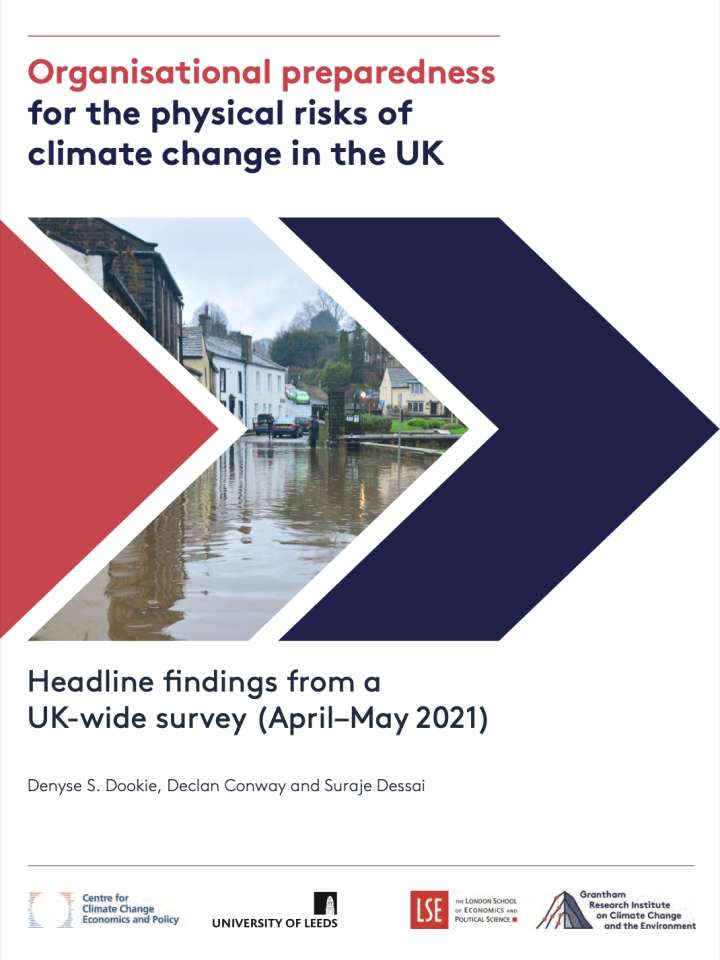
    Coverpage of "Organisational preparedness for the physical risks of climate change in the UK"
    Documents and publications
    13 October 2021
    Organisational preparedness for the physical risks of climate change in the UK

    This report presents the headline findings from a national survey of UK-based organisations’ perceptions about adapting to a changing climate.

    Centre for Climate Change Economics and Policy
    University of Leeds
    London School of Economics and Political Science, the
    Grantham Research Institute on Climate Change and the Environment
    This report presents the headline findings from a national survey of UK-based organisations’ perceptions about adapting to a changing climate.
    Documents and publications
    22 July 2021
    Supporting urban adaptation to climate change: what role can resilience measurement tools play?

    In this study, the authors explore how and to what extent such tools can be or have been utilised by city-level actors to support their decision-making processes for building climate change resilience. Cities are emerging as leading forces for climate

    Grantham Research Institute on Climate Change and the Environment
    London School of Economics and Political Science, the
    Centre for Climate Change Economics and Policy
    In this study, the authors explore how and to what extent such tools can be or have been utilised by city-level actors to support their decision-making processes for building climate change resilience. Cities are emerging as leading forces fo
    Documents and publications
    1 April 2021
    Saving lives and livelihoods: the benefits of investments in climate change adaptation and resilience

    This report highlights six case studies of successful climate change adaptation and resilience, mostly in developing countries. It assesses the success of specific adaptation and resilience processes, the benefits gained and the lessons learned.

    The

    Grantham Research Institute on Climate Change and the Environment
    London School of Economics and Political Science, the
    Centre for Climate Change Economics and Policy
    This report highlights six case studies of successful climate change adaptation and resilience, mostly in developing countries.
    Documents and publications
    27 August 2020
    Designing a funding framework for the slow-onset impacts of climate change: insights from recent experiences with planned relocation

    This paper investigates recent approaches to the planned relocation of communities as one possible response to climate change impacts. The authors find that funding for this pre-emptive response strategy is inadequate and consider principles to inform the

    University of Leeds
    Economic and Social Research Council
    Grantham Research Institute on Climate Change and the Environment
    London School of Economics and Political Science, the
    Centre for Climate Change Economics and Policy
    This paper investigates recent approaches to the planned relocation of communities as one possible response to climate change impacts.
    Documents and publications
    11 August 2020
    Enabling private sector adaptation to climate change among small businesses in developing countries: What role for multi-stakeholder partnerships? Experiences from Kenya

    This paper investigates the role of multi-stakeholder partnerships (MSPs) in supporting the development of enabling conditions for adaptation to climate change among micro, small and medium enterprises (SMEs) in developing countries, with a focus on Kenya

    Grantham Research Institute on Climate Change and the Environment
    Centre for Climate Change Economics and Policy
    This paper investigates the role of multi-stakeholder partnerships (MSPs) in supporting the development of enabling conditions for adaptation to climate change among micro, small and medium enterprises (SMEs) in developing countries, with a focus
    Documents and publications
    6 August 2020
    Disaster impacts and financing: local insights from the Philippines

    The Philippines is considered one of the most hazard-exposed countries in the world. The country’s people and economy are especially vulnerable to the impacts of natural hazards due to their dependency on climate-reliant activities such as agriculture and

    University of Leeds
    Economic and Social Research Council
    Grantham Research Institute on Climate Change and the Environment
    London School of Economics and Political Science, the
    Centre for Climate Change Economics and Policy
    The Philippines is considered one of the most hazard-exposed countries in the world.

    Pagination

    Showing results 1–8 on this page

    • 1
    • 2
    • Next

    More content for this organization may be available on PreventionWeb or on the site search.

    Voluntary Commitments

    The organization has no registered commitments.

    The Sendai Framework Voluntary Commitments (SFVC) online platform allows stakeholders to inform the public about their work on DRR. The SFVC online platform is a useful toolto know who is doing what and where for the implementation of the Sendai Framework, which could foster potential collaboration among stakeholders. All stakeholders (private sector, civil society organizations, academia, media, local governments, etc.) working on DRR can submit their commitments and report on their progress and deliverables.

    Contact information

    http://www.cccep.ac.uk/
    [email protected]

    Is this page useful?

    Yes No
    Report an issue on this page

    Thank you. If you have 2 minutes, we would benefit from additional feedback (link opens in a new window).

    PreventionWeb is the global knowledge sharing platform for disaster risk reduction (DRR) and resilience.

    • Newsletter
    • Submit your content
    • Blog pitches
    • Submission and publishing policy
    • About PreventionWeb
    • Contact us

    Hazards

    • Avalanche
    • Cold Wave
    • Cyclone, Hurricane and Typhoon
    • Drought and Desertification
    • Earthquake
    • Epidemic and pandemic
    • Flood
    • Heatwave, extreme heat and heat stress
    • Insect infestation
    • Land subsidence
    • Landslide
    • Nuclear, biological, chemical (NBC)
    • Sea level rise
    • Technological hazard
    • Thunderstorm
    • Tornado
    • Tsunami
    • Volcano
    • Wildfire

    Regions

    • Africa
    • Americas
    • Asia
    • Europe
    • Oceania

    Themes

    Understanding & managing risk

    • Preparedness
    • Early warning
    • GIS and mapping
    • Data and information management
    • Risk identification and assessment
    • Small Island Developing States
    • Earth Observation

    Natural environment

    • Climate change
    • Environment and ecosystems
    • Food security and agriculture
    • Water

    Cross-cutting

    • Systemic risk
    • Recovery

    Human development

    • Capacity development
    • Children and youth
    • Civil society / NGOs
    • Community-based DRR
    • Cultural heritage
    • Gender
    • Human mobility
    • Inclusion
    • Social impacts and resilience

    Science, knowledge & advocacy

    • Disaster risk communication
    • Traditional and Indigenous knowledges
    • Science-policy-practice interface

    State, governance & economy

    • Financing DRR
    • Fragility and conflict
    • Governance
    • Insurance and risk transfer
    • Private sector

    Infrastructure & critical services

    • Critical infrastructure
    • Education and school safety
    • Health and health facilities
    • Structural safety
    • Urban risk and planning
    Loading