My account
Menu
Your experience on PreventionWeb

Please help us improve PreventionWeb by taking this brief survey. Your input will allow us to better serve the needs of the DRR community.

See the survey

Group on Earth Observations Global Agricultural Monitoring Initiative

GEOGLAM
Switzerland
Academic & Scientific
Propose an edit Upload your content

Mission

GEOGLAM is the Group on Earth Observations Global Agricultural Monitoring Initiative. It was initially launched by the Group of Twenty (G20) Agriculture Ministers in June 2011, in Paris. The G20 Ministerial Declaration states that GEOGLAM "will strengthen global agricultural monitoring by improving the use of remote sensing tools for crop production projections and weather forecasting". By providing coordinated Earth observations from satellites and integrating them with ground-based and other in-situ measurements, the initiative will contribute to generating reliable, accurate, timely and sustained crop monitoring information and yield forecasts.

Show more
Latest additions
Items: 80
Publication
Published on
12 November 2024
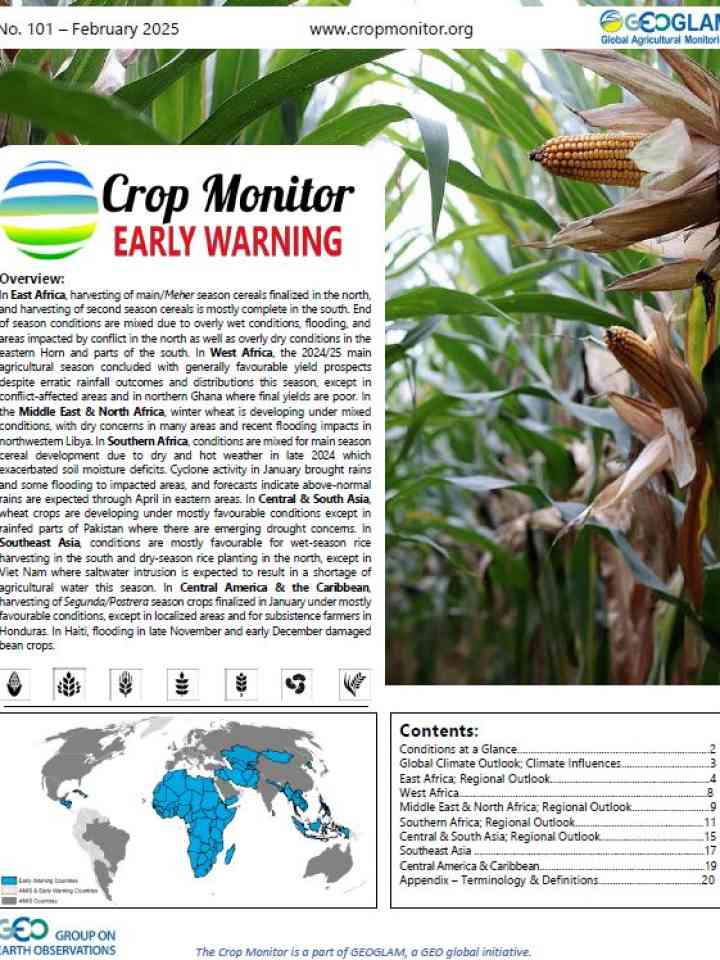
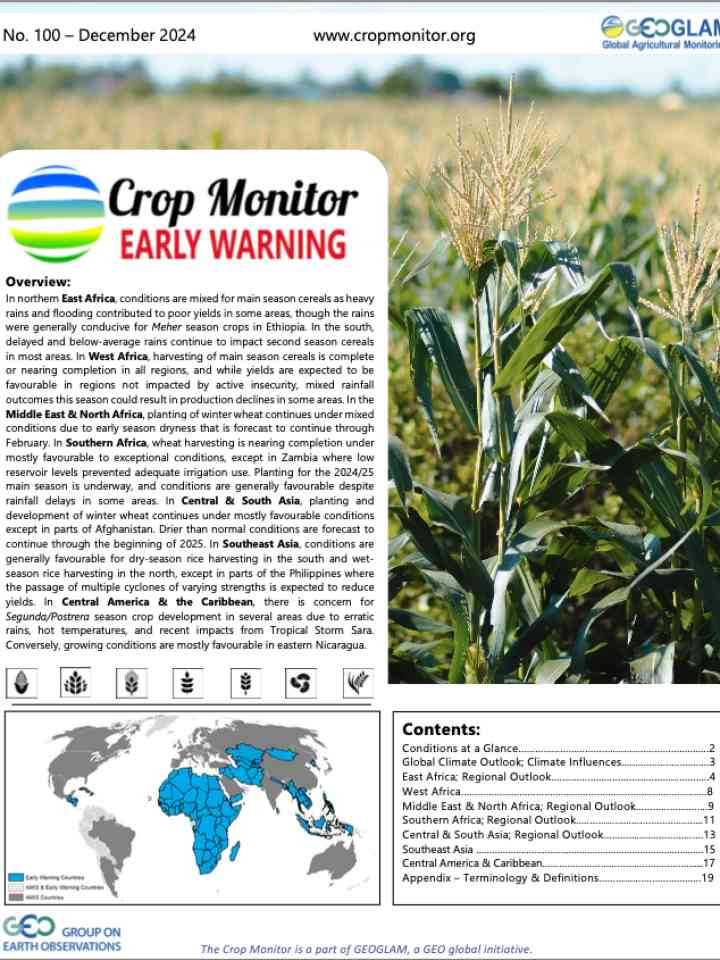
GEOGLAM Crop Monitor for Early Warning report: November 2024
The GEOGLAM Crop Monitor for Early Warning (CM4EW) is an international and transparent multi-source, consensus assessment of the crop growing conditions, status, and agro-climatic conditions that are likely to impact global production.
Publication
Published on
4 October 2024
GEOGLAM Crop Monitor for Early Warning report: October 2024
The GEOGLAM Crop Monitor for Early Warning (CM4EW) is an international and transparent multi-source, consensus assessment of the crop growing conditions, status, and agro-climatic conditions that are likely to impact global production.
Publication
Published on
6 September 2024
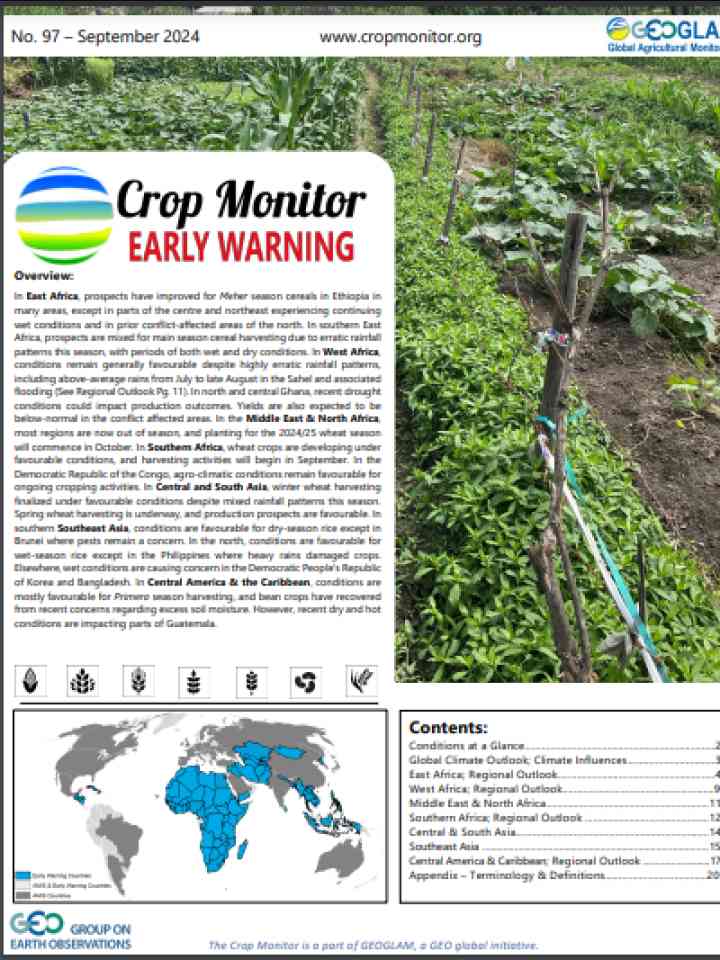
GEOGLAM Crop Monitor for Early Warning report: September 2024
The GEOGLAM Crop Monitor for Early Warning (CM4EW) is an international and transparent multi-source, consensus assessment of the crop growing conditions, status, and agro-climatic conditions that are likely to impact global production.
Publication
Published on
5 August 2024
GEOGLAM Crop Monitor for Early Warning Report: August 2024
The GEOGLAM Crop Monitor for Early Warning (CM4EW) is an international and transparent multi-source, consensus assessment of the crop growing conditions, status, and agro-climatic conditions that are likely to impact global production.
Publication
Published on
5 July 2024
GEOGLAM Crop Monitor for Early Warning Report: July 2024
The GEOGLAM Crop Monitor for Early Warning (CM4EW) is an international and transparent multi-source, consensus assessment of the crop growing conditions, status, and agro-climatic conditions that are likely to impact global production.
Publication
Published on
10 June 2024
GEOGLAM Crop Monitor for Early Warning report: June 2024
The GEOGLAM Crop Monitor for Early Warning is an international assessment of the crop growing conditions, status, and agro-climatic conditions that are likely to impact global production. This issue covers conditions in May 2024.
Publication
Published on
5 April 2024
GEOGLAM Crop Monitor for Early Warning report: April 2024
The GEOGLAM Crop Monitor for Early Warning (CM4EW) is an international and transparent multi-source, consensus assessment of the crop growing conditions, status, and agro-climatic conditions that are likely to impact global production.
Publication
Published on
8 March 2024
GEOGLAM Crop Monitor for Early Warning report: March 2024
The CM4EW reports on climate hazards, such as drought, flood, and extreme weather, as well as pests and crop diseases, as part of its monitoring of countries at risk of famine and to provide early warnings of impending crop shortfalls.

Pagination

  • Previous page ‹ Previous
  • Page 1
  • Page 2
  • Current page 3
  • Page 4
  • Page 5
  • Page 6
  • Page 7
  • Page 8
  • Page 9
  • »
  • Next page Next ›

More content for this organization may be available on PreventionWeb or on the site search.

Voluntary Commitments

The organization has no registered commitments.

The Sendai Framework Voluntary Commitments (SFVC) online platform allows stakeholders to inform the public about their work on DRR. The SFVC online platform is a useful toolto know who is doing what and where for the implementation of the Sendai Framework, which could foster potential collaboration among stakeholders. All stakeholders (private sector, civil society organizations, academia, media, local governments, etc.) working on DRR can submit their commitments and report on their progress and deliverables.

Contact information

http://www.geoglam.org
[email protected]
+62431-844095. 844730
Fax:
+62431-844145
Facebook
LinkedIn
Twitter

Is this page useful?

Yes No
Report an issue on this page

Thank you. If you have 2 minutes, we would benefit from additional feedback (link opens in a new window).

PreventionWeb is the global knowledge sharing platform for disaster risk reduction (DRR) and resilience.

  • Newsletter
  • Submit your content
  • Blog pitches
  • Submission and publishing policy
  • About PreventionWeb
  • Contact us

Hazards

  • Avalanche
  • Cold Wave
  • Cyclone, Hurricane and Typhoon
  • Drought and Desertification
  • Earthquake
  • Epidemic and pandemic
  • Flood
  • Heatwave, extreme heat and heat stress
  • Insect infestation
  • Land subsidence
  • Landslide
  • Nuclear, biological, chemical (NBC)
  • Sea level rise
  • Technological hazard
  • Thunderstorm
  • Tornado
  • Tsunami
  • Volcano
  • Wildfire

Regions

  • Africa
  • Americas
  • Asia
  • Europe
  • Oceania

Themes

Understanding & managing risk

  • Preparedness
  • Early warning
  • GIS and mapping
  • Data and information management
  • Risk identification and assessment
  • Small Island Developing States
  • Earth Observation

Natural environment

  • Climate change
  • Environment and ecosystems
  • Food security and agriculture
  • Water

Cross-cutting

  • Systemic risk
  • Recovery

Human development

  • Capacity development
  • Children and youth
  • Civil society / NGOs
  • Community-based DRR
  • Cultural heritage
  • Gender
  • Human mobility
  • Inclusion
  • Social impacts and resilience

Science, knowledge & advocacy

  • Disaster risk communication
  • Traditional and Indigenous knowledges
  • Science-policy-practice interface

State, governance & economy

  • Financing DRR
  • Fragility and conflict
  • Governance
  • Insurance and risk transfer
  • Private sector

Infrastructure & critical services

  • Critical infrastructure
  • Education and school safety
  • Health and health facilities
  • Structural safety
  • Urban risk and planning
Loading