1. Home
  2. Hubs: tools and knowledge
  3. Wildfire Portal

Public Health

Wildfires pose serious risks to public health, both during and long after a fire.

Beyond deaths and injuries caused directly by flames, wildfire smoke and air pollution can affect communities far from the affected area, increasing respiratory and cardiovascular risks and placing pressure on health systems. Explore the latest research, insights and resources on the health impacts of wildfires and the measures needed to reduce risk and protect vulnerable populations.
Uploaded on
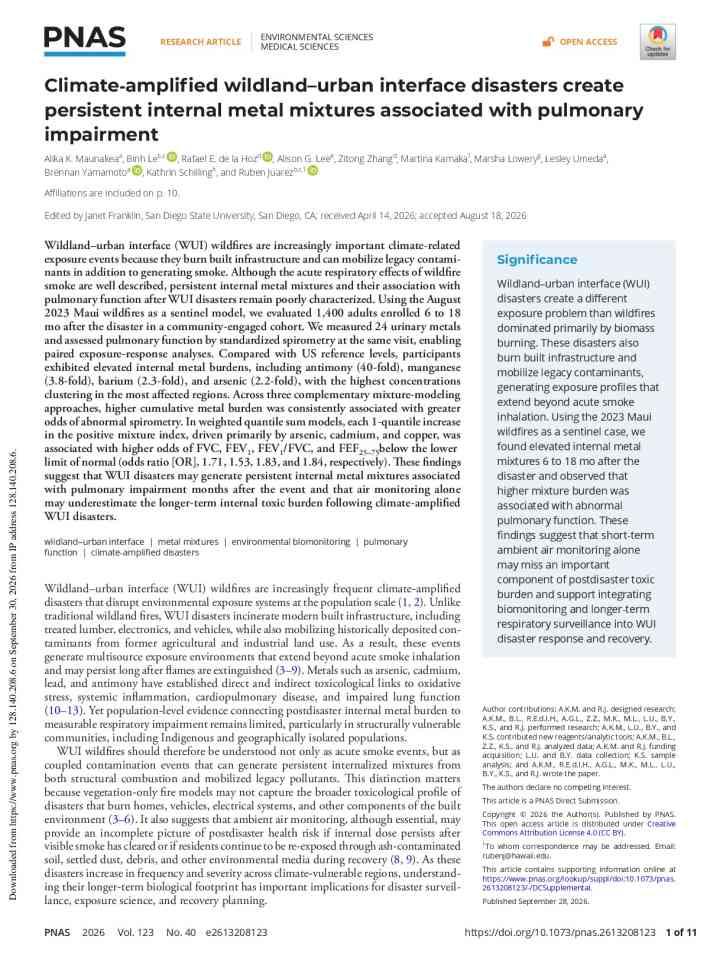
Climate-amplified wildland–urban interface disasters create persistent internal metal mixtures associated with pulmonary impairment thumbnail
Documents and publications

This study suggests that wildland-urban interface (WUI) disasters create a distinct post-disaster exposure regime characterised by persistent internal metal mixtures associated with pulmonary impairment months after the event.

Proceedings of the National Academy of Sciences of the United States of America (PNAS)
Dynamic image of a wildfire engulfing a countryside field, with thick smoke and flames.
Update

Wildfires can turn natural metals in soil into toxic, airborne particles. Stanford researchers are working to predict where these metals travel and warn people in harm’s way.

Doerr School of Sustainability, Stanford University
Dynamic image of a wildfire engulfing a countryside field, with thick smoke and flames.
Update

An increase in pollution from wildfires and heatwaves risks undermining international efforts to improve air quality and protect human and ecosystem health, according to a new WMO report, which traces interlinkages between air quality and climate.

World Meteorological Organization (WMO)
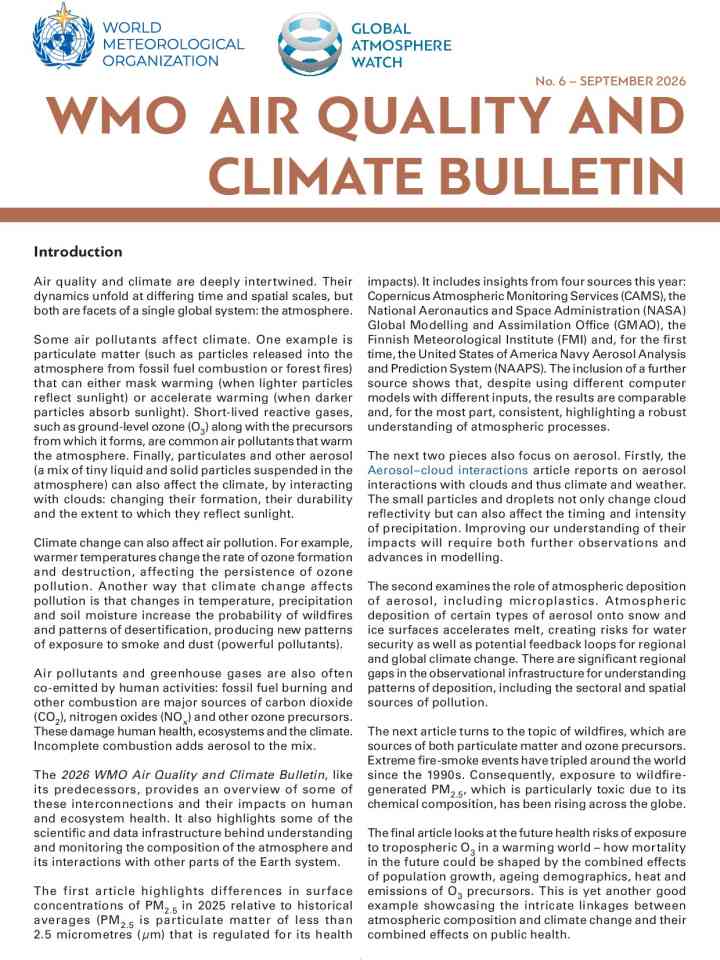
WMO air quality and climate bulletin thumbnail
Documents and publications

The sixth WMO Air Quality and Climate Bulletin examines links between air quality and climate change, highlighting aerosol impacts, wildfire smoke, ozone pollution and atmospheric monitoring needs.

World Meteorological Organization (WMO)
Update

Smoke from wildfires can travel thousands of kilometres, crossing borders, oceans and continents. Understanding where it will go next has become an increasingly important scientific challenge.

World Meteorological Organization (WMO)
Many people wear facial masks on June 7, 2023 because of bad air quality brought in by smoke of Canadian wildfires
Research briefs

As regulations have reduced prenatal exposure to harmful emissions from vehicles and industry in recent years, smoke from climate-fueled wildfires is erasing air quality gains.

Inside Climate News
Two young boys in masks play with colorful toys outdoors
Update

Smoky summers are the new normal forcing a generation of children to grow up indoors. Repeated smoke events change children’s daily routines, limiting opportunities for outdoor play and social interaction and reshape how many families experience summer.

Inside Climate News
Research briefs

UCLA and UC Davis researchers found the strongest associations on very smoky days and in areas with cleaner air overall.

University of California, Los Angeles
Uploaded on