1. Home
  2. Hubs: tools and knowledge
  3. Extreme Heat Portal

Heat and public health

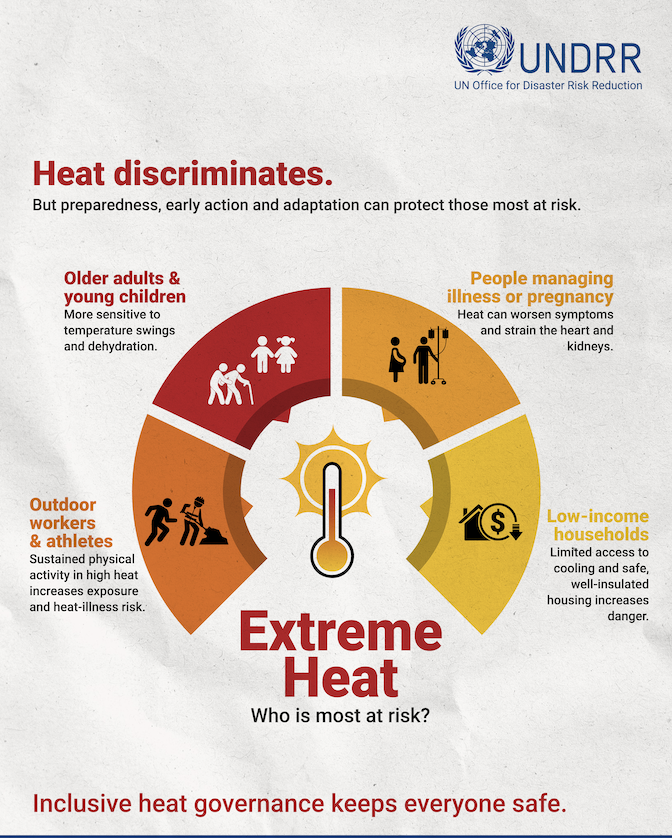
Who does extreme heat discriminate against?
Uploaded on
 Young Latin male tennis player resting and drinking water on tennis court in sunny hot day at summer
Update

With extreme heat a growing challenge for summer sport, University of Sydney researchers are working with Tennis Australia to develop evidence-based tools to keep players safe at the Australian Open.

University of Sydney
Update

Kenya's outdoor workers face rising skin damage as climate change drives higher heat and UV exposure. Dermatologists report more burns, pigmentation issues and infections, while costly sunscreen limits protection for millions.

Science and Development Network
Update

The Australian Open tennis tournament, scheduled for the second half of January amid peak summer weather in the Southern Hemisphere, has been forced to rearrange some of its matches and adjust court assignments.

The Cool Down
Outback mining town in North of Western Australia
Research briefs

From 5–10 January, 2026, south-eastern Australia experienced its most severe heatwave since 2019–20. Temperatures exceeded 40°C in major cities including Melbourne and Sydney, with even hotter conditions across regional Victoria and New South Wale.

World Weather Attribution
Update

By 2050, climate change could contribute to 14.5 million additional deaths, $12.5 trillion in economic losses and $1.1 trillion in extra healthcare costs. Health adaptation makes the conversation about climate change real and urgent in the here and now.

World Economic Forum (WEF)
Update

Many chronic pain patients cite the weather as a driver of their suffering, and climate change is making the torment more likely and harder to deal with. But research on the relationship is uncertain, and federal cuts could hold it back.

Inside Climate News
A child sits on a boat on a polluted river in Negro River, Amazon
Update

Earlier this year, a spate of deaths in Florida caused by a flesh-eating bacteria, made headlines. Infections of this kind are on the rise as ocean temperatures surge higher and marine heat waves increase in frequency and intensity due to climate change.

Mongabay
Update

Socioeconomic factors drive how much extreme heat public transit users in Chicago, NYC, and Washington, D.C., experience as they walk to and from metro stations.

Eos - AGU
Uploaded on