Pasar al contenido principal
UNDRR Logo
My account
Navigation loading…
Your experience on PreventionWeb

Please help us improve PreventionWeb by taking this brief survey. Your input will allow us to better serve the needs of the DRR community.

See the survey

Global Initiative on Disaster Risk Management (GIDRM)

GIDRM
Germany
Networks and Others
Propose an edit Upload your content

Mission

The Global Initiative on Disaster Risk Management (GIDRM) was founded by the German Federal Ministry for Economic Cooperation and Development (BMZ) and is implemented by the German Gesellschaft für Internationale Zusammenarbeit (GIZ). The project was set up to strengthen the German contribution to improved disaster risk management worldwide and to support partners with the implementation of the Sendai Framework.

DRR activities

Disaster Risk Reduction Goal

The GIDRM aims to enhance the implementation of Disaster Risk Management approaches as integrated solutions in selected development projects and partner projects. Insights gained and knowledge acquired throughout previous phases serve to inform future projects while safeguarding development and protecting lives.

In phase I, GIDRM collaborated with regional stakeholders to identify risks and strengthen risk reducing approaches. As these measures were implemented in accordance with cost-benefit projections, the first phase contributed to the strengthening of a sustainable disaster risk management worldwide.

Phase II the focus shifted to highlight the increasing need for more coherence in planning, implementation and reporting regarding the global agendas particularly the Sendai Framework.

Building on previous phases, phase III focused on the complex nature of risks by implementing risk-informed development to safeguard development achievements.

Our current phase focuses on minimising risk creation and foster resilience of people, infrastructures and stakeholders across all sectors. Accumulating all lesson learned, GIDRM IV builds capacity of institutions to understand risks and apply approaches to integrate disaster and climate risks in decision making process. By doing so, GIDRM safeguards development achievements and progress for the future.

Policies and Programmes in DRR

GIDRM identifies national and subnational examples of successful agenda-coherence. With respect to the implementation of global agendas, we define agenda-coherence as concerted state action in all relevant sectors and at all relevant levels in order to achieve both common and respective goals of all agendas more efficiently and effectively. The Sendai Framework Voluntary Commitments (SFVC) online platform allows stakeholders to inform the public about their work on DRR. The SFVC online platform is a useful tool to know who is doing what and where for the implementation of the Sendai Framework, which could foster potential collaboration among stakeholders. All stakeholders (private sector, civil society organizations, academia, media, local governments, etc.) working on DRR can submit their commitments and report on their progress and deliverables.
Show more
Latest additions
Items: 26
Cover
Documents and publications
29 April 2024
Risk-informed development: Why it matters

This publication covers adopting a risk-informed development (RID) perspective as crucial to safeguard development gains, foster resilience, and leave no one behind.

Deutsche Gesellschaft für Internationale Zusammenarbeit (GIZ)
Global Initiative on Disaster Risk Management (GIDRM)
This publication covers adopting a risk-informed development (RID) perspective as crucial to safeguard development gains, foster resilience, and leave no one behind.
Cover
Documents and publications
24 November 2023
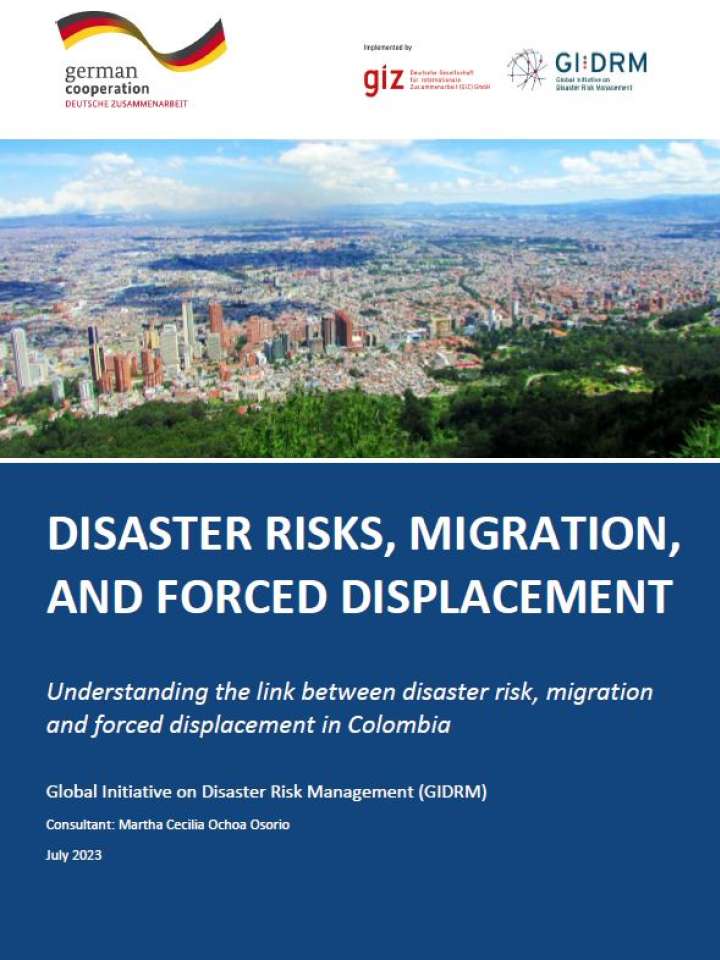
Disaster risks, migration, and forced displacement: Understanding the link between disaster risk, migration and forced displacement in Colombia

By examining the link between disaster risk conditions in the host communities and the vulnerability of migrants, the report aims to highlight the potential of reducing risks by incorporating risk-informed development approaches.

Global Initiative on Disaster Risk Management (GIDRM)
Deutsche Gesellschaft für Internationale Zusammenarbeit (GIZ)
By examining the link between disaster risk conditions in the host communities and the vulnerability of migrants, the report aims to highlight the potential of reducing risks by incorporating risk-informed development approaches.
Cover
Documents and publications
23 November 2023
International development in a contested world: ending extreme poverty and tackling climate change

By examining the link between disaster risk conditions in the host communities and the vulnerability of migrants, the report aims to highlight the potential of reducing risks by incorporating risk-informed development approaches.

Global Initiative on Disaster Risk Management (GIDRM)
By examining the link between disaster risk conditions in the host communities and the vulnerability of migrants, the report aims to highlight the potential of reducing risks by incorporating risk-informed development approaches.
Cover
Documents and publications
11 November 2023
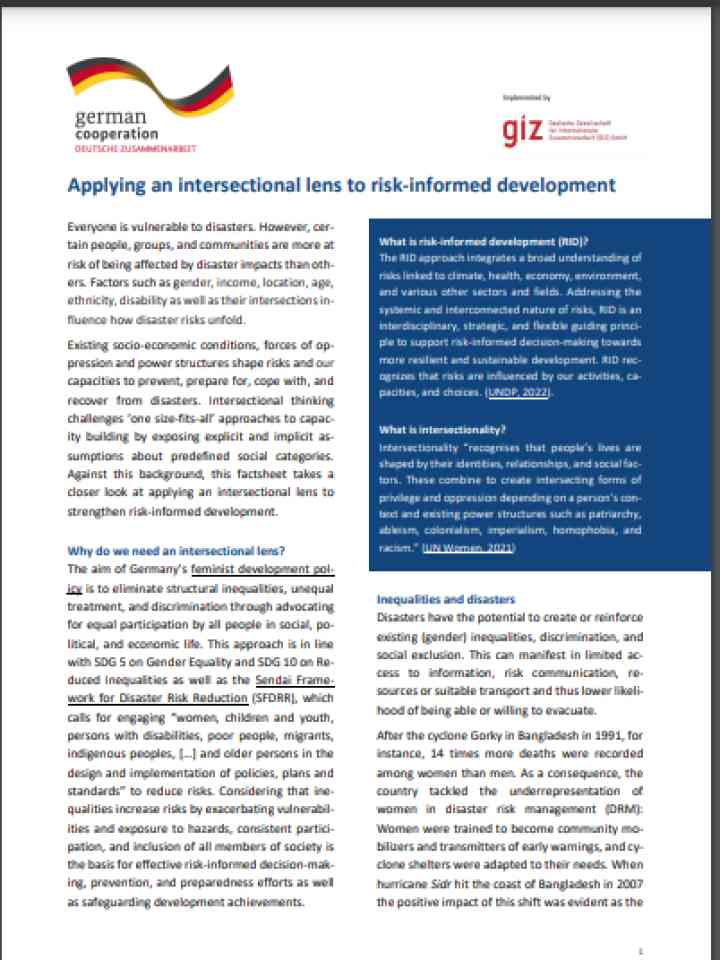
Applying an intersectional lens to risk-informed development

This factsheet takes a closer look at applying an intersectional lens to strengthen risk-informed development.

Global Initiative on Disaster Risk Management (GIDRM)
Deutsche Gesellschaft für Internationale Zusammenarbeit (GIZ)
This factsheet takes a closer look at applying an intersectional lens to strengthen risk-informed development.
Cover
Documents and publications
5 October 2023
Resilient public investment: Post-Covid economic recovery in LAC

This factsheet presents findings from an analysis of 14 Latin American countries to document the SNIPs’ response to the pandemic, as well as to draw recommendations and lessons-learned for stimulating economic recovery in a resilient manner.

Deutsche Gesellschaft für Internationale Zusammenarbeit (GIZ)
Global Initiative on Disaster Risk Management (GIDRM)
This factsheet presents findings from an analysis of 14 Latin American countries to document the SNIPs’ response to the pandemic, as well as to draw recommendations and lessons-learned for stimulating economic recovery in a resilient manner.
Cover
Documents and publications
30 August 2023
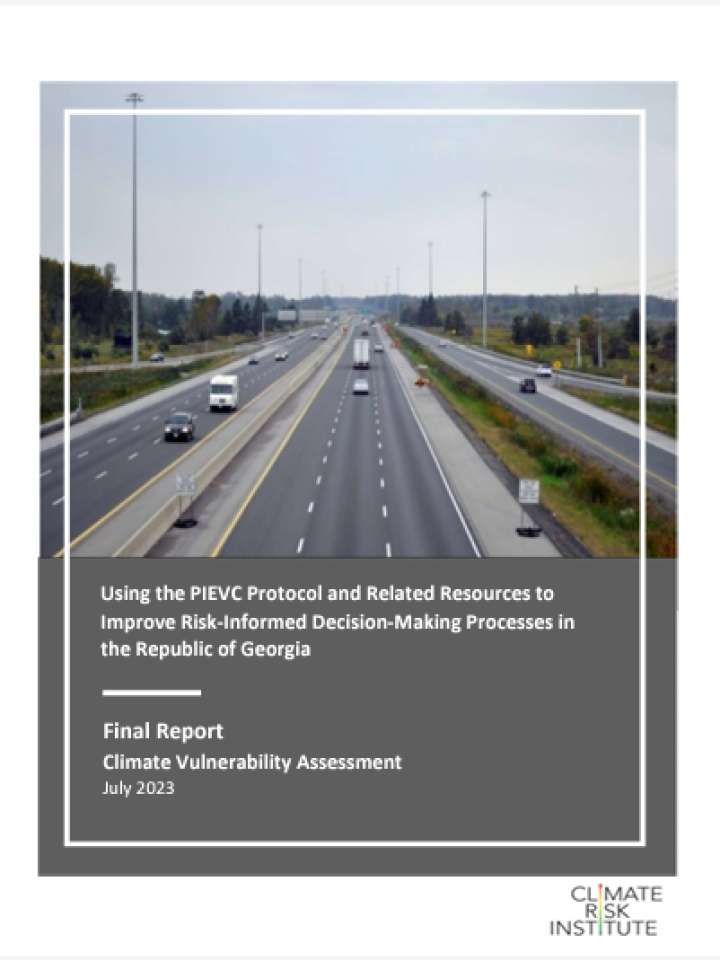
Application of the PEIVC protocol in Georgia: Risk-informed decision-making processes

The main focus of the project was a desktop-based vulnerability assessment of road segments in a region of the Republic of Georgia particularly prone to the impacts of severe weather, especially in the form of landslide related events.

Global Initiative on Disaster Risk Management (GIDRM)
The main focus of the project was a desktop-based vulnerability assessment of road segments in a region of the Republic of Georgia particularly prone to the impacts of severe weather, especially in the form of landslide related events.
Cover
Documents and publications
11 November 2022
Guidelines for the potential implementation of the technical guidance on comprehensive risk assessment and planning in the context of climate change in planning instruments in Colombia

This report sets out the main findings, recommendations and a roadmap for a potential implementation of the "Technical Guidance on Comprehensive Risk Assessment in the Context of Climate Change" in Colombia.

Global Initiative on Disaster Risk Management (GIDRM)
This report sets out the main findings, recommendations and a roadmap for a potential implementation of the "Technical Guidance on Comprehensive Risk Assessment in the Context of Climate Change" in Colombia.
Strengthening Decision-Making for Risk-Informed Development: Lessons learnt from Climate Resilient Economic Development
Documents and publications
7 November 2022
Strengthening decision-making for risk-informed development: Lessons learnt from climate resilient economic development

This paper discusses why we need to be more risk-informed and how we can become more risk-informed in international cooperation. We are facing increasingly complex, interconnected, and unpredictable risks.

Deutsche Gesellschaft für Internationale Zusammenarbeit (GIZ)
Global Initiative on Disaster Risk Management (GIDRM)
This paper discusses why we need to be more risk-informed and how we can become more risk-informed in international cooperation. We are facing increasingly complex, interconnected, and unpredictable risks.

Paginación

Showing results 1–8 on this page

  • 1
  • 2
  • Siguiente

More content for this organization may be available on PreventionWeb or on the site search.

Voluntary Commitments

The organization has no registered commitments.

The Sendai Framework Voluntary Commitments (SFVC) online platform allows stakeholders to inform the public about their work on DRR. The SFVC online platform is a useful toolto know who is doing what and where for the implementation of the Sendai Framework, which could foster potential collaboration among stakeholders. All stakeholders (private sector, civil society organizations, academia, media, local governments, etc.) working on DRR can submit their commitments and report on their progress and deliverables.
Contact information

[email protected]

Is this page useful?

Yes No
Report an issue on this page

Thank you. If you have 2 minutes, we would benefit from additional feedback (link opens in a new window).

PreventionWeb is the global knowledge sharing platform for disaster risk reduction (DRR) and resilience.

  • Newsletter
  • Submit your content
  • Blog pitches
  • Submission and publishing policy
  • About PreventionWeb
  • Contact us

Hazards

  • Avalanche
  • Cold Wave
  • Cyclone, Hurricane and Typhoon
  • Drought and Desertification
  • Earthquake
  • Epidemic and pandemic
  • Flood
  • Heatwave, extreme heat and heat stress
  • Insect infestation
  • Land subsidence
  • Landslide
  • Nuclear, biological, chemical (NBC)
  • Sea level rise
  • Technological hazard
  • Thunderstorm
  • Tornado
  • Tsunami
  • Volcano
  • Wildfire

Regions

  • Africa
  • Americas
  • Asia
  • Europe
  • Oceania

Themes

Understanding & managing risk

  • Preparedness
  • Early warning
  • GIS and mapping
  • Data and information management
  • Risk identification and assessment
  • Small Island Developing States
  • Earth Observation

Natural environment

  • Climate change
  • Environment and ecosystems
  • Food security and agriculture
  • Water

Cross-cutting

  • Systemic risk
  • Recovery

Human development

  • Capacity development
  • Children and youth
  • Civil society / NGOs
  • Community-based DRR
  • Cultural heritage
  • Gender
  • Human mobility
  • Inclusion
  • Social impacts and resilience

Science, knowledge & advocacy

  • Disaster risk communication
  • Traditional and Indigenous knowledges
  • Science-policy-practice interface

State, governance & economy

  • Financing DRR
  • Fragility and conflict
  • Governance
  • Insurance and risk transfer
  • Private sector

Infrastructure & critical services

  • Critical infrastructure
  • Education and school safety
  • Health and health facilities
  • Structural safety
  • Urban risk and planning
Loading