Research briefs

Keep up to date with the latest research on disaster risk and resilience on the PreventionWeb knowledge base.

Explore cutting-edge research on disaster risk reduction and resilience through PreventionWeb's dedicated research briefs section. Our platform curates and highlights the most recent academic studies, providing valuable insights into disaster risk management. Each research brief distills key findings from peer-reviewed journals and academic publications.

Submit a research brief.

These briefs are designed to keep you informed about the latest scientific advances. Links to the full publications are always included, ensuring easy access to in-depth knowledge. Please note that this section exclusively features academic research, distinct from reports by international organizations or Non-Governmental Organisations.
Uploaded on
Research briefs

Wildfires and drought have led to $11.2 billion in damages to privately held timberland in California, Oregon and Washington over the past two decades, a new Oregon State University study found.

Journal of Environmental Economics and Management
Research briefs

When floods are predicted only on the basis of local data, there may be unpleasant surprises. A new method makes it possible to significantly improve predictions - using international data from hydrologically similar areas.

Technische Universität Wien
Research briefs

Compound extreme events, defined as those where multiple climate extremes converge, often result in more severe and devastating impacts than individual events.

Chinese Academy of Sciences
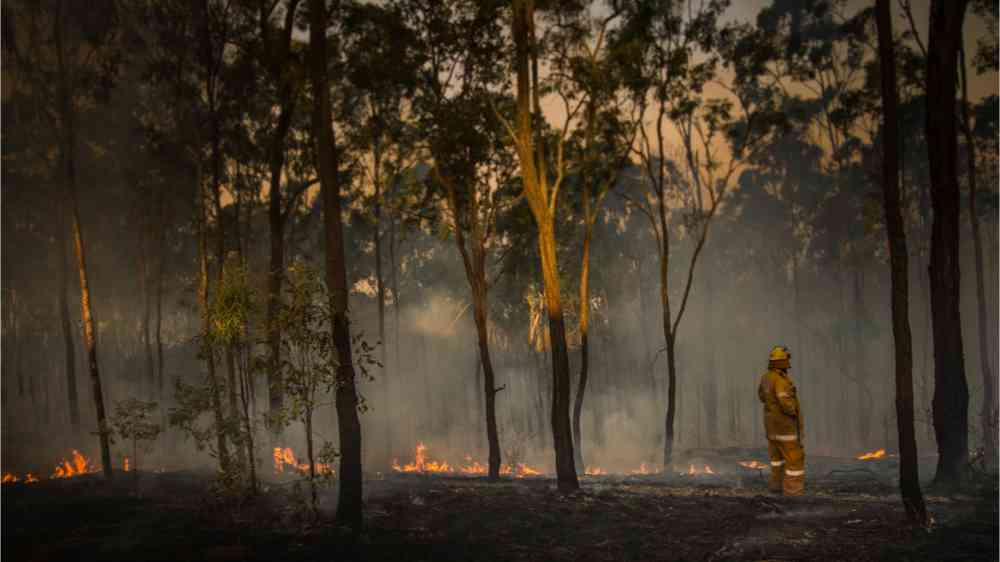
A firefighter surveys wildfire damage in Queensland, Australia
Research briefs

High-intensity, often catastrophic, wildfires have become increasingly frequent across the Western U.S. Researchers quantified the value of managed low-intensity burning to dramatically reduce the risk of such fires for years at a time.

Stanford Woods Institute for the Environment
Research briefs

As climate variability revises peak demand for heating and cooling in an electrified future, grid operators must plan ahead to guarantee reliability, say the authors of a new paper published in the journal Nature.

The Energy Mix
Research briefs

New research shows that lightning is the biggest threat to boreal forests and that its frequency will increase with climate change.

Faculty of Environment, University of Leeds
Research briefs

Using properties measured from distortions in the seafloor near the remains of an underwater landslide off the coast of Oregon, researchers have developed a novel approach for analyzing the risk that underwater landslides may trigger deadly tsunamis.

Ohio State University
Research briefs

A new study has uncovered a trend of increased short-duration extreme precipitation over mountainous regions under global warming in Southwest China. Short-duration extreme precipitation events can lead to flash floods and landslides.

Chinese Academy of Sciences