Research briefs

Keep up to date with the latest research on disaster risk and resilience on the PreventionWeb knowledge base.

Explore cutting-edge research on disaster risk reduction and resilience through PreventionWeb's dedicated research briefs section. Our platform curates and highlights the most recent academic studies, providing valuable insights into disaster risk management. Each research brief distills key findings from peer-reviewed journals and academic publications.

Submit a research brief.

These briefs are designed to keep you informed about the latest scientific advances. Links to the full publications are always included, ensuring easy access to in-depth knowledge. Please note that this section exclusively features academic research, distinct from reports by international organizations or Non-Governmental Organisations.
Uploaded on
Research briefs

Scientists have developed a way of modelling its behavior which could more effectively monitor potential eruptions from 'stealthy' volcanoes and provide warning to people in the path of danger.

Risk Frontiers Holdings Pty Ltd
Research briefs

Twenty years of data from around the world show that areas that are not too dry and not too wet are most conducive to wildfire burning.

Eos - AGU
Research briefs

A study buoyed traditional statistics with novel machine learning techniques, using artificial intelligence, to test early warning models for Tofino, B.C. - a popular surfing and tourist destination on Vancouver Island's west coast.

University of Western Ontario (Western University)
Research briefs

A new study finds that even storms below hurricane strength significantly increase infant deaths in low- and middle-income countries, and not just for the reasons experts expected.

University of Southern California Dornsife
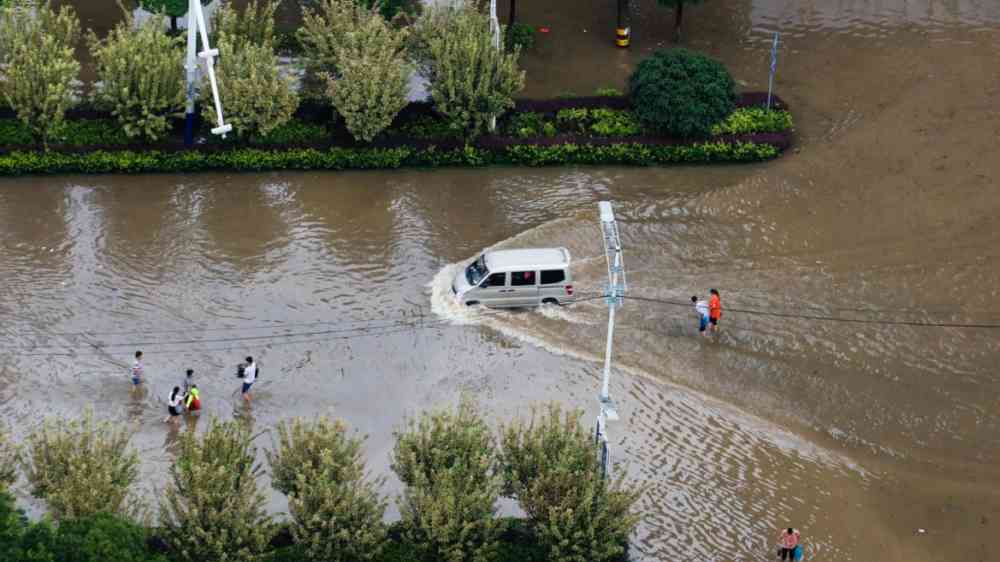
Aerial view of floods in a Chinese city, 2017
Research briefs

A paper reveals that climate extremes are increasingly striking in combination-and their compounding impact is posing a growing threat to public health across China.

Institute of Atmospheric Physics, Chinese Academy of Sciences
Research briefs

Despite climate change-driven global ocean warming, an area of the North Atlantic stands out as a zone of relative cooling. A new study projects that wind-driven changes in ocean circulation would add to the cooling effect in the region by about 2040.

University of Alaska Fairbanks
Research briefs

A spectacular breakthrough in geoscience shows that our planet is in motion even at a depth of 3000 kilometres.

ETH Zurich
Research briefs

Heatwaves, droughts and forest fires are some of the extreme climate-related events that are expected not only to become more frequent but also to increasingly strike at the same time, according to a new study.

Uppsala University