
When disasters disrupt democracy: The impact of extreme weather on the 2024 super-cycle year of elections
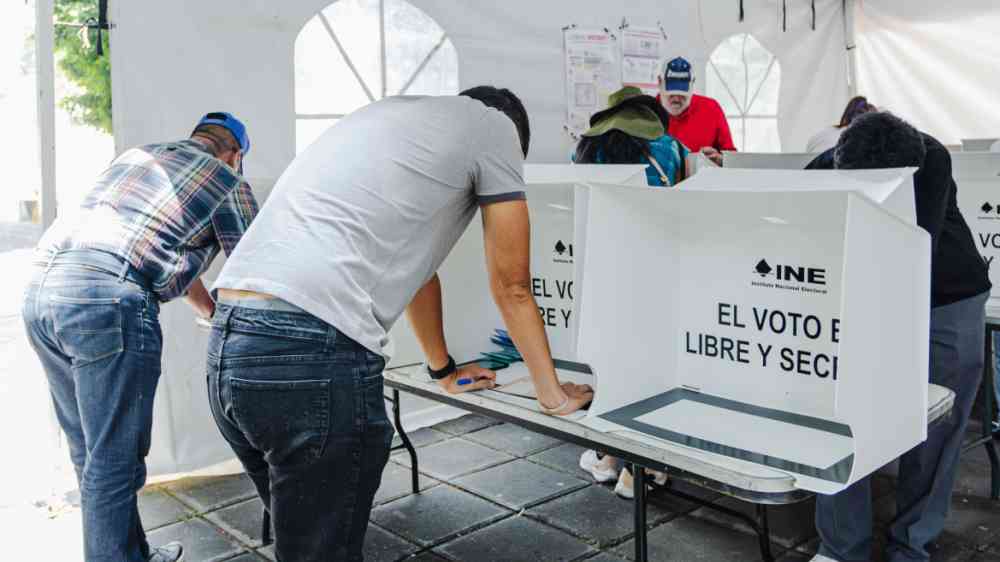
The year 2024 has been described as a super-cycle election year, with 1.6 billion people voting in 74 national elections in 62 countries due to a convergence in national electoral calendars. This was an extraordinary moment in our democratic history, but what is also extraordinary is that disasters and extreme weather events disrupted 20 elections at different levels in 15 countries.
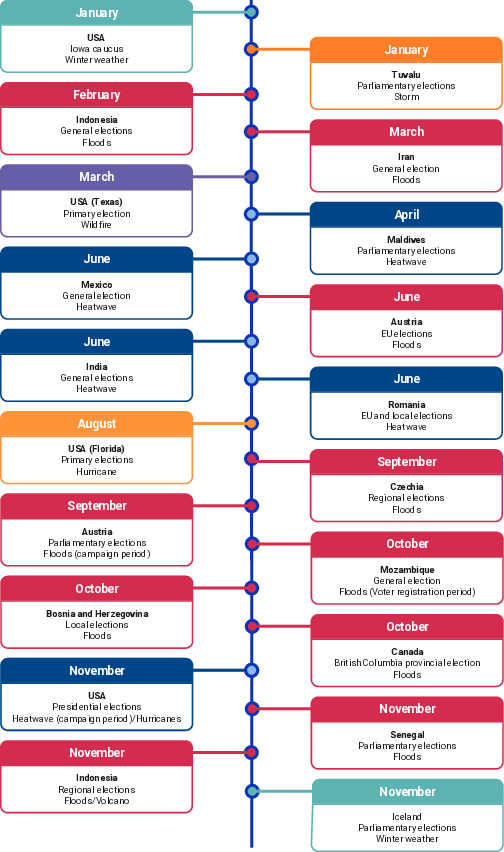
Austria, Bosnia and Herzegovina, Canada, Czechia, Iceland, India, Indonesia, Iran, the Maldives, Mexico, Mozambique, Romania, Senegal, Tuvalu and the USA, all experienced disruptions (See Figure 3). These included meteorological, hydrological, climatological, and geophysical disasters that damaged or destroyed critical infrastructure such as roads, polling stations, and election materials and interrupted electoral timetables.
Many disasters also lead to displaced voters and, in some cases, the deaths of voters and poll workers, all of which provide evidence of how the climate crisis is tangibly impacting democracy.
The impact of disasters on the 2024 elections varied based on the type of hazard, the level of exposure to the hazard, and the vulnerability of the exposed population. Beyond climate change, the 2023-2024 El Niño was also a contributing factor.
Natural hazards that affected elections in 2024
In 2024, eleven national elections and nine primary, subnational, and supranational elections were affected by disasters at different times of the electoral cycle (See Figure 3).
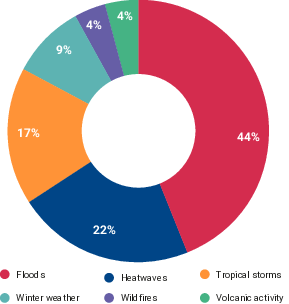
The most common types of hazards affecting elections included floods (44 per cent), heatwaves (22 per cent), and tropical storms (17 per cent). Other natural hazards, such as wildfires, winter weather, and volcanic eruptions, were less common (16 per cent) during the same period (See Figure 3).
In some cases, hazards affected more than one election in a single country. This was the case in Austria, Indonesia, and the USA. In the USA, freezing temperatures and snow in January 2024 disrupted the Iowa Caucus, wildfires affected the presidential primary elections in Texas held in March, and a heatwave in June affected the campaign events in Arizona and Nevada. Between August and October 2024, hurricanes Debby, Milton, and Helene disrupted registration and voting operations in several southeastern states. Moreover, on election day, 5 November, two polling officials died due to floods in Missouri.
Figure 2: Natural hazards that affected elections in 2024, by hazard type
Source: Asplund, E. & Harty, M., 'The Impact of natural hazards on 2024 Elections' in Toby S. James, Holly Ann Garnett and Erik Asplund (Eds), 'Review of the 2024 Super-Cycle Year of Elections: Trends, Challenges and Opportunities', International IDEA, 9 June 2025, accessed 28 June 2025. E. Asplund (ed.), Election Emergency and Crisis Monitor: Mapping Impact and Response to Disasters, International IDEA, 12 November 2024 (and updated), accessed 28 June 2025.
How elections were protected against extreme weather in 2024
Many of the 15 countries that held elections amid natural hazards showed resilience by activating legal, institutional, or management safeguards during different phases of the electoral cycle.
This typically included changes in administrative voting procedures, such as moving polling locations and election materials, adjusting registration and voting requirements, introducing health and safety measures, and, in some cases, postponing elections in municipalities heavily affected by a disaster. Moreover, many Election Management Bodies (EMBs) exhibited a whole-of-government approach by collaborating with National Disaster Agencies to mitigate the impact of the disaster, especially to reduce the health risks.
For example, with the support of the National Disaster Management Authority, the Election Commission of India introduced health and safety guidelines and measures, including water, tents, and medical kits at polling stations, when a heatwave was forecast to affect many parts of India during the election period. However, despite these protective measures, there were reports of voters and poll workers losing consciousness or dying because of heat-related illnesses - undoubtedly, the health risks would have been much higher if not for the efforts of the Election Management Body and other national agencies.
In some cases, EMBs cannot hold elections due to the scale of the disaster.
This was the case in Bosnia and Herzegovina, which had undergone flooding and landslides only days before the October 2024 local election. After consultation with local election commissions with first-hand information on the unfolding situation, the Central Election Commission (CEC) postponed elections in five municipalities for humanitarian and logistical reasons for 14-28 days. Elections for the rest of the country were held on schedule.
Despite the legal safeguards allowing the CEC to postpone elections for up to 30 days, there was a notable weakness in interagency cooperation. For example, the CEC was not part of the federal protection and rescue coordination mechanism, leading to a lack of formal information and updates about the situation in the affected municipalities.
Figure 3. Countries affected by natural hazards in 2024, by month and type of election
Source: Asplund, E. & Harty, M., 'The Impact of natural hazards on 2024 Elections' in Toby S. James, Holly Ann Garnett and Erik Asplund (Eds), 'Review of the 2024 Super-Cycle Year of Elections: Trends, Challenges and Opportunities', International IDEA, 9 June 2025, accessed 28 June 2025
Designating elections as part of critical infrastructure
Extreme weather worsened by climate change will continue to affect countries and electoral processes around the globe. Policymakers and election officials should therefore consider climate adaptation in their planning and decision-making to build resilience against the impact of natural hazards on elections.
This could include designating electoral processes as part of critical infrastructure, enhancing government cooperation between election management bodies and national disaster, meteorological, and health agencies, and facilitating emergency funding.
Meanwhile, election management bodies should strengthen risk management frameworks, contingency plans, and training efforts.
--
This article is based on "Asplund, E. & Harty M., 'The Impact of natural hazards on 2024 Elections' in Toby S. James, Holly Ann Garnett and Erik Asplund (Eds), 'Review of the 2024 Super-Cycle Year of Elections: Trends, Challenges and Opportunities', International IDEA, 9 June 2025. For more information, visit International IDEA.
Disclaimer: Views expressed in this commentary are those of the author, who is a staff member of International IDEA. This commentary is independent of specific national or political interests. Views expressed do not necessarily represent the institutional position of International IDEA, its Board of Advisers or its Council of Member States.
Erik Asplund is a Senior Advisor in the Electoral Processes Programme, International IDEA. His research covers elections during emergencies and crises, risk management in elections, and training and professional development in electoral administration. Recent publications include Review of the 2024 Super-Cycle Year of Elections and Elections during Emergencies and Crisis: Lessons from Electoral Integrity from Covid-19 Pandemic.