
Rebuilding blind: The global failure to count homes destroyed
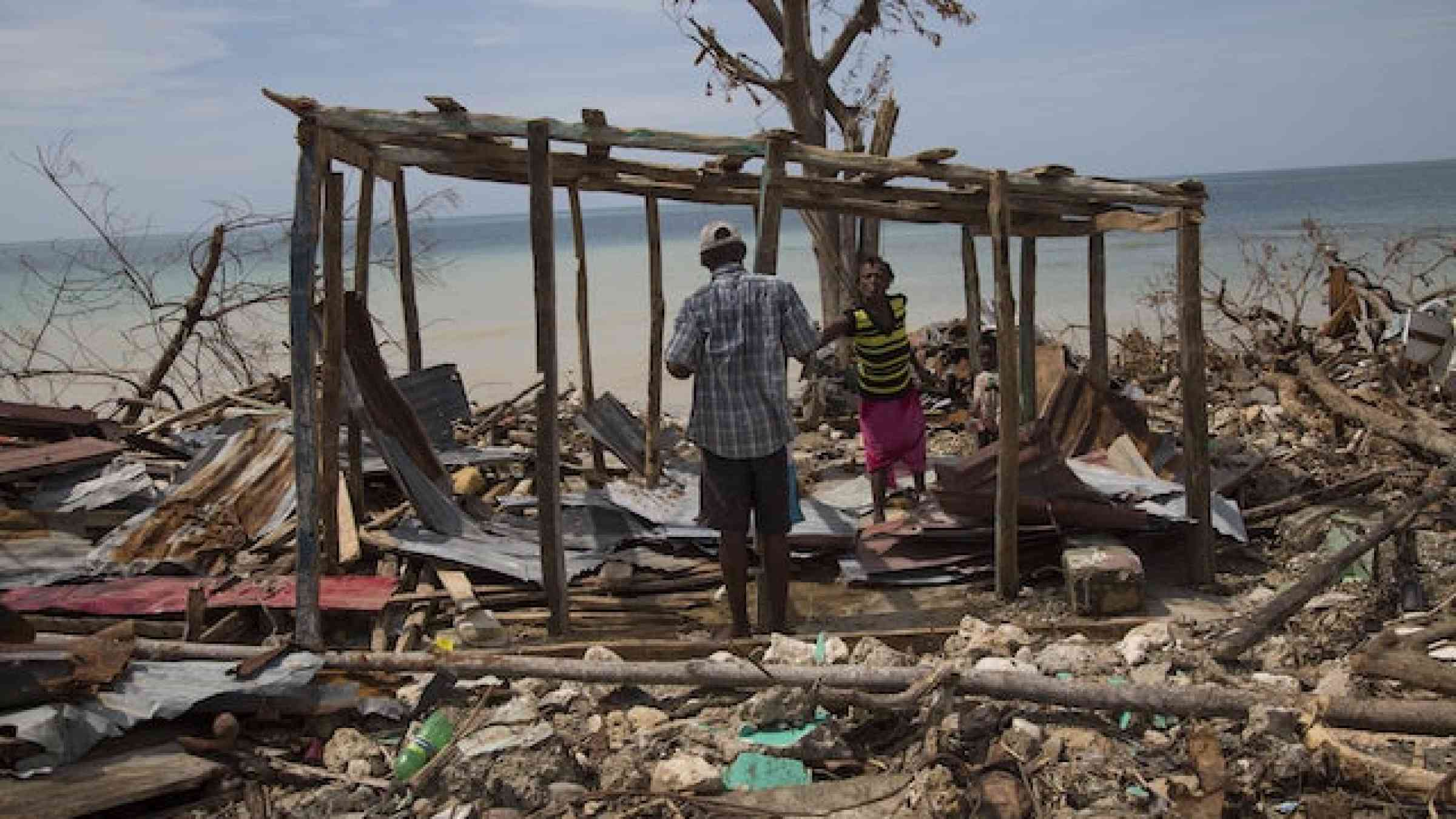
Each year, we count the millions of people displaced by disasters and calculate the cost of the destruction. Take 2024, where disasters displaced a record-breaking 45.8 million people worldwide and caused an estimated US $320 billion in economic losses.
But there's one number you won't find in the global databases: how many homes were actually destroyed.
In some disasters, the number of housing units damaged or destroyed is recorded, as national authorities often track this after major earthquakes, cyclones, or floods. But the data is inconsistent, definitions vary, and there is no global system to compile these numbers into a comparable, comprehensive record. We first came across this gap while researching the global housing crisis, and it was striking. Displacement statistics lump together people fleeing from a wide range of disaster impacts; they don't reveal how many roofs were ripped away or walls collapsed. Without knowing this, we cannot tell whether we are closing the global housing gap or just treading water as each disaster wipes out years of progress.
The global housing gap: A humanitarian crisis
Right now, we're not even close to building enough housing. The United Nations Human Settlements Programme, UN-Habitat, projects that by 2030, 3 billion people, roughly 40 percent of the global population, will require adequate housing, driving demand for about 96,000 new affordable, accessible units every single day. Today, an estimated 100 million people are homeless, and one in four live in conditions that endanger their health, safety, and well-being. Disasters widen this gap by depleting the housing stock faster than it can be replaced. Every destroyed home is a step backward for families, communities, and national development. Without accurate loss data, the housing finance systems, insurance schemes, and public subsidies to support post-disaster rebuilding cannot be calibrated to real needs, nor can we track how climate change is compounding the problem over time.
Behind nearly every displacement statistic is a family that lost a home. Housing destruction represents both an urgent humanitarian crisis and a long-term development challenge, yet it is rarely systematically recorded. This omission is more than a simple data gap; it is a critical blind spot that obscures how we design recovery efforts, strengthen resilience, and plan for reconstruction. Housing is the anchor for post-disaster repatriation and reintegration. Without it, temporary displacement risks devolving into permanence.
Home destruction and deepening inequality
And it's not just any homes being destroyed - it's overwhelmingly affordable housing. Whether it's a self-built shelter in a floodplain or a subsidized apartment block in an earthquake zone, disasters disproportionately claim the homes of lower-income households, homes whose residents have fewer resources to secure housing of a comparable or improved standard after loss. Poor households often have their savings tied up in physical assets - especially their homes - which tend to be older, built with more hazard-prone materials, and located in higher-risk areas. Globally, the poorest 20% are almost twice as likely as the average person to live in "fragile" dwellings. In coastal Bangladesh, 76% of traditional mud-and-bamboo houses were damaged during Cyclone Aila, compared to 47% of concrete or wood homes. In the United States (U.S.), one out of every three federally assisted homes sit in a high-risk disaster zone - double the exposure of owner-occupied housing - and 41% are in communities already facing high social and economic vulnerability. When such homes are lost, they are among the least likely to be rebuilt, unless there is significant public or philanthropic support, leading to prolonged and often irreversible displacement.
Counting homes vs. economic loss
Why don't we count homes lost in disasters? Partly because there is no definition for what a house is. Housing types differ so widely, ranging from concrete houses in Chile to bamboo shelters in Bangladesh, meaning that many rely on monetary loss estimates alone. But that's exactly why we need to count units, not just dollars. For every home destroyed, someone is displaced, and if current climate disaster trends persist, we may be looking at upwards of 167 million homes lost worldwide by 2040. Measuring loss in homes, not just monetary value, makes clear the full scale of reconstruction needed ontop of the already growing housing deficit.
Tracking the number of homes lost could also make disaster recovery funding more equitable. Loss models based on Gross Domestic Product (GDP) can mask disproportionate impacts on vulnerable populations. Poor households lose two to three times more of their total wealth than wealthier households when disasters strike, largely because their assets are concentrated in their homes. For the 73% of the global poor who live in urban areas, exposure to hazards is significantly higher, and housing destruction can trigger cascading shocks: lost livelihoods, food insecurity, and reduced access to healthcare.
A call to action
For housing policy, the implications are direct. Without measurable data on the housing stock destroyed each year, governments and development partners cannot set realistic targets for construction, financing, and resilience investments.
It is time to treat housing loss as a core disaster metric - not a footnote. If we do not count what we lose, we cannot plan for what we need to rebuild.
Olivia Nielsen is a Principal at Miyamoto International where she focuses on market-driven housing solutions for all. From Haiti to Papua New Guinea, she has developed and worked on critical housing programs in over 45 countries. Olivia has over a decade of experience in housing finance, housing public-private partnerships, post-disaster reconstruction and resilient construction. Through her work she hopes to make housing markets work for all.
Emma Harwood is a Senior Program Coordinator at Miyamoto International specializing in housing and climate resilience across diverse regions worldwide. At Miyamoto, Emma contributes research and technical analysis to the firm's global affordable housing and urban planning portfolios to advance sustainable and equitable development. Her work has supported major studies for the World Bank, IFC, and Habitat for Humanity International, and emphasizes the intersection of housing, climate resilience, and social inclusion in fragile and conflict-affected contexts.